
Trier-Saarburg between Roman times and the Viez Route
Accommodation in Trier-Saarburg
Roman sites, views over the Saar Valley and regional Viez offerings give Trier-Saarburg a varied character. If you are looking for a holiday apartment in the region, you can choose where to stay based on the experiences you want your trip to focus on: historic places, routes through the landscape or discoveries around Viez. The destinations offer different reasons to explore the region.
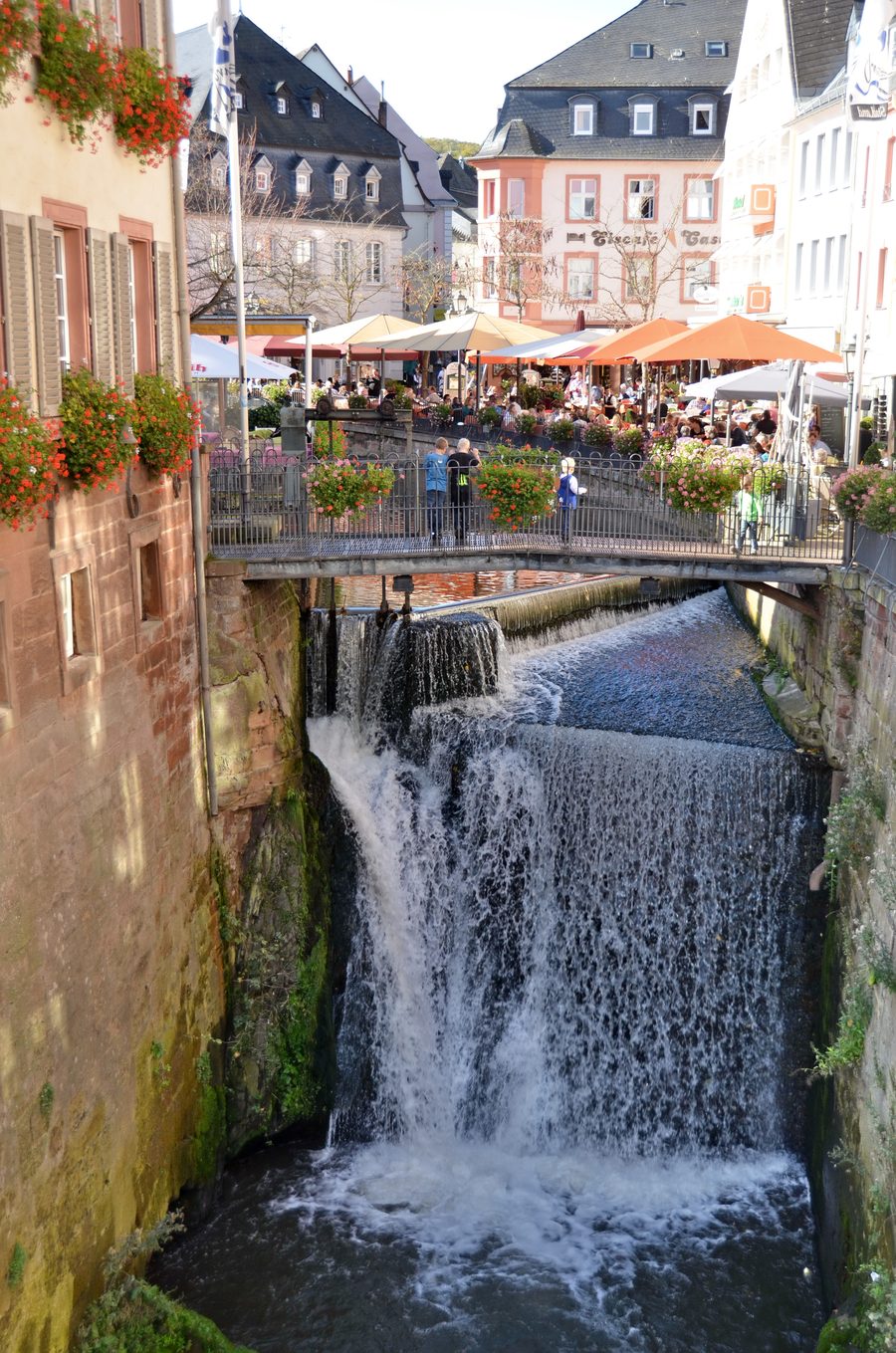 The famous waterfall in Saarburg forms part of the historic townscape.
Photo: Henk Monster via Wikimedia Commons, CC BY 3.0
The famous waterfall in Saarburg forms part of the historic townscape.
Photo: Henk Monster via Wikimedia Commons, CC BY 3.0
Cycle paths, a circular route and landscapes
Trier-Saarburg district already has 492 kilometres of cycle paths. In addition, there is a dense network of cycling and hiking trails along the Viez Route. If you enjoy spending time outdoors, this offers a theme you can combine with regional discoveries. The figures refer to different offerings: the number of cycle paths applies to the district, while the network of cycling and hiking trails follows the Viez Route.
One specific route is the Tälchen Tour. It is designated as a moderately difficult circular route, is 37.28 kilometres long and is listed as taking around 2 hours and 45 minutes. It starts and ends in Konz. The route leads to the Wiltinger Saarbogen nature reserve and recommends a detour to the waterfall in Saarburg’s old town. It thus combines a route description with two clearly named destinations; the stated distance and approximate duration are useful guides for planning your day.
The Kastel Felsenpfad also adds a distinctive landscape feature: it leads through a red sandstone landscape with striking rock formations. Panoramic views over the Saar Valley open up across the Pinschbach Valley and from Altfels. If you especially enjoy making trails and views the focus of your trip, you can consider this path a discovery in its own right.
Roman traces and a medieval castle
In Tawern, the Roman road settlement of Tabernae is considered the origin of the town. It was established shortly before the turn of the era on the Roman main road from the Moselle via Metz to Rome. An authentic model of the road settlement, at a scale of 1:75, is on display in the pavilion; in the forest, you can also find Tawern’s large reconstructed temple complex. The free ARGO app lets you view the temple complex on site at full size and as a 360-degree augmented reality display. The model, reconstructed complex and digital display offer different ways to explore this Roman-era theme.
Among the Roman remains in Konz is part of a cold-water pool, around 4 metres high, preserved from the Roman Imperial Palace. From the palace’s former terrace, there are views of the Moselle and Saar rivers and the surrounding mountains. The term “former terrace” refers to the historic site. Another historic stop is Freudenburg Castle Ruins: they date back to the castle built in the 14th century to control the military road between Trier and Metz. A guided tour of the ruins can be booked on request.
Large sections of Saarburg Castle’s surrounding walls and a residential tower have been preserved. Several viewing platforms and the tower offer panoramic views over the Saar Valley. In Kastel-Staadt, a 2.5-kilometre Archaeological Discovery Trail is part of the Roman theatre site. Alongside the Roman sites in Tawern and Konz, these are further specific historic destinations to choose from.
The Viez Route and choosing where to stay
The Viez Route is a 175-kilometre route: it runs from Merzig on the Saar through Saarburger Land to the Moselle town of Trier. Along the route, fruit growers, fruit brandy distillers, farmers, hoteliers and restaurateurs offer information, regional recipes and experiences centred on Viez. This makes it a distinct way to explore the region, alongside cycling and hiking trails and historic sites.
When choosing a holiday apartment, you can first ask yourself which of these themes you would like to pursue during your trip. If you are especially interested in Roman history, Tawern and Konz offer specific points of connection; Saarburg is another destination for its castle and views, while the Viez Route is the focus for all things Viez. The individual town pages can help you narrow down your options based on the places you would like to get to know better.
More town pages to help you find your way around: Hermeskeil, Bescheid, Heddert, Longuich, Beuren, Baldringen, Newel, Nittel, Butzweiler, Trierweiler, Wehr, Langsur, Konz, Riol, Irsch, Mertesdorf, Wiltingen, Naurath, Kasel, Pölich, Föhren, Kahren, Bekond, Grimburg, Gusenburg, Lampaden, Neuhütten, Waldweiler, Geisfeld, Züsch, Reinsfeld, Kordel, Hentern, Mehring, Merzkirchen, Taben-Rodt, Thörnich, Schweich, Detzem, Saarburg, Schleich, Wincheringen, Klüsserath, Serrig, Köwerich, Temmels, Gusterath, Igel, Wellen, Freudenburg, Kell Am See, Fell, Waldrach, Trassem, Kenn, Holzerath, Palzem, Saarburg-Hosteberg, Longen, Mannebach, Wawern, Oberbillig, Krettnach, Greimerath, Morscheid, Kanzem, Zerf, Schöndorf, Tawern, Biebelhausen, Wasserliesch, Ralingen, Welschbillig, Zemmer, Ensch, Leiwen, Ockfen, Rascheid, Schillingen, Schoden, Trier.
For the wider travel overview: Rhineland-Palatinate.

