
Schallodenbach
Accommodation in Schallodenbach
Schallodenbach stands out for its special sundial on the Reiserberg: it is designed to be walked through and combines distinctive stonework with a motif from the history of the municipalities. Walking and cycling routes also shape the opportunities for exploration. If you are considering Schallodenbach as a holiday destination, you can decide whether the sundial, the various trails or the Catholic parish church of St. Laurentius should be the focus of your outing.
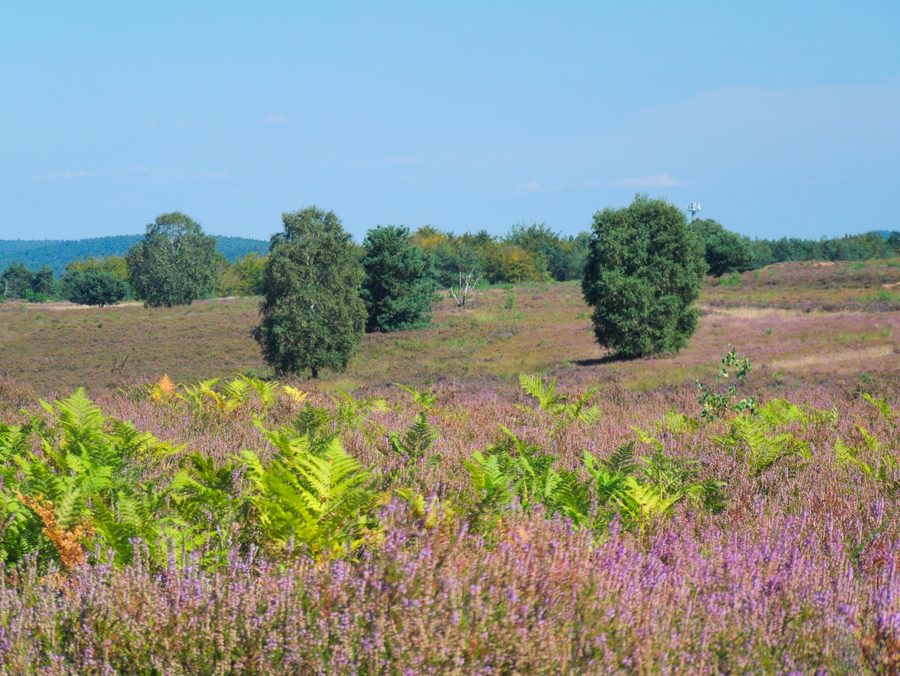 Die Mehlinger Heide ist ein Naturziel im weiteren Umfeld von Schallodenbach.
Photo: _artbird_ via Wikimedia Commons, CC BY-SA 3.0
Die Mehlinger Heide ist ein Naturziel im weiteren Umfeld von Schallodenbach.
Photo: _artbird_ via Wikimedia Commons, CC BY-SA 3.0
The sundial on the Reiserberg
Twelve large stones stand in a circle on a hill. The walk-through sundial is designed with obelisks made of local sandstone. Since 2020, twelve stone obelisks have stood on the Reiserberg; each bears the coat of arms of a municipality and the numeral for the corresponding hour. This embeds timekeeping in a design that is not limited to a single clock face: the circle, stones, sandstone and hourly divisions are all defining features of this place.
The stone circle symbolizes the coming together of twelve local municipalities in a new municipal association. This gives the installation a municipal significance as well as its function as a sundial. It also makes the development and tradition of sundials tangible and easy to understand. For families who enjoy discovering unusual forms and their background together while travelling, it offers a concrete topic for conversation: the connection between timekeeping, design and the depicted union of the municipalities.
Walking and cycling trails
Several trail names are associated with Schallodenbach when planning walks. The Schallodenbach Panorama Trail starts in the village. In addition, the 5.2 km “Sundial Trail” was newly signposted in Schallodenbach. Its length is a useful point of reference when considering a route. The details differ: the starting point in Schallodenbach is specified for the Panorama Trail, while the Sundial Trail is described by its signposted length of 5.2 km.
Cycling routes offer different points of reference, too. The sundial on the Reiserberg is on the Planetary Circular Trail and the North Palatinate Heights Cycle Route. The Odenbach Valley Cycle Route follows a different described course: it runs along Hauptstraße through Schallodenbach and continues from the edge of the village on a cycle path alongside the road towards Niederkirchen. If you are planning a trip that combines cycling and cultural experiences, you can consider these details separately rather than assuming that the different route names refer to one shared route.
St. Laurentius and the history of the site
Another cultural point of interest is the Catholic parish church of St. Laurentius. It was built on a site where a church already stood in the early 18th century. One structural feature is its foundation: parts of the church rest on rock, while others stand on a pile foundation. For visitors interested in churches and architectural history, this variation in the type of foundation is a specific aspect of the building.
Choosing which experiences to enjoy can focus your visit on what suits your travel interests: the sundial represents an unusual design and a municipal symbol, the trails offer different experiences on foot and by bike, and St. Laurentius adds a cultural focus.
Discover more places
You can also discover Lambsborn, Olsbrücken, Hohenecken, Hochspeyer, Erfenbach, Heiligenmoschel, Sulzbachtal and Katzweiler as you explore further.
For the broader travel overview: Kaiserslautern.

