
Leopoldshöhe: History and Nature at the Heimathof
Accommodation in Leopoldshöhe
The Heimathof, historic farms, church architecture and nature give Leopoldshöhe its varied character. You can get to know the town through its history, focus on a cycling theme or explore its natural surroundings. When choosing a holiday apartment, consider what you would like to shape your days: cultural history, architecture, cycling or an insight into the animal world.
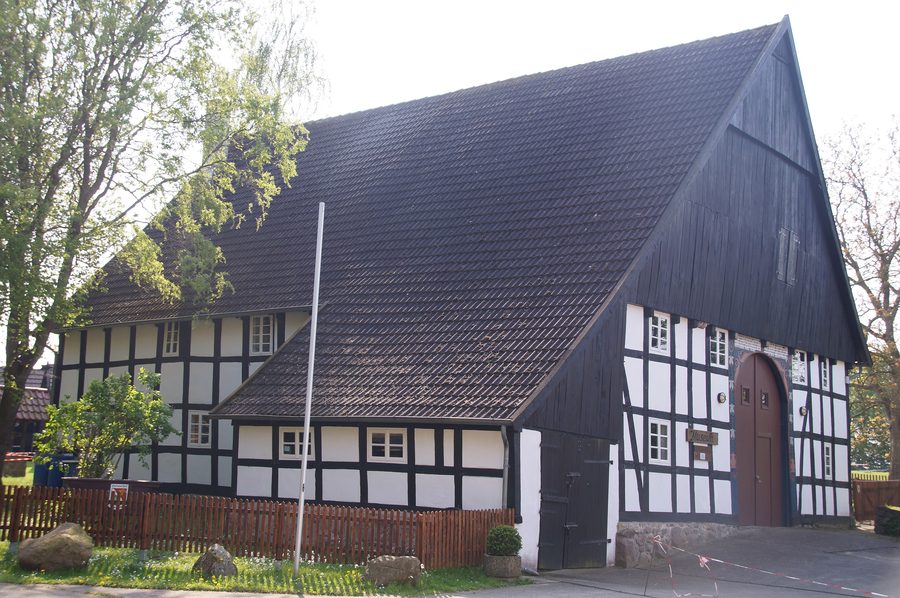 Heimathof in Leopoldshöhe, ein Baudenkmal der Gemeinde.
Photo: Leopold070 via Wikimedia Commons, CC BY-SA 3.0
Heimathof in Leopoldshöhe, ein Baudenkmal der Gemeinde.
Photo: Leopold070 via Wikimedia Commons, CC BY-SA 3.0
Heimathof: Museum, Half-Timbered Buildings and Rural Life
The Leopoldshöhe local history museum is housed in the main building of the former Eickmeyer farm. This four-bay half-timbered building dates from 1793. The former residence at the Heimathof was restored from 1996 onwards at the initiative of the local history association and converted into a local history museum; it opened in 1999. The earliest known documentary reference to the Heimathof dates back to the Everstein feud at the beginning of the 15th century.
The museum focuses on objects from various aspects of rural life and work over the past 150 years or so. A separate exhibition room is devoted to local wildlife, with numerous bird and mammal specimens on display. A computer-controlled system lets visitors listen to the calls of many of these animals. Visits to the local history museum are available by appointment.
The Heimathof also includes a large orchard and a woodland area, maintained and cared for by the Leopoldshöhe local history association. Since renovation work was completed in 1993, the bakehouse and barbecue area have been used for various events. An apple and potato festival and a threshing festival featuring many historic tractors and machines are examples of joint events organised by the Leopoldshöhe local history association and the Leopoldshöhe tractor enthusiasts.
Farms and Churches with Their Own Histories
Gut Niederbarkhausen was first mentioned in a document in 1036 as a table estate of Bishop Meinwerk. At the time, it was one of the larger episcopal farm estates, with five outlying farms. The ensemble includes a manor house, a coach house, a stable and farm buildings, a fortified farmhouse, and a half-timbered building that was formerly a brewery. The fortified farmhouse is a stone granary built between the 13th and 15th centuries. The different building types and the long historical record give the estate a distinctive place in the town’s history.
The Protestant Reformed Church of Leopoldshöhe is another example of regional architectural history. Its interior is designed as a stepped, three-aisled hall church: the nave is considerably higher than the two side aisles. In Lippe, the church served as a model for other churches designed by the same architect. Architecture enthusiasts can find a different way into the area’s history here than at the Heimathof or Niederbarkhausen.
Cycling, Nature and Community Projects
The Tichler Route, a cycling route funded by LEADER that passes through three regions, begins at the Heimathof. For shorter sections of the “Around Leopoldshöhe” cycle tour, the marketplace makes a convenient starting and finishing point. These are two different ways to incorporate cycling into your trip: a route starting at the Heimathof and shorter sections using the marketplace as a reference point.
Another project at the Heimathof is the teaching apiary, completed in summer 2024. It is intended for aspiring beekeepers, school and children’s groups, and other interested visitors. To enquire about using it, you can contact the municipality. The Heipker See nature reserve in Krentrup, a district of Leopoldshöhe, is another natural attraction in the municipality.
This offers a choice of different themes for planning your holiday, rather than a single day’s itinerary: rural history and exhibitions, architecture, cycling or nature. The theme that best suits your trip can also help guide your choice of holiday apartment in Leopoldshöhe.
Lippe as the Wider Regional Setting
Across the wider Lippe destination, the hiking trail network covers around 2,000 kilometres. It includes part of European long-distance path E1, as well as the award-winning “Hermannshöhen” and “Hansaweg” hiking trails. This regional perspective complements Leopoldshöhe’s local themes with more options for hiking enthusiasts; check trail conditions before setting out.
Discover more destinations: Lemgo, Blomberg, Schieder-Schwalenberg, Rott, Barntrup, Lügde, Lage, Detmold.
Go to the wider travel overview: Lippe.

