
Altenstadt: Romanesque Art in Focus
Accommodation in Altenstadt
In Altenstadt, Romanesque church art and reconstructed historic roads come together. St. Michael’s Basilica preserves works of impressive dimensions and enduring art-historical significance; the Via Claudia Square also commemorates two different kinds of historic roads.
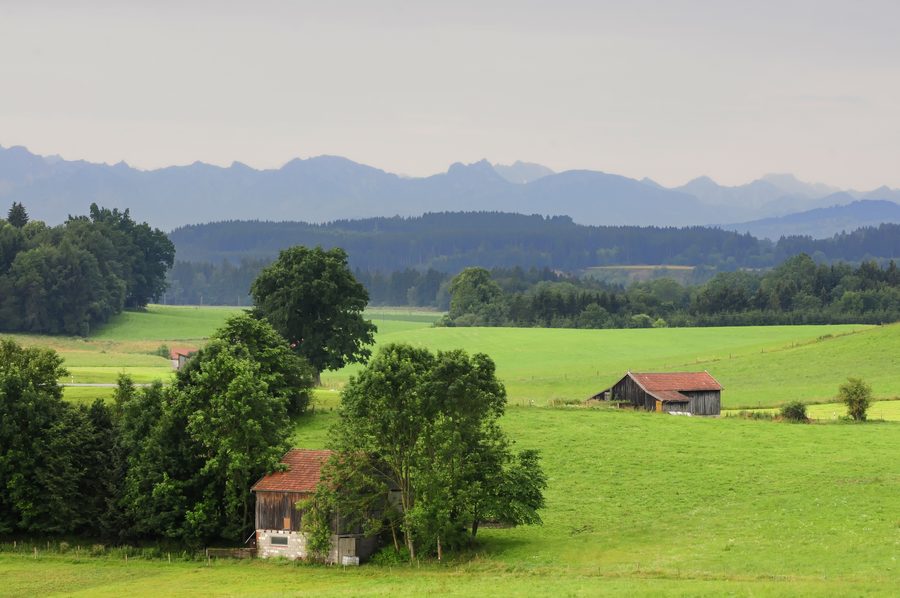 Unterwegs im Pfaffenwinkel: regionale Landschaft im weiteren Umfeld von Altenstadt
Photo: Heiko Trurnit via Wikimedia Commons, CC BY-SA 3.0
Unterwegs im Pfaffenwinkel: regionale Landschaft im weiteren Umfeld von Altenstadt
Photo: Heiko Trurnit via Wikimedia Commons, CC BY-SA 3.0
Romanesque Art in St. Michael’s Basilica
One remarkable work is the monumental Romanesque crucifix, dating from the time the church was built and popularly known as “The Great God of Altenstadt.” It was carved from two limewood trunks that cross at shoulder height. At 3.25 metres long, with an arm span of 3.18 metres, its size shapes how the figure is perceived.
The eight-metre-high fresco of St. Christopher also dates from the time the basilica was built. Discovered in 1994 and subsequently uncovered, it is one of the oldest Romanesque depictions of St. Christopher of this kind in Bavaria. The baptismal font offers another way into the visual language: it is considered one of the most significant Romanesque baptismal fonts in the German-speaking world, and its reliefs depict the rite of baptism.
The works each make a distinct impression: the crucifix stands out for its material, dimensions and form carved from two trunks; the fresco combines its great height and depiction of St. Christopher with its art-historical significance. The baptismal font draws attention to its reliefs and the rite depicted. Anyone interested in Romanesque art will find several specific themes in Altenstadt to consider when planning a trip.
Historic Roads at Via Claudia Square
At Via Claudia Square, replicas of the original imperial military road and the medieval trade and pilgrim route can be found. This adds another historical theme alongside sacred art: roads associated with rule, trade and pilgrimage. The two reconstructed types of road can be explored as a distinct point of interest alongside the basilica’s artworks.
More Things to Explore in the Wider Weilheim-Schongau Destination
Weilheim-Schongau is in the Pfaffenwinkel travel region. The district is bordered by the Lech to the west, the Ammer flows through its central area, and the Loisach runs along its eastern boundary. These geographical landmarks provide a framework for other, distinct travel interests in the wider destination.
The Wieskirche, a UNESCO World Heritage Site since 1983, is located near Steingaden. Dominikus Zimmermann built it from 1745 to 1754. Church services, summer concerts and quiet contemplation are among the reasons to visit; dates may vary. This precisely datable building thus offers different ways to experience the site.
In Penzberg, the Mining Museum preserves the memory of the local bituminous coal mining industry, which operated from 1796 to 1966. Guided tours in several languages are available for international visitors, families and school classes. In Schwabsoien, the Blacksmith Museum offers a different focus: its faithfully reconstructed hammer mill has three heavy tail hammers. Mining history and historic craftsmanship are two clearly distinct cultural themes.
Routes through the landscape offer different kinds of experiences, too. The approximately five-kilometre Erdfunkstelle hiking trail starts at Raisting railway station and forms a circular route through the satellite earth station, passing large satellite dishes and the industrial monument Radom with its historic Antenna 1. The six-kilometre Schwarzlaichmoor themed trail runs through the adjacent moorland, with information boards along the way, and starts at the Hetten inn. In winter, the approximately seven-kilometre Filzloipe trail in Hohenpeißenberg is groomed for skating and classic cross-country skiing; its availability depends on winter conditions.
When choosing a holiday apartment, you can first decide which themes you want to focus on: Altenstadt offers points of interest in Romanesque church art and historic roads. The wider Weilheim-Schongau destination also includes World Heritage, mining, craftsmanship and scenic routes, among other things. Consider whether you want your trip to focus mainly on Altenstadt’s themes or whether you would like to plan a broader mix of regional experiences.
Discover More Destinations
Ingenried, Hohenfurch, Schwabsoien, Penzberg, Peiting, Schongau, Seeshaupt and Oberhausen.
Back to the wider travel overview: Weilheim-Schongau.

