
Saxony: Cultural Landscapes, Cities and Trails
Accommodation in Saxony
Saxony combines impressive landscapes with distinctive cultural sites and trails for a range of travel interests. The cross-border Erzgebirge/Krušnohoří Mining Region is a UNESCO cultural landscape comprising 22 sites in Saxony and the Czech Republic. In Muskau Park, the Neisse River flows through another exceptional cultural landscape: of its 830 hectares, one part lies in Saxony and the other in Poland. The experiences you have in mind can therefore be a good starting point when choosing your holiday apartment in Saxony.
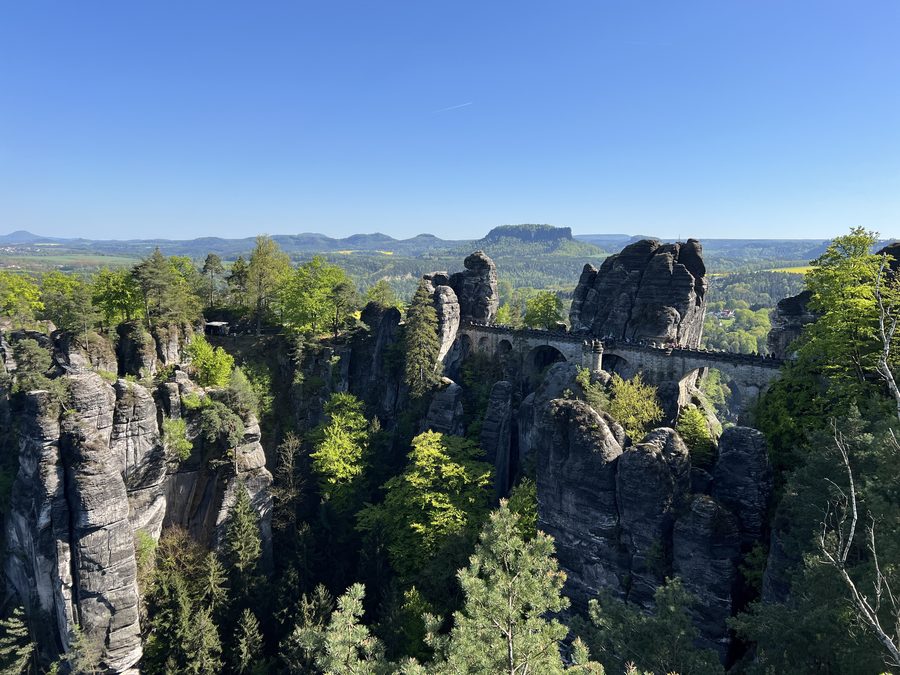 The Bastei bridge in Saxon Switzerland, a classic sandstone landscape and hiking area.
Photo: Lukas Beck via Wikimedia Commons, CC BY 4.0
The Bastei bridge in Saxon Switzerland, a classic sandstone landscape and hiking area.
Photo: Lukas Beck via Wikimedia Commons, CC BY 4.0
Discover cultural sites and history
In Herrnhut, the local history museum tells the story of the Moravian Church and displays original Biedermeier interiors. A comprehensive two-hour tour includes visits to the church hall, the local history museum and the Gottesacker cemetery. If you are interested in history and architecture, you can take in several different impressions during a single guided visit.
Dresden also offers a varied cultural programme: the Zwinger houses museums belonging to the Dresden State Art Collections, including the Porcelain Collection and the Old Masters Picture Gallery. The venue also hosts performances and concerts under the name “Zwinger Concerts.” This means you can shape your stay in Dresden around collections and art, or around events.
Moritzburg Castle offers a very different setting. The castle stands symmetrically on an island amid a landscape of woodland and ponds. In the Erzgebirge, meanwhile, you can go hiking, stroll through mining towns and visit underground treasure chambers. Whether you would rather fill your trip with city and museum visits or discoveries in mining towns, these different highlights can help you decide which region to explore more closely.
Parkland, rock formations and trails
In Muskau Park, ten bridges connect the parkland across the German-Polish border. The park has been part of the UNESCO World Heritage List since 2004. The café in the park’s castle outbuilding serves homemade Fürst-Pückler ice cream—a regional speciality for anyone who likes to pair an outing with a sweet treat.
In the Elbe Sandstone Mountains, the Painters’ Way winds through the landscape. Its described highlights include narrow paths and ladders between rock crevices, large rock formations, dense forests, babbling streams and panoramic views. The Bastei Bridge spans a 194-metre-deep gorge and offers views of the rugged landscape. If you want to combine nature and cultural experiences on your trip, you can take these destinations into account when choosing a regional focus.
For a longer cycling trip, the Saxon section of the Elbe Cycle Route covers 180 kilometres and passes through Saxon Switzerland, Dresden and Meißen. The route therefore crosses a variety of landscapes and urban areas.
Travel interests as a guide
In winter, the Erzgebirge/Vogtland Ridge Trail, around 36 kilometres long, is a specific option for cross-country skiing. It runs between Johanngeorgenstadt and Schöneck and has been awarded the “Excellent Trail” quality seal. Saxon Switzerland is also one of three sustainably certified travel regions in Saxony. These examples show different facets of the state without requiring every trip to follow the same kind of holiday plan.
When searching for a holiday apartment, you can start by deciding which experiences matter most to you: museums and concerts, park and pond landscapes, trails in the Elbe Sandstone Mountains, cycling or cross-country skiing. For further regional guidance, see the pages for Saxon Switzerland, Bautzen District, Erzgebirgskreis, Görlitz, Leipzig District, Meißen, Central Saxony, North Saxony, Vogtland, Zwickau District, Dresden and Chemnitz.
For the broader travel overview: Germany.

