
Discover Leutesdorf: architectural history, wine and trails
Accommodation in Leutesdorf
Leutesdorf combines architectural history with wine-related topics and signposted trails. The different themes can help you plan your stay around the interests of your fellow travelers: should the focus be on historic architecture, the history of grapes, or a selection of trails with different themes?
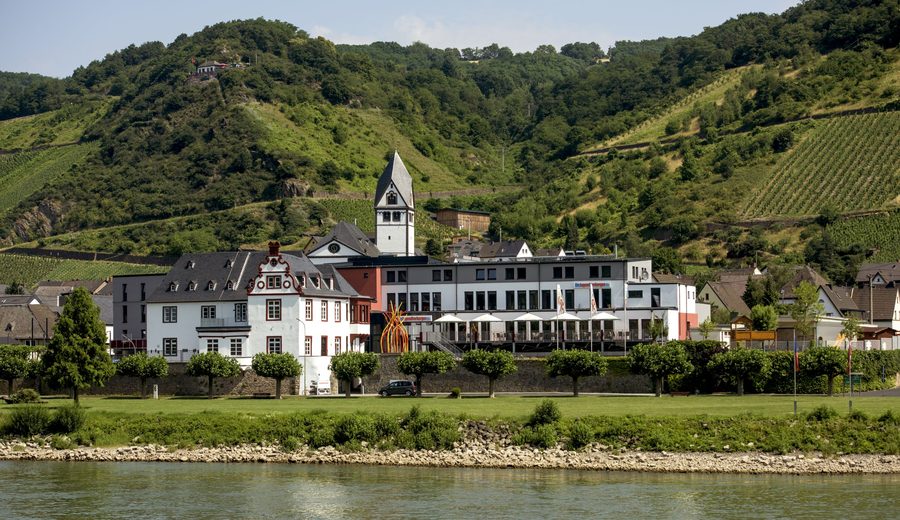 Das ehemalige Kloster in Leutesdorf am Rhein wurde 2015 zur Jugendherberge umgebaut.
Photo: Deutsches Jugendherbergswerk, Landesverband Rheinland-Pfalz/Saarland e.V., CC BY-SA 4.0
Architectural history with specific dates
The preserved Fronhof brings together architectural elements from different historical periods. It includes the Romanesque palas from the mid-12th century, last expanded in 1776; the late Gothic Vogtshaus from 1501; and the medieval press house, last remodeled in 1559. These dates bring several layers of history to life: in addition to the construction history of each building, they include the later expansion of the palas and the remodeling of the press house. This makes the Fronhof a clear focal point if you would like to get to know Leutesdorf primarily through its architecture.
The Baroque Marienburg Castle also represents a distinct building period. It was built from 1750 to 1754 by Ernst Anton Sohler, a privy councilor to the Electorate of Trier, probably on the foundations of an older castle in Leutesdorf. This brings together a precisely dated construction period and a possible, but unconfirmed, earlier history. The crypt of the Pilgrimage Church of the Holy Cross contains a replica of the Holy Sepulchre. The Bungert House, meanwhile, is associated with a specific episode in someone’s life: August Bungert lived there in 1910/11. Together, these details create different points of interest—from a religious depiction to a clearly dated period in someone’s life.
Wine-related topics and trails
Leutesdorf has four signposted circular trails covering nature, history, and interesting facts about vineyards and wine cellars. Their themes therefore range from nature and history to winegrowing. The Leutesdorf Art and Cultural Trail also runs along the Rheinsteig for 700 meters; the artworks are on permanent loan. The formats differ: one option is four circular trails with different themes, while the other is an art and cultural trail with a stated length. If you plan to use the circular trails, check the local signs before setting out.
The Leutesdorf Village Museum offers another perspective on winegrowing. It explores the journey of grapes from the vineyard to the bottle. The focus therefore extends from the vineyard to the finished product in the bottle, offering a different perspective from the architectural history of the Fronhof and Marienburg. Together with the circular trails, this gives you the option of exploring winegrowing both as a trail theme and through the journey of the grapes.
The right holiday apartment for your travel interests
When looking for a holiday apartment in Leutesdorf, you can first decide which themes you would like to shape your stay. Are you especially interested in the historic building periods of the Fronhof and Marienburg, the journey of the grapes from vineyard to bottle, or the four signposted circular trails and the 700-meter-long Art and Cultural Trail? This gives your vacation planning a concrete starting point without limiting your trip to just one theme. If you are planning with family or friends, you can take everyone’s different interests into account when choosing activities for your vacation.
Discover more destinations
Discover more destinations: Urbach, Hochscheid, Buchholz, Bruchhausen, Rheinbrohl, Hausen, Linkenbach, Isenburg.
Back to the main travel overview: Neuwied.
