
Discover Gronau (Westphalia)
Accommodation in Gronau
Gronau combines a history as a textile town with a distinctive musical identity. The guided city tour shows how this transformation can be discovered locally: it leads through the Inselpark grounds and the city centre, exploring Gronau’s transition from a textile town to a music town. Inselpark itself also tells the story of the area’s industrial heritage: it was created on the former site of the van Delden spinning mill. Canals divide it into individually designed islands.
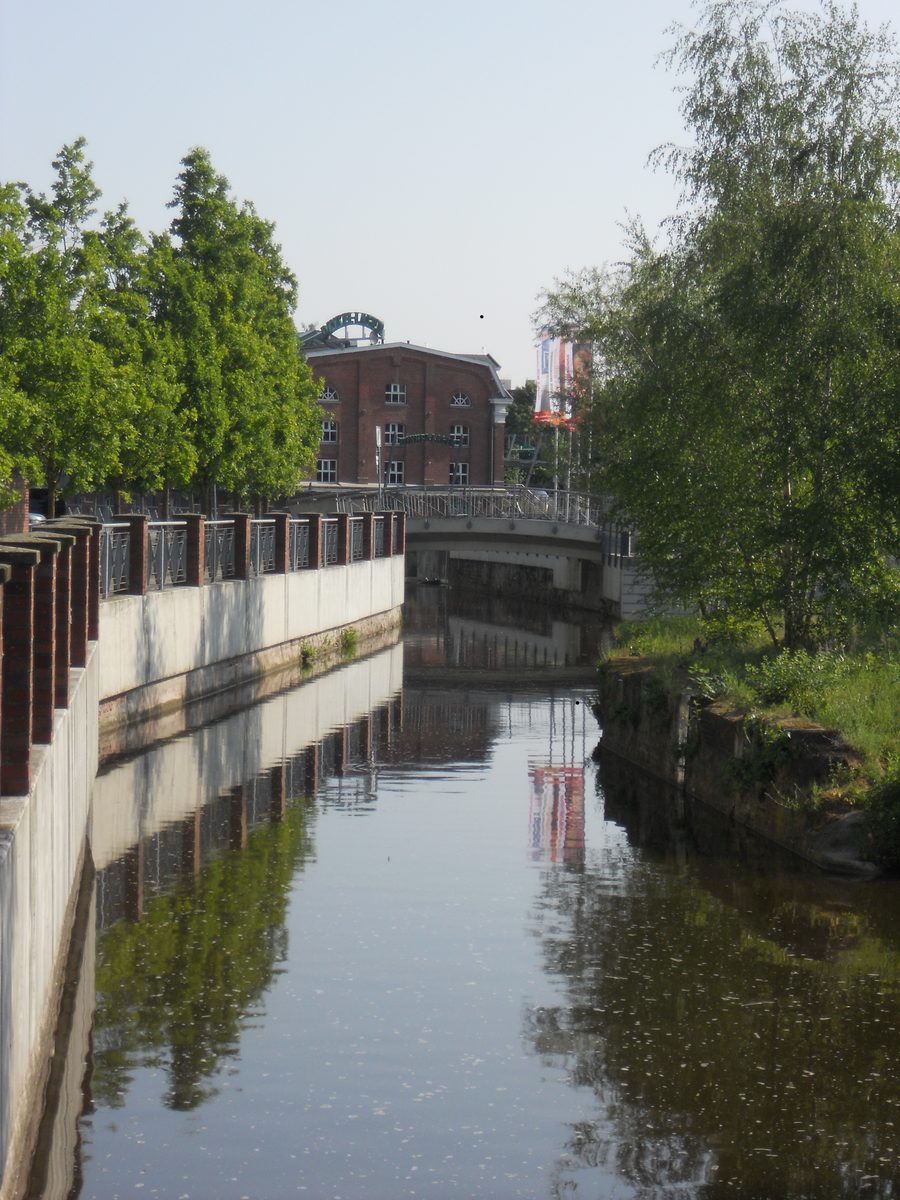 Die Dinkel bei Gronau veranschaulicht die flache Flusslandschaft des Ortes.
Photo: Kleuske via Wikimedia Commons, CC BY-SA 3.0
Die Dinkel bei Gronau veranschaulicht die flache Flusslandschaft des Ortes.
Photo: Kleuske via Wikimedia Commons, CC BY-SA 3.0
Music history and special places
The rock’n’popmuseum is located in Inselpark. Its multimedia exhibition brings together sounds, images and exhibits. The museum is accessible, with a lift, an accessible toilet and sturdy wheelchair ramps. It is also close to Gronau railway station and the city centre.
In front of the museum, the water maze offers a very different experience, with numerous water features: fountains rise from the ground there at changing intervals. From the top of the LAGA Pyramid, you can take in views of Inselpark and the city centre. A visit to the park therefore brings together landscaped islands, music history and water attractions, although these stops do not all offer the same kind of outing.
Other places also give Gronau its distinctive character. The water tower is a landmark visible from far across the city. In the centre of Gronau, beside a roundabout on the old B54 highway, stands the Udo Lindenberg monument, which makes a good photo opportunity. The former stair tower of the van Delden ring-spinning mill is 19 metres high and has two climbing walls of varying difficulty. The animal park in the city park is home to numerous bird species as well as coatis, monkeys, donkeys, goats, porcupines and fallow deer.
Dreiländersee: swimming, walking and hiking
Dreiländersee offers several specific ways to enjoy the water and nature during your stay. The 28-hectare lake is registered as an official EC bathing water site and is regularly tested and monitored by the health authority. During the summer months, there is a bathing area with a white sandy beach and a water playground. If you are planning a shorter outing, you can take a walk along the approximately 2.9-kilometre path around the lake.
A longer hike from Dreiländersee passes through 740 hectares of moorland and heath. The route is 10.5 kilometres long; along the way, low dune ridges alternate with wet moorland heath. The area provides habitats for meadow birds, and there are two observation towers along the route. The different route lengths make it easy to plan your day around the kind of walk or hike you have in mind.
Exploring the paths and the Dinkel River
You can also explore the surrounding area by bike: a cycling route leads from the Inselpark grounds via Dreiländersee, past the De Oelemars bird sanctuary and along the Dinkel River back to Gronau. As part of the Losser–Gronau Dinkel project, paths, boardwalks and bridges were built to let visitors cycle and walk along the newly landscaped Dinkel. The Laga Route is separate from this: it follows the paths of the first cross-border horticultural show, held in Gronau and Losser in 2003, and connects the two places. On the return leg of the Laga Route, the trail passes the De Oelemars bird sanctuary.
Dreiländersee connects the Netherlands, Lower Saxony and North Rhine-Westphalia. When choosing your holiday apartment, you can consider whether you want your stay to focus more on Gronau itself or on spending time at Dreiländersee.
More places to discover: Borken, Ahaus, Velen, Isselburg, Gescher, Heek, Raesfeld, Bocholt.
Back to the main travel overview: Borken.

