
Leśna Podlaska – Sanctuary, Local History and Forest Landscape
Accommodation in Leśna Podlaska
Leśna Podlaska can be explored from two perspectives: sacred history and forest landscape are just as defining as the sites in the village centre. There, you’ll find a triangular market square and an adjoining green space. At the same time, the Chmielinne forest nature reserve lies within the village, while the Kołowierz forest area is in the western part of the village, by the Klukówka River. When planning your trip, you can give targeted consideration to cultural interests and different aspects of nature.
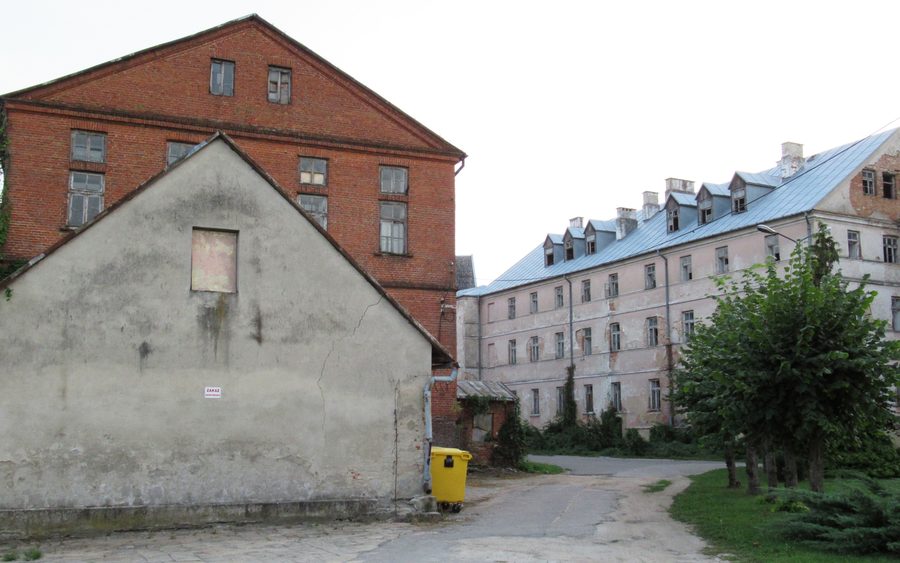 Leśna Podlaska (powiat bialski, województwo lubelskie) – zrujnowane budynki w kompleksie klasztornym.
Photo: Grzegorz W. Tężycki via Wikimedia Commons, CC BY-SA 4.0
Leśna Podlaska (powiat bialski, województwo lubelskie) – zrujnowane budynki w kompleksie klasztornym.
Photo: Grzegorz W. Tężycki via Wikimedia Commons, CC BY-SA 4.0
Sanctuary and historical traces
The church of the sanctuary in Leśna Podlaska was consecrated on 8 September 1758 under the patronage of the Nativity of the Blessed Virgin Mary and the holy Apostles Peter and Paul. In 1984, it was elevated to the status of a minor basilica. The Marian image in the sanctuary is a relief carved from fieldstone. It is 29.3 cm wide, 31.4 cm high and 4.6 cm thick, and weighs 9.5 kg. For travellers interested in culture, the history of the church’s consecration is thus paired with a precisely described work of art carved from fieldstone.
The Chapel of the Apparition of the Miraculous Image was built in 1718 at the traditionally identified site of the apparition and still stands today. The parish church of the Nativity of Mary and the holy Apostles Peter and Paul, as well as the Pauline monastery in Leśna Podlaska, were also plundered by Swedish troops in 1706. Taken together, these details point to several historical aspects of the village: the consecration and elevation of the sanctuary church, the chapel at the traditionally identified site of the apparition, and the plundering of the parish church and Pauline monastery.
Squares, park and forest areas
In the centre of Leśna Podlaska are a triangular market square and an adjoining green space. The 3.5-hectare park is in the centre, behind the 17th-century building of the Sanctuary of Our Lady of Leśna (Matki Bożej Leśniańskiej) and the Wincenty Witos Agricultural Education Centre School Complex (Zespół Szkół Centrum Kształcenia Rolniczego im. Wincentego Witosa). The central squares and the park thus describe an area of the village with different spatial points of reference.
The “Chmielinne” forest nature reserve (Las Chmielina) is under partial protection, covers 67.2 hectares and was established in 1967. It lies in the central part of the municipality, within the village; the Biała Podlaska–Stara Kornica voivodeship road runs across it. Kołowierz (Las Kołowierzch) is in the western part of the village, by the Klukówka River, where alders predominate in the tree cover. There are five natural monuments in this forest: three pedunculate oaks, including Dąb Miłości, and two common ash trees.
The two forest areas have different features: Chmielinne is a partially protected area with a defined size and an establishment date of 1967; at Kołowierz, the alders and five natural monuments stand out in particular. Those interested in the local natural environment can therefore explore two distinct points of interest rather than just one forest setting.
Planned development in the historic park
By the end of 2027, a new, extensive tourist area is due to be created in the historic park in the centre as part of an EU-funded project. A network of educational trails is also planned for the park. This is to include an almost 3.6 km walking and cycling route that will run from the village centre towards the nearby Chmielinne nature reserve. The area and route are planned projects; their completion has not been confirmed.
When looking for a holiday apartment, you can use this to frame a practical question about location: should the village centre, with its squares and church history, or the forest landscape in the west have a greater influence on your choice? If cultural history is your priority, you can base your choice on the history of the sanctuary and the central squares. If you’re more drawn to nature, consider Kołowierz and the Chmielinne reserve as distinct features of the area.
Discover more destinations: Grabanów, Horbów, Wisznice, Bubel-Łukowiska, Mokrany Nowe, Biała Podlaska, Sławatycze, Janów Podlaski
For the overview of the wider area: Bialski.

