
Alanta: Sacred Buildings and a Challenging Hiking Route
Accommodation in Alanta
Discover Alanta through two very different aspects: sacred buildings with a clearly identifiable history, and a hiking route that requires careful planning. The synagogue represents the town’s Jewish heritage; the Church of St. James the Apostle features a later Neo-Romantic style. Those who also want to explore on foot will find a distinct undertaking in the route known as “Alanta”. This means culture and physical activity can each be the focus of your trip.
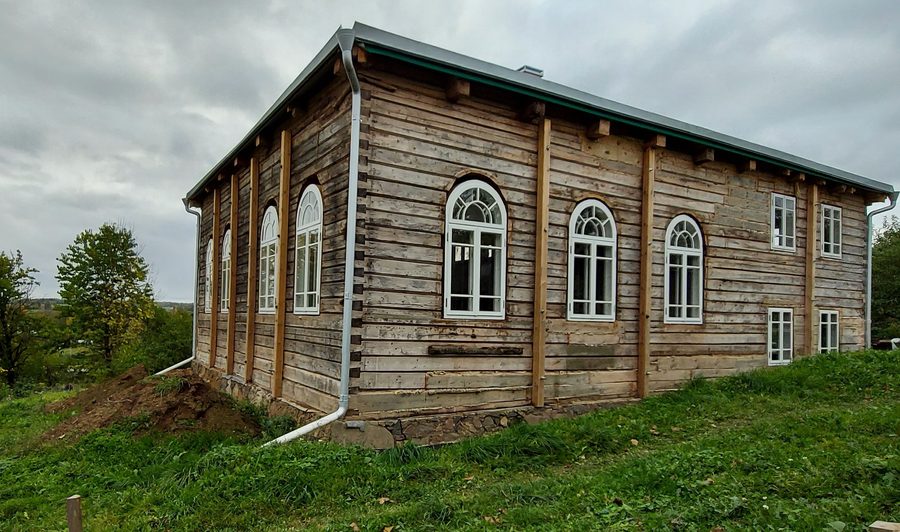 Alanta's surviving wooden synagogue, described as one of only a small number of wooden synagogues remaining in Lithuania.
Photo: Emma Cornelia Jerusalem via Wikimedia Commons, CC BY-SA 4.0
Alanta's surviving wooden synagogue, described as one of only a small number of wooden synagogues remaining in Lithuania.
Photo: Emma Cornelia Jerusalem via Wikimedia Commons, CC BY-SA 4.0
Synagogue: History and Visitor Access
The Alanta Synagogue is a state-protected Jewish religious monument of local significance, dating from the mid-19th century. It is designed in the Romantic style and is one of the 17 surviving wooden synagogues in Lithuania. It therefore combines a specific architectural history with a monument that also has a special place in the national context.
The synagogue is not currently open to visitors on a regular basis. If you are planning a visit, check access again before your trip, as this status may change.
The Church of St. James the Apostle
The Church of St. James the Apostle was built between 1904 and 1912, to a design by Liepāja architect K. E. Strandmann. Its style is Neo-Romantic. Two towers, a hall-like design, three naves and a Latin-cross floor plan define its architecture. The three naves divide the church interior; the Latin-cross floor plan describes the basic shape of the building. Together, these features give a clear picture of the structure without requiring any architectural knowledge. In chronological terms, the synagogue dates from the mid-19th century, while the church was built between 1904 and 1912.
A Hiking Route with a Challenge of Its Own
The hiking route known as “Alanta” starts at the Alanta Municipal Administration. It follows roads and field edges in the Alanta area, as well as more densely wooded sections. These forest stretches are more difficult to walk. The route is considered fairly long and challenging and requires good preparation. Its character is shaped by several factors: its starting point in Alanta, its varied sections and its explicitly challenging nature.
Planning a Trip Around Culture and Hiking
For your planning, the buildings and the route raise different considerations. If culture is your focus, the construction dates, styles and heritage status are the main points of interest. Those planning the hiking route should take its difficulty and the preparation required into account. If both are part of your stay, treat the hike as a separate activity. This can also help you structure your search for a holiday apartment in Alanta: consider whether culture or hiking will be the main focus of your trip.
Discover more destinations: Rimšė, Utena, Bičionys, Dubingiai, Girsteitiškis, Anykščiai, Balninkai, Šilinė
For the broader travel overview: Utena County.

