
Rimšė: Church Art and the Location on Lake Ilgiai
Accommodation in Rimšė
Rimšė can be explored through two very different points of reference: its location on the southern shore of Lake Ilgiai and its history of sacred art. The landscape and culture thus offer different ways to discover the town. When planning a stay, you can consider whether the lakeside setting or the historical heritage is the stronger factor in choosing your destination. The geographical location provides a concise description of Rimšė; paintings and architectural history make its cultural side more tangible.
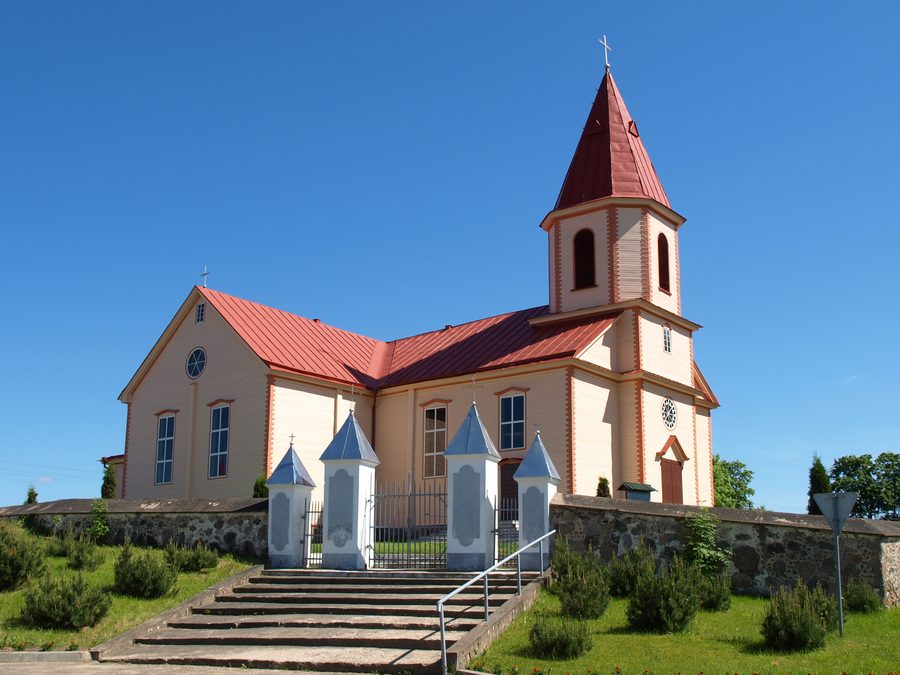 Die Kirche der Heiligen Dreifaltigkeit ist ein benanntes lokales Wahrzeichen von Rimšė.
Photo: Juste via Wikimedia Commons, CC BY 3.0
Wooden church with older building fabric
The present-day wooden Rimšės Švč. Trejybės bažnyčia was built between 1900 and 1908, incorporating part of the older church. It is therefore neither a complete new beginning nor simply an older building preserved unchanged: it belongs to a later construction phase while also incorporating older fabric. This offers a concrete comparison between the wooden structure and the part that was retained. The building’s history can thus be told not only through its dates, but also through the relationship between renewal and reuse.
Paintings as cultural heritage monuments
Two paintings in the Rimšės Švč. Trejybės bažnyčia are cultural heritage monuments: “Marija su Kūdikiu” and “Šv. Jurgis.” The first title means “Mary with the Child” and directly identifies the subject. In the lower part of “Marija su Kūdikiu,” a panel bearing the coats of arms of the Pacai is painted. This detail draws attention to more than the central image: within the same work, a heraldic element appears alongside the religious subject. The second painting, “Šv. Jurgis,” provides a distinct point of reference. Together, the two works make sacred art a tangible part of Rimšė’s cultural history; the panel with the coats of arms also gives the first painting a specific detail to focus on when exploring the work.
An earlier trace in the town’s history
In 1669, Feliksas Pacas built a chapel in Rimšė. This date offers a different historical perspective from that of the present church: it points to a 17th-century chapel, not to a later construction phase. This distinction is useful for understanding sacred architecture in the town. Rimšė’s history can thus be considered through different points of reference: the chapel, the later wooden church, and the paintings it houses. Those interested in history can see the building phases and artworks as distinct, complementary aspects of the town.
Lakeside setting and travel choices
Rimšė lies on the southern shore of Lake Ilgiai. This geographical reference and the church’s cultural history offer two concrete ways to consider the town as a travel destination. If you first look at the lakeside location when choosing a destination, the southern shore is the precise point of reference. If you are more drawn to architectural history and sacred art, the wooden church and the two cultural heritage monuments offer specific subjects to explore. When looking for a holiday rental in Rimšė, you can therefore first consider which feature of the town matters more for your stay: its lakeside location or the history reflected in its buildings and paintings.
Discover more destinations: Ignalina, Videniškiai, Girsteitiškis, Šilinė, Balninkai, Anykščiai, Alanta, Dubingių Seniūnija
For the broader travel overview: Utena County.

