
Dunabogdany on the Danube Bend
Accommodation in Dunabogdany
Dunabogdany brings together a variety of interests for a holiday on the Danube Bend: its freely accessible beach, a section of the Danube Cycle Route and striking reminders of the town’s history. Chapels, a roadside statue and a Roman military camp also give the town a distinct cultural character. When choosing a holiday apartment, it may therefore help to consider in advance whether the water and cycling or historical discoveries will play a greater part in your trip.
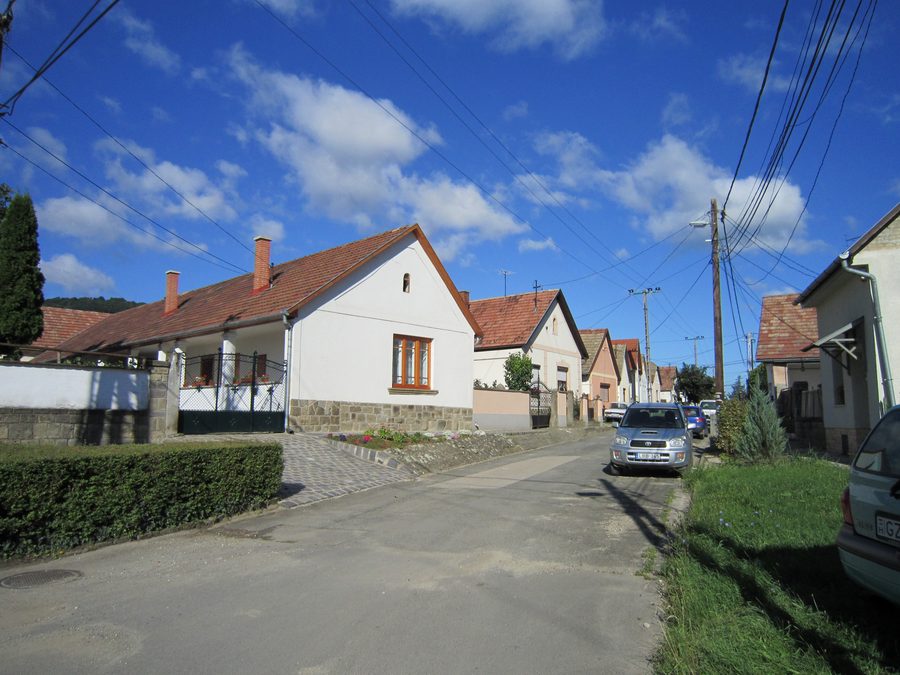 Szent Donát utca in Dunabogdány, Pest County, Hungary.
Photo: Rok at Hungarian Wikipedia via Wikimedia Commons, CC BY-SA 3.0
The Danube, the beach and the cycling route
Dunabogdány Free Beach is a freely accessible beach in the municipality. Route 11 and scheduled buses from Budapest and Esztergom are listed for getting there: you can reach the beach by car via Route 11, and buses also run from both cities. These details relate to the beach and can help you plan your journey for a stay focused on the Danube.
In addition to the beach, there is a designated area where camping and launching kayaks and canoes are possible with prior registration. If you would like to include these activities in your trip, registration is required.
For cyclists, a 2,422-metre section of the Danube Cycle Route in the outskirts of Dunabogdany is of interest. It is part of the EuroVelo 6 network; following its renovation, the section was completed and opened to cyclists. Its length gives you a sense of the scale of this section, but says nothing about how far you may wish to ride beyond it. If cycling is part of your holiday, you can include this section as one specific element of your plans.
Chapels, Roman times and local history
One notable religious building is the single-nave Chapel of Saint Donatus, a late Baroque building on a steep hill above the town. It was completed on 29 March 1829 after a year and a half of construction. The chapel’s location and construction date give it a distinct place in the town’s history. Further north, at the upper end of town near the main road, stands the Chapel of Saint Roch. This simple late Baroque building dates from the early 19th century and was renovated as early as 1800.
Also at the upper end of town, beside the main road, stands the statue of Saint John of Nepomuk. The Rococo roadside statue stands on a pillar pedestal. The painted stone figure is believed to have been created around 1770. Together with the two chapels, it shows that Dunabogdany’s historical landmarks take different forms: religious buildings and a statue in the streetscape.
Another historical trace leads back to Roman times. The military camp Castrum Cirpi was located in Váradok-dűlő, on the left bank of Kalicsa Creek, right beside the Danube. It formed part of the eastern frontier system of the Roman Limes; the outlines of the fort are still clearly visible in the terrain. History enthusiasts will find not only buildings in the town but also a tangible link to the Roman frontier fortifications.
Öreg Kálvária lies on the edge of the built-up area and the protected forest of Duna-Ipoly National Park. The small sunken chapel and its forecourt are of local cultural-historical and landscape significance. The forecourt offers a sweeping view of the Danube Bend at Dunabogdany. This offers a different focus for trip planning than the architectural details of the chapels or the visible outlines of the fort: here, the landscape and the view take centre stage.
Church, stonemasonry and local tradition
The Roman Catholic church is considered a modern church building and was built in 1939. Its predecessor, or the earlier church building, was severely damaged by fire on 4 June 1849. During repairs, the gable collapsed in 1937. These events are part of the church’s building history and should be kept in chronological order: the fire occurred in 1849, the gable collapsed in 1937, and the present church building was constructed in 1939.
The andesite quarry and the surviving evidence of local stonemasonry are also part of the municipality’s cultural heritage and are considered values worth preserving. Another local feature is the bogdányi dinka grape variety, which was cultivated in Dunabogdany. Its large, juicy berries were well known and were used to make a mild table wine with a pleasant aroma. Together, stone and wine complement the religious and Roman heritage with aspects of local craftsmanship and the region’s former winemaking tradition.
If you would like to compare other places for your trip, you can also find Szigetmonostor, Leanyfalu, Kisoroszi, Horany, Csobánka, Pilisszentkereszt, Witzegrad and Tahitótfalu here.
For the broader travel overview: Szentendrei.

