
Urmitz: Discover traditions and industrial history
Accommodation in Urmitz
Urmitz offers a variety of reasons to discover the town: living traditions, a monument to the pumice industry, and the Rhine Cycle Route as an activity at the motorhome site. There is also the history of the Kronprinz Wilhelm Bridge near Urmitz and Engers. These topics can help guide your search for a holiday apartment if you want to plan your vacation around culture, history and activities.
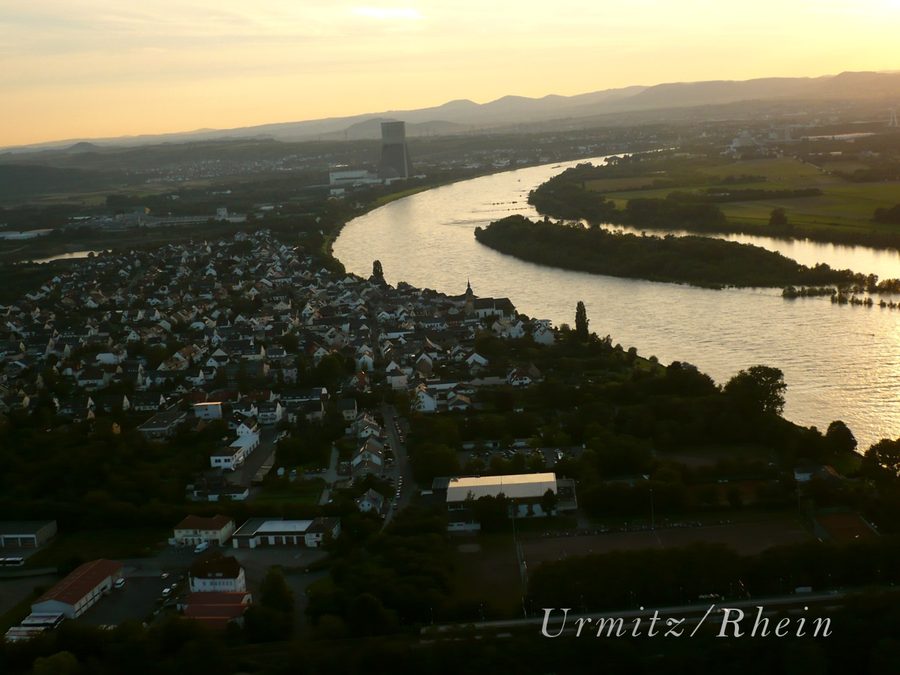 Luftaufnahme von Urmitz am Rhein, mit der Flussinsel Urmitzer Werth im Vordergrund.
Photo: M. Rünz ( Möwe-rhein601 ) via Wikimedia Commons, CC BY-SA 3.0 de
Traditions and industrial history in Urmitz
Rhenish Carnival, the Cherry Festival and St. Martin’s Day are traditions celebrated and kept alive throughout the year in Urmitz, and passed down from one generation to the next. These three customs give the town a varied cultural profile: they bring together different occasions and a tradition of sharing them across generations.
A specific place to visit for anyone interested in industrial history is the pumice industry monument. Alongside an information board, a knocking machine is on display. This visible technical detail brings the subject to life on site without the need for a lengthy explanation.
The Kronprinz Wilhelm Bridge near Urmitz and Engers also offers a historical connection. It is named after the eldest son of Kaiser Wilhelm II and was opened to traffic on 15 August 1918. The date places the bridge in a specific historical period; its name also links it to the history of the imperial family.
The Rhine Cycle Route (EuroVelo Route EV15) is listed as an activity at the motorhome site in Urmitz. The motorhome parking area in Urmitz opened in 2011. Cycling and local history are two different themes that may play a part in planning a stay in Urmitz.
Culture in the broader Mayen-Koblenz destination
Beyond Urmitz, the wider Mayen-Koblenz destination offers further cultural and historical topics. In Mayen, Genovevaburg Castle is one of the city’s landmarks. It was built in 1280 by Heinrich of Finstingen, Archbishop of Trier. In Sayn, the abbey’s history goes back further: it was founded around 1200, and its abbey church was consecrated in 1202. The abbey’s exterior paintings, dating from around 1255, are considered the best-preserved examples from the High Middle Ages in Germany.
Another way to explore the region’s history is through the Sayn Ironworks. It is an anchor point on the European Route of Industrial Heritage and the only monument in Rhineland-Palatinate to receive this distinction. Following restoration, this industrial monument invites visitors to explore its modern exhibitions and multimedia presentations; the Sayn Ironworks also offers guided tours and creative workshops. Here, the history of an industrial monument meets contemporary approaches to exhibition design.
The churches of St. Medard in Bendorf also offer a distinctive cultural feature: the Protestant and Catholic churches are housed under one roof and connected by the so-called Ecumenical Portal. Nearby, Hein’s Mill represents the history of milling in Bendorf and the surrounding area. It is the only one of the 20 former mills in the area that is still fully operational. The mill museum shows and explains the stages of the milling process as well as the importance of the milling trade in the region.
Other themes range from aristocratic history to volcanism. At the New Museum at Sayn Castle, Prince Alexander and Princess Gabriela give visitors a private glimpse into the life of their aristocratic family. In the Children’s Realm, visitors can try on historical costumes. The Lava Dome in Mendig is the German Volcano Museum. The Geyser Museum explains how the world’s highest cold-water geyser works in five exhibition areas.
Gardens and cycling routes offer different perspectives
Sayn Castle Park provides a scenic contrast to castles, churches and museums. Between 1840 and 1850, the architect Carl Friedrich Thelemann designed the park as an English landscape garden at the request of Prince Ludwig Adolf Friedrich zu Sayn-Wittgenstein-Sayn. The park features a castle pond with a water fountain, winding paths, numerous benches and secluded, quiet spots. Visitors interested in historic gardens will find a distinct focus here within the broader Mayen-Koblenz destination.
For active travelers, there is also the 33-kilometer Vulkanpark Cycle Route. It runs from Mayen through Mendig, Kretz and Plaidt to Andernach, linking numerous attractions in the Vulkanpark along a relaxed, family-friendly route. The route offers a different perspective on the destination than a day focused mainly on castles, architectural history or museums.
When looking for a holiday apartment in Urmitz, you can consider which themes you would like your vacation to focus on: local traditions and industrial history, or cultural, garden and cycling experiences across the broader Mayen-Koblenz destination. This helps you focus on the interests that matter to you when choosing a place to stay.
Discover more destinations: Acht, Kalt, Plaidt, Polch, Welling, Siebenbach, Lind, Waldesch.
View the broader travel overview: Mayen-Koblenz.

