
Gresse: Church, Finkenberg and Manor House
Accommodation in Gresse
Discover Gresse through three very different highlights: the village church on a hill, the path to Finkenberg, and a manor house on a small island in the Boize. Half-timbering, woodland and park each add their own character. When planning your trip, you might first consider whether historic architectural styles, a walk into the woodland or the church’s seasonal appearance interests you most.
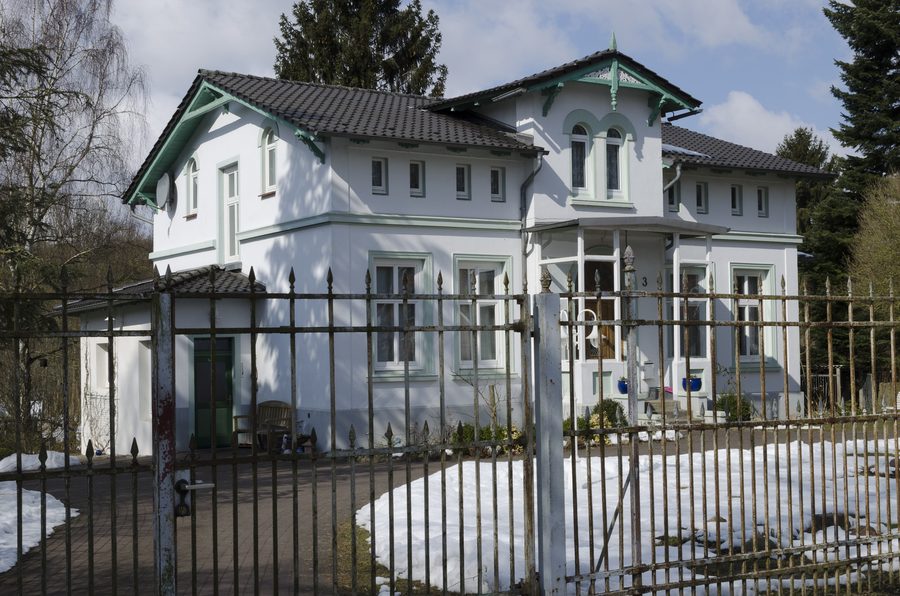 Kulturdenkmal in Gresse, heute als Wohnhaus genutzt.
Photo: Patrick Ch. Apfeld via Wikimedia Commons, CC BY-SA 3.0
Kulturdenkmal in Gresse, heute als Wohnhaus genutzt.
Photo: Patrick Ch. Apfeld via Wikimedia Commons, CC BY-SA 3.0
Village Church and Churchyard
Gresse’s village church stands on a hill and is hidden behind old trees. At its core is a half-timbered structure dating from the late 17th century. The church thus combines a distinctive setting with a specific historic architectural style. In autumn and winter, the building is illuminated, making it a striking feature of the darker season. The illuminated church then adds a seasonal accent to its setting among the old trees.
The churchyard includes a burial chapel, three soldiers’ graves and a 1939/45 war memorial. Alongside the village church, the site therefore comprises several distinct features. Those interested in Gresse’s history can broaden their view from the half-timbered building to the churchyard and its different elements.
The Path to Finkenberg
To reach Finkenberg from the village of Gresse, cross the B195 and follow Lindenweg for 750 metres. Visitors can leave their bicycles at Finkenberg. From there, a footpath leads into the woodland; after a few metres, you will reach the impressive burial mound. The directions provide specific landmarks: the B195 crossing, Lindenweg and the footpath beyond. If you are travelling by bicycle, leaving it at Finkenberg is also part of the route described.
The mound’s origins are not clear. It looks like an impressive Bronze Age barrow, but may only have been created in the 19th century by the local manor owners. This open question makes the site an opportunity to distinguish its visible form from its possible history. When visiting with children, discussing how the appearance of a Bronze Age barrow differs from the possibility that it was created later can prompt a conversation along the way.
Manor House on the Boize
Gresse’s manor house offers a different architectural highlight. It stands on a small island in the middle of a beautiful park on the Boize. In 1850/60, architect Heinrich Gustav Thormann rebuilt it in the Tudor style. Gresse thus brings different architectural styles and periods into view: the village church’s core half-timbered structure dates from the late 17th century, while the manor house was rebuilt in the Tudor style in 1850/60. Those interested in architecture can use these details as different starting points for exploring the buildings.
When choosing a holiday apartment in Gresse, you can take your preferred focus for the trip into account: the path to Finkenberg follows Lindenweg and continues into the woodland, bringing you to the open question of the mound’s origins. If you are interested in architectural history, half-timbering and the Tudor style offer different topics to explore. You can choose where to stay based on the experiences in Gresse that interest you most.
If you would like to explore other places: Tessin B. Boizenburg, Nostorf, Besitz, Dersenow, Neu Gülze, Schwanheide, Teldau and Bengerstorf.
For the regional travel overview: Amt Boizenburg-Land.

