
Wipfeld: Wine, Trails and History
Accommodation in Wipfeld
Wipfeld is a small, historic wine-growing town on the Mainschleife. Vineyards, a historic town trail and spots along the Main River give your stay a variety of highlights. The Historic Celtis Trail leads through narrow streets to historical landmarks and past the Literature House; the Zehntgrafen Wine Trail forms a circular route through the vineyards. Other highlights include sacred architectural history, regional wine culture and opportunities to observe nature along the Main River. When looking for a holiday apartment, it is therefore helpful to first decide what you would like to focus on: local history, wine country or observing nature along the Main River.
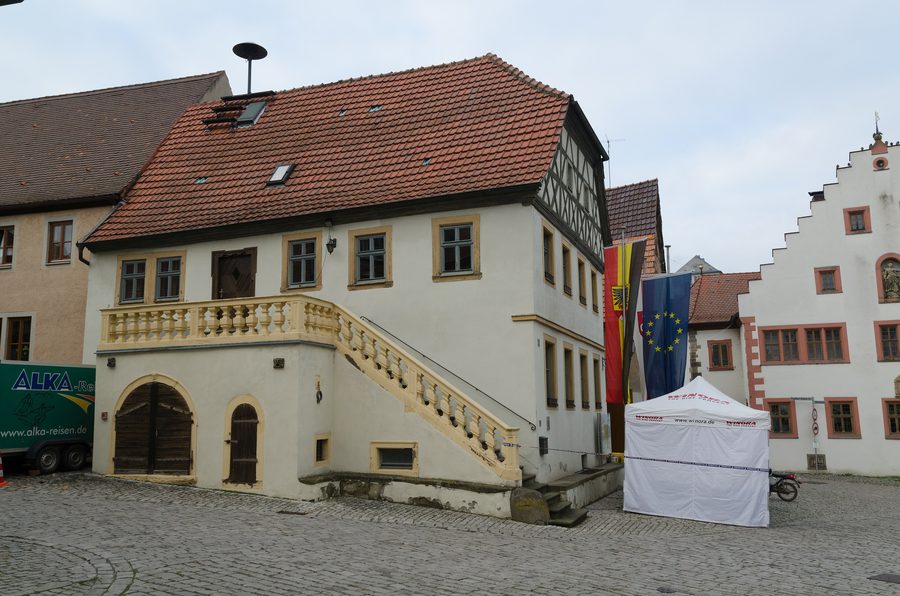 Das historische Rathaus am Marktplatz prägt das Ortsbild von Wipfeld.
Photo: Tilman2007 via Wikimedia Commons, CC BY-SA 3.0
Das historische Rathaus am Marktplatz prägt das Ortsbild von Wipfeld.
Photo: Tilman2007 via Wikimedia Commons, CC BY-SA 3.0
Circular Trails Between Local History and Vineyards
The Historic Celtis Trail honours Conrad Celtis (1459–1508), described as Wipfeld’s most famous son and the first crowned German poet. Information boards at 22 stops provide details about historic buildings and events. The trail starts on Mainstraße, follows a clockwise route through town and ends at St. John’s Parish Church. It winds through the narrow streets and past the Wipfeld Literature House, a literature museum and cultural centre for the village.
The Zehntgrafen Wine Trail is a 3.3 km circular route through Wipfeld’s vineyards. The two trails offer different highlights: 22 stops in town versus a loop through the vineyards. You can take a turnoff from the Celtis Trail to the Zehntgrafen Wine Trail, combining local history with wine country.
The Zehntgrafenlaube is a rest stop along the Zehntgrafen Wine Trail, maintained by the Wipfeld Winegrowers’ Association. Visitors can sample regional wines there. The “Wipfelder Zehntgraf” vineyard site is also a defining feature of this wine-growing town: it is a renowned site with just over 85 hectares of vines. Wipfeld is considered an especially typical wine village in the district; the town hosts various wine festivals and has wine taverns and wine bars.
Architectural History and Culture in the Village
The village centre features well-preserved historic ensembles. St. John the Baptist Parish Church brings together building phases from several centuries: the Julius Echter Tower was built in 1599, followed by the choir in 1615, and the Neoclassical nave was built between 1786 and 1790. The high altar is by Materno Bossi. The figures on the predella come from the former Heidenfeld Monastery and were created by Johann Peter Wagner.
St. Ludwig Monastery Church, built in the Beuronese style, offers another facet of the area’s religious and cultural history. Together with the ensembles in the village centre and the stops along the Celtis Trail, it makes for a distinct theme on days focused on architectural history and literature.
The Main River, Landscape and Getting Around
Along the Main River, the Generations Square complements the large playground. From there, you can watch boats and the stork’s nest in the “Mainaue bei St. Ludwig” nature reserve. The viewpoint on Speiersberg offers a different perspective on the landscape: at 325 m above sea level, it is one of the highest points on the Mainschleife.
Wipfeld has cycling and hiking trails. The town is easy to reach from the surrounding area via the Main Cycle Route and by Main ferry. If you would like to plan your arrival around the ferry, check the timetable in advance. This will help you decide which aspects of Wipfeld suit your stay.
Discover more destinations: Kolitzheim, Gochsheim, Frankenwinheim, Üchtelhausen, Geldersheim, Michelau im Steigerwald, Werneck, Dittelbrunn
Back to the main travel guide: Schweinfurt.

