
Huglfing: Landscape, Stone and Culture
Accommodation in Huglfing
Huglfing combines the landscape of the Pfaffenwinkel region with traces of a richly layered local history. Between gentle moraine hills and broad meadows, a remarkable spring moor lies on the southeastern edge of the village; the parish church and St. Sebastian’s Chapel tell of different phases of construction and renovation. Families can explore the Stone Discovery Trail, with its information and play stations on the subject of stone. Nature, architectural history and a themed trail offer different ways to spend your vacation days.
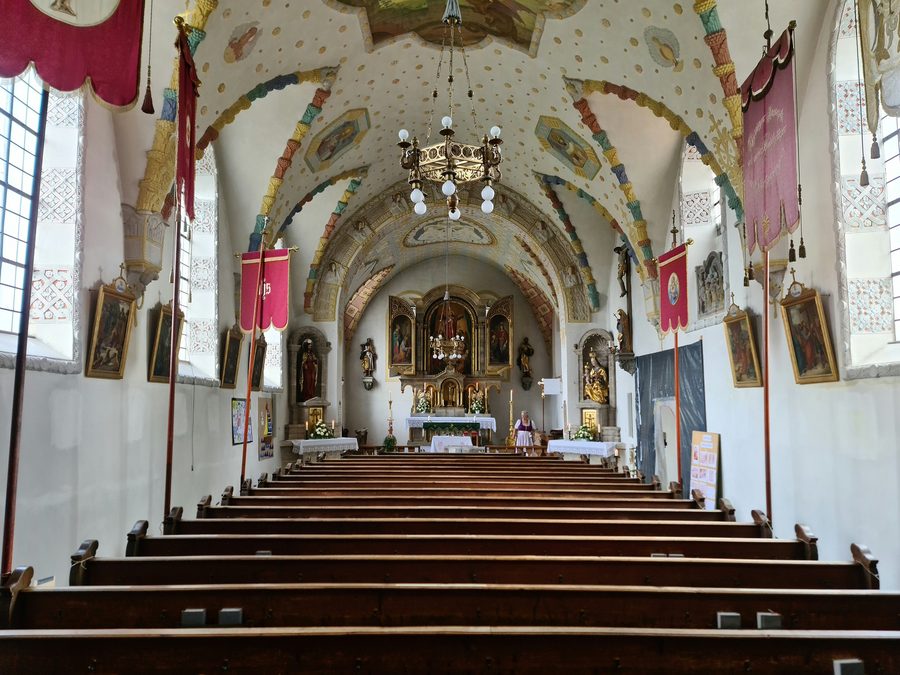 Der Innenraum der Pfarrkirche St. Magnus in Huglfing.
Photo: Ricardalovesmonuments via Wikimedia Commons, CC BY-SA 4.0
Der Innenraum der Pfarrkirche St. Magnus in Huglfing.
Photo: Ricardalovesmonuments via Wikimedia Commons, CC BY-SA 4.0
Moorland and Geology
Spring water emerges from Würm glacial gravel on the southeastern edge of the village. This has created a shallow moor and deposits of lime in a hollow. The spring moor is a protected natural area and is considered a geotope of local historical and tourist importance. Anyone interested in how a landscape was formed and what makes it distinctive will find a different way to experience Huglfing here than through its village history or church. The moor, spring water and lime deposits are tangible geological features; at the same time, gentle hills and broad meadows shape the landscape of the Pfaffenwinkel region.
Huglfing’s award in the European Entente Florale Europe competition is also part of the village’s story: the municipality received the Gold Medal Plus for outstanding village design, sustainability and community spirit. For your travel plans, this offers another perspective on Huglfing, alongside its natural and cultural attractions: the village’s design and the sense of community among local people.
Discover Stone: A Trail with Information and Play Stations
The Stone Discovery Trail around Huglfing explores the extraction of gravel and tuff stone. At sites of current or former extraction, it offers information and play stations on the subject of stone. The trail combines useful insights with playful elements, so you can discover the area in more than one way. For a family outing, the play stations offer a hands-on activity for children; if you are especially interested in the history of local stone extraction, you can focus on the information along the trail.
The route leads into Huglfing village and returns to the railway station via Steinbruchstraße. This route offers clear guidance: the Stone Discovery Trail takes in both the village and Steinbruchstraße, and ends back at the station. If you would like to plan your vacation days around different interests, the trail offers a distinct focus alongside a visit to the churches or an exploration of the spring moor.
Churches with Different Building Phases
The Roman Catholic parish church of St. Magnus is a listed church. Its tower dates back to a Romanesque predecessor built around 1100. The later Gothic church was built in 1501 and remodeled, extended and redesigned in the Rococo style in 1773 and 1843. St. Magnus thus reveals several distinct historical layers: the Romanesque tower, the later Gothic church and its Rococo-style alterations. If you are interested in church architecture and changes over the centuries, the church offers a particularly tangible example.
St. Sebastian’s Chapel has its own history. It was built as a burial chapel for the nobles of Romegg between 1573 and 1606. It was remodeled in 1773, altered again in 1882 and dedicated to St. Sebastian. The chapel underwent extensive renovation from 2016 to 2022. These successive dates show that its history is not limited to a single building phase. Together with St. Magnus, it offers another perspective on Huglfing’s religious architecture; the two churches differ in their documented phases of construction and alteration.
Art and Culture in the Old Signal Box
The art and culture association ausstellwerk Huglfing e.V. is based in the old signal box and railway goods shed at Huglfing station. The association has held art exhibitions and cultural events. It launched its “Image and Word” lecture series in the winter of 2012/2013; since the association was founded, three lectures on different subjects have regularly been held each year. Its location in the old signal box and goods shed connects the association’s name with the spaces at the station. If you would prefer a more culture-focused trip, Huglfing offers exhibitions, events and lectures alongside its churches.
Discover More Places
You can also discover these places: Hohenpeißenberg, Raisting, Seeshaupt, Penzberg, Wielenbach, Peiting, Weilheim in Oberbayern and Oberhausen.
For the regional travel overview: Weilheim-Schongau.

_Innenraum.jpg)