
Wiesensteig: Town History on the Alb Escarpment
Accommodation in Wiesensteig
Wiesensteig lies at the edge of the Alb escarpment, in a narrow valley. Forests and juniper heaths frame the slopes, which rise to 850 metres. In the historic town centre, striking buildings meet trails leading into the countryside. When choosing a holiday apartment, you can therefore consider whether architectural history, hiking or cycling should be the focus of your stay—or whether you would like to combine these interests.
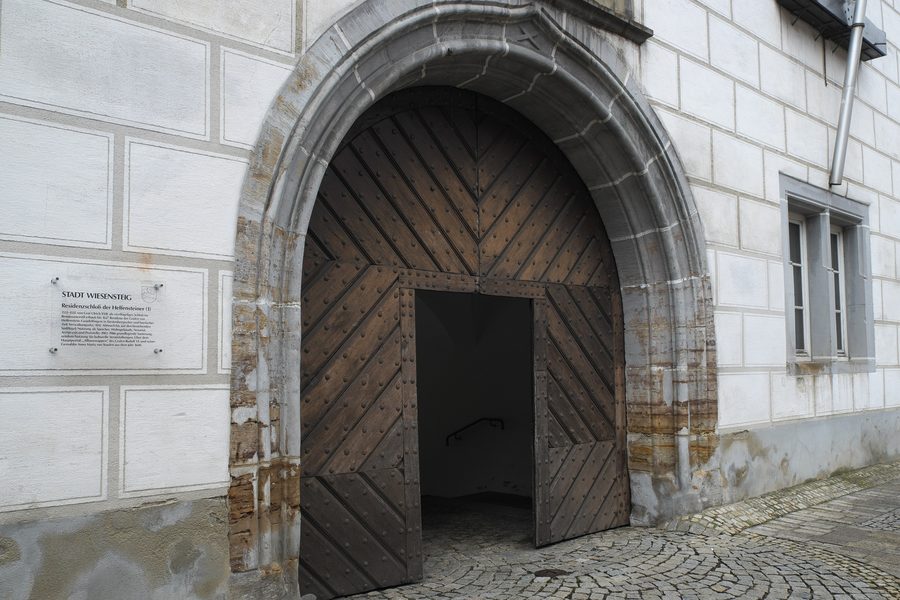 Die Toreinfahrt des Schlosses in Wiesensteig.
Photo: GFreihalter via Wikimedia Commons, CC BY-SA 3.0
A Town Centre with Layers from Different Periods
The Collegiate Church of St. Cyriakus stands out with its twin towers and Gothic architecture: Provost Johann Count of Werdenberg had it built in 1466. Inside, a Baroque choir meets a Neoclassical nave. Different architectural styles thus stand side by side within the same building.
The town centre’s history can also be traced through specific dates at other locations. Count Ulrich XVII laid the foundation stone of the Helfenstein family’s residential palace in 1551; the palace served as a residence until the counts’ line died out in 1627. The Old Stable dates from 1562 and was originally a granary belonging to the palace. The half-timbered building at Hauptstraße 39 followed in 1669, and the market fountain was built in 1718. Its Corinthian capital bears the town’s coat of arms, framed by those of the Counts of Helfenstein and Fürstenberg.
You can find further artistic and architectural details at the cemetery chapel: it contains Renaissance frescoes and Baroque altars and was restored in 1969. The buildings, their former functions and their different styles offer several starting points for a cultural walk through the town centre.
Hiking Trails with Different Highlights
The Wiesensteig GEOPFAD (Geotrail) runs along the Sommerberg to geological windows where rock from the Upper Jurassic period can be seen. Here, geology takes centre stage. The Albtraufgängerweg, by contrast, leads to Wiesensteig and through the medieval town centre. The well-marked trail offers views over the Wolfsklinge and returns beneath the Papierfelsen to the Papiermühle car park. The Löwenpfad Filsursprung-Runde is another named hiking route in Wiesensteig.
There is also a distinct destination north of town: a footpath lined with Stations of the Cross leads through a beech forest to the Kreuzkapelle. The nearby ruins of Reußenstein Castle lie five kilometres northwest of Wiesensteig. They can be reached on foot from the paid Papiermühle car park via the Bronnensteige and the Feldkopf. These destinations offer a clear contrast to a walk through the town centre: when planning your day, you can choose between architectural history, geological insights and trails to the chapel or castle ruins.
Cycling and Winter Sports Are Also Part of the Town’s Character
For mountain bikers, the Wiesensteiger Löwentrail Reußenstein-Runde is a named route; the AlbCrossing mountain bike trail passes by Wiesensteig, among other places. According to the town, the Bläsiberg Skilifte Wiesensteig form the largest ski area on the Swabian Alb. Together with the hiking options, these offer various themes to consider when planning your trip. Choose your holiday apartment based on what interests you most locally, and check the latest information for offerings that vary by season or date.
Discover more destinations: Geislingen an der Steige, Hattenhofen, Salach, Heiningen, Bad Überkingen, Bad Ditzenbach, Albershausen, Eislingen/Fils.
Go to the overview of destinations: Göppingen.

