
Jedlicze: Churches, Memorial Sites and Chlebianka
Accommodation in Jedlicze
Jedlicze brings together a diverse history of church architecture, memorial sites and Chlebianka Reservoir. This makes the town interesting for travellers who want to include both historic buildings and a body of water known for its distinctive fish population in their plans. The parish church, cemetery, park and reservoir represent different themes that you can use to shape the focus of your stay.
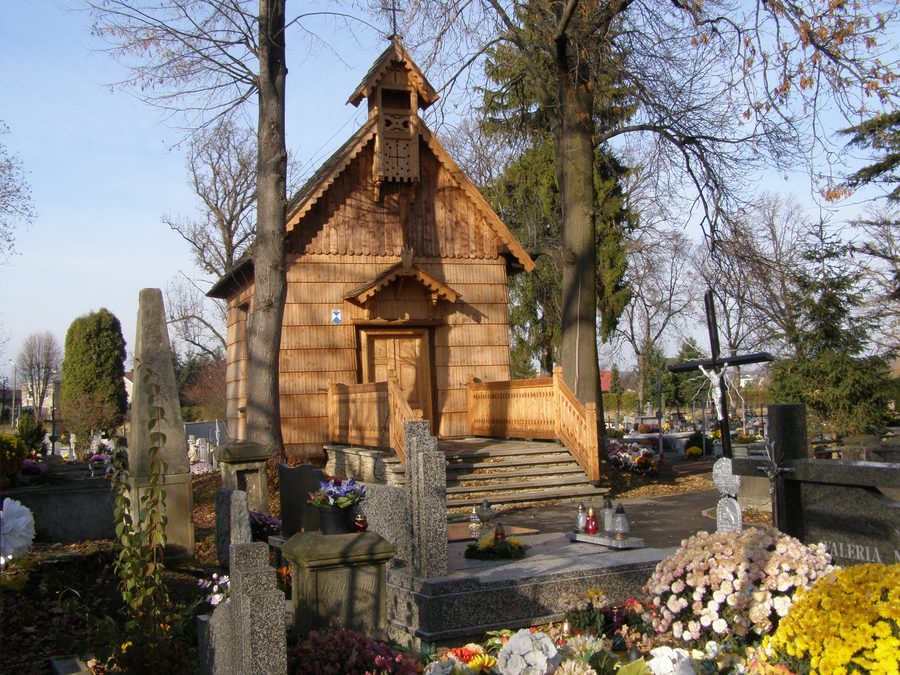 Zabytkowa kaplica na cmentarzu w Jedliczu, datowana na 1865 rok.
Photo: Leszek39 via Source, CC BY-SA 3.0 pl
Zabytkowa kaplica na cmentarzu w Jedliczu, datowana na 1865 rok.
Photo: Leszek39 via Source, CC BY-SA 3.0 pl
The History of Church Architecture in Jedlicze
From 1598, a wooden church in the Vistula Gothic style stood on the site of the present parish church in the town centre. It burned down in 1712. After the fire, Remigiusz Wielowiejski had another wooden church built on the same site; it was demolished in 1931. A Baroque church replaced the earlier wooden church and was later demolished because of its poor condition.
Construction of the present Church of St Anthony of Padua began in 1911, based on a design by architect Jan Sas-Zubrzycki. The church is built of brick and dressed stone in the Neo-Romanesque style. Its floor plan follows the shape of a Latin cross, and its towers are 65 metres high. The cruciform floor plan describes the shape of the church building: a longer space is crossed by a transverse section. This makes it possible to identify specific architectural features, from the materials used to the spatial layout.
If you are travelling with children, the sequence of church buildings can spark a conversation about change and construction methods: What distinguishes a wooden church from a Neo-Romanesque building, and what does a cruciform floor plan mean? The dates 1598, 1712 and 1931 make the different chapters of the town’s history tangible.
Memorial Sites in the Parish Cemetery
The graves of Laura Pytlińska and Zofia Mickiewiczowa, the daughters of Maria Konopnicka, are located in the parish cemetery. The cemetery is also home to a mass grave for 22 unnamed patriots who were shot by Germans in February 1943. The two sites represent different aspects of remembrance: Maria Konopnicka’s family history and commemoration of those who were murdered. The cemetery thus complements the architectural history with both a personal and a collective perspective on Jedlicze’s past.
Reservoir and Park
Chlebianka Reservoir is known for its large catfish, zander, carp and grass carp. If you are interested in bodies of water and fish species, this offers a different way to explore the town than its church architecture and history. Another cultural landmark is Pałac Stawiarskich, which has a park. Here, the palace and park belong together, broadening the choice of themes to include a historic building with a connection to a park.
Choosing the Focus of Your Stay
When looking for a holiday apartment in Jedlicze, your reason for travelling is a useful starting point. Would you like to focus on architectural history and local remembrance, or are you more interested in the reservoir and its fish species? The parish church, cemetery, Pałac Stawiarskich and its park, and Chlebianka offer different themes to help you decide whether Jedlicze is the right destination for you. That way, your choice reflects what interests you most about the area.
Discover more destinations: Chyrowa, Moderówka, Dukla, Odrzykoń, Krosno, Bóbrka, Trzciana, Tylawa
See the broader travel overview: Krośnieński.

