
Discover Roßdorf: History and Hiking Trails
Accommodation in Roßdorf
Roßdorf combines distinctive memorial sites with two hiking trails that differ in length and route. The village is in the Thuringian part of the Rhön Biosphere Reserve. Visitors who want to combine history, church architecture, and walks through the countryside will find a range of themes to consider when planning their trip.
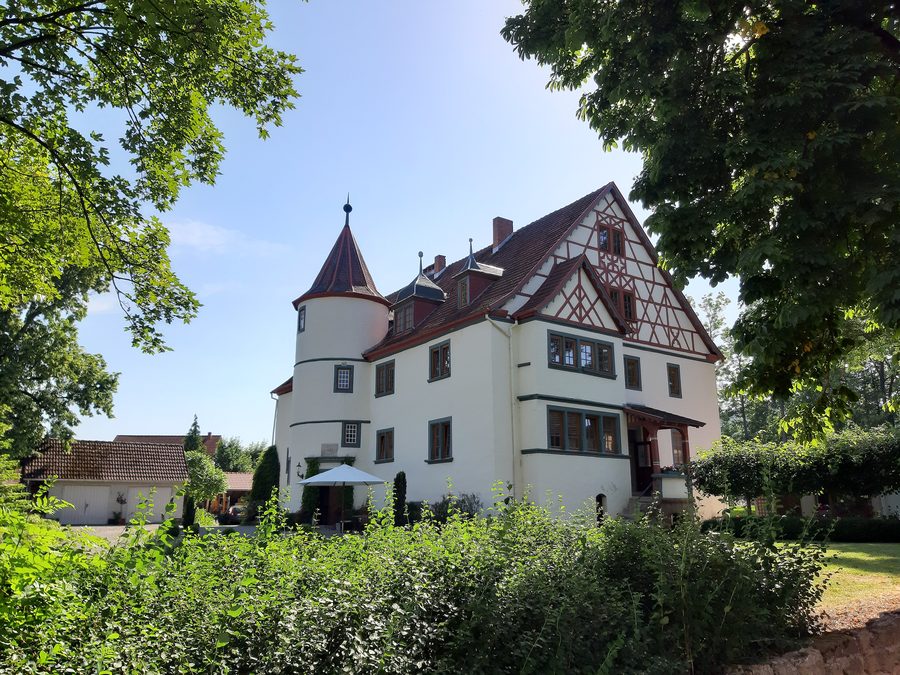 Das Geysosche Schloss in Roßdorf gilt als vermutlich um 1600 errichtetes zweigeschossiges Wohngebäude.
Photo: Dk0704 via Wikimedia Commons, CC BY-SA 4.0
Das Geysosche Schloss in Roßdorf gilt als vermutlich um 1600 errichtetes zweigeschossiges Wohngebäude.
Photo: Dk0704 via Wikimedia Commons, CC BY-SA 4.0
History at Nebelberg and in Roßdorf
On July 4, 1866, near Roßdorf at Nebelberg, Bavarian troops fought on the Austrian side against Prussian troops. The skirmish left hundreds dead and injured. In the village, a sandstone obelisk in the cemetery, the Bavarian Monument, commemorates the fallen Bavarian soldiers. A small museum in Roßdorf is dedicated to the skirmish at Nebelberg and is also known as the 1866 Museum.
The exhibition at Gutshof Roßdorf offers another cultural perspective. Its exhibits include several reproductions of important oil paintings and some original prints by Carl Wagner. Alongside the commemoration of the skirmish, works by a regional artist are also in the spotlight.
Trinity Church: Baroque architecture with unusual details
Roßdorf Trinity Church is primarily a Baroque building. From 1682 to 1733, it was extensively renovated and extended eastward by two bays. At the same time, the tower on the church’s unusual north side was rebuilt. The building’s history places it in a clear period; other details shape its spatial character.
The church is an elongated hall with an unusually deep interior. Rich figurative paintings adorn the barrel vault and the galleries, which run around three sides on two levels. An octagonal baptismal font dating from 1674 completes the furnishings. For visitors finding their bearings in Roßdorf, the church offers a different perspective from the Bavarian Monument and the museum dedicated to the skirmish.
Two hiking trails, two different routes
The 14-kilometer Wagner-Mosengeil Memorial Trail commemorates Ernst Wagner and runs from Roßdorf via Pleß to Breitungen. It starts at the Roßdorf parsonage and follows Kirchweg, Badegasse, Schlosspark, Salzunger Weg, Hohe Straße, and Eichberg to Stoffelskuppe. It then continues via Roßdorfer Tor, Roßdorfer Ausspanne, Hohlweg, Kleine Pleßwiese, Pleßkuppe, Roten Stock, and Breiten Weg to Breitungen.
Along the way, the memorial trail passes the turnoffs for Helmers and Gaststätte Wittgenthal, Knollbach, the Breitunger Landwehr, the path toward the train station, and the Breitunger Seen nature reserve. Further along the route are the church, forestry office, market square, Zehntmauer, Gaststätte Zur Linde, and the Frauenbreitungen parsonage. These many named points make the route easy to distinguish; the trail ends in Breitungen.
The 12-kilometer Roßdorf 2 circular trail follows a different route and returns to Roßdorf. From the community center, it leads via the park, Roßdorfer Kutte, Salzunger Weg (Wagner-Mosgeil-Weg), Stoffelskuppe, Hoher Rain, Bernshäuser Kutte, Bernshausen, Horn, Langer Rain, and Bernshäuser Straße back to the starting point.
The difference matters when choosing a route: Roßdorf 2 is a loop that returns to Roßdorf, while the longer Wagner-Mosengeil Memorial Trail continues to Breitungen. If you are looking for a holiday apartment as a base for your trip, the trail length, route, and your interest in the cultural attractions can all inform your choice of location.
More to explore in the wider Schmalkalden-Meiningen destination
The wider Schmalkalden-Meiningen destination also offers individual attractions with different focuses. In Schmalkalden, visitors can see nougat being made at the Viba Nougat World’s glass-walled factory. Hands-on confectionery courses include molding chocolate, decorating nougat, and creating pralines. Check course times and booking conditions before taking part.
The “Neue Hütte” blast furnace museum in Schmalkalden offers another distinctive experience: the blast furnace complex dates from 1835; local iron ores were smelted there using charcoal to produce pig iron until 1924. The exhibition covers nearly 1,300 years of iron and steel goods production in the Schmalkalden region, including the well-known “Schmalkalder Artikel.” A 45-minute guided tour explores the history and function of the blast furnace operation.
For detailed route planning around the biosphere reserve, check its current boundaries. Roßdorf is in the Thuringian part of the Rhön Biosphere Reserve.
Discover more destinations: Zella-Mehlis, Struth-Helmershof, Christes, Rhönblick, Trusetal-Laudenbach, Wernshausen, Fambach, Brotterode-Trusetal.
Back to the wider travel guide: Schmalkalden-Meiningen.

