
Teistungen: Border History and Trails at Glockengraben
Accommodation in Teistungen
Teistungen combines the history of the division of Germany with hiking and cycling trails of varying lengths and destinations. The Eichsfeld Borderland Museum and its original GDR border installations provide a special historical context for a visit. There are also trails to the “Glockengraben” reservoir, along the Hahle and up to Pferdeberg. If you are looking for a holiday apartment in Teistungen, these varied interests may help you decide: Would you primarily like to experience border history, take a short walk or plan longer routes?
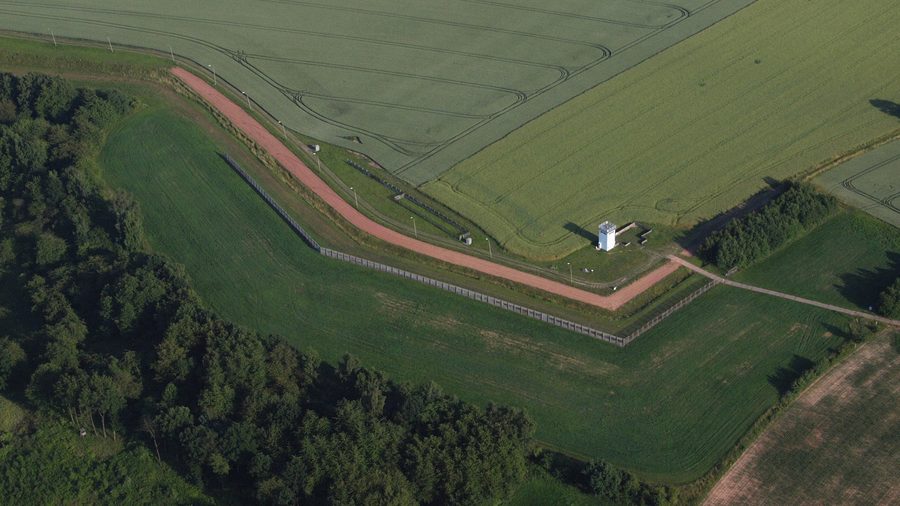 Grenzlandmuseum Eichsfeld bei Teistungen am ehemaligen innerdeutschen Grenzabschnitt.
Photo: Wolkenkratzer via Wikimedia Commons, CC BY-SA 3.0
Grenzlandmuseum Eichsfeld bei Teistungen am ehemaligen innerdeutschen Grenzabschnitt.
Photo: Wolkenkratzer via Wikimedia Commons, CC BY-SA 3.0
Border history at the former crossing
The Eichsfeld Borderland Museum is located at the former Duderstadt-Worbis inner-German border crossing. It provides information about the history of the division of Germany and Europe from 1945 to 1990. You can explore the original GDR border installations along the Borderland Trail. The trail is open year-round and can be walked at any time; its historical significance comes directly from the installations preserved here.
The accessibility of the main building is also relevant when planning your visit: it is wheelchair-accessible and step-free. There is a lift and accessible toilets. This information applies to the museum’s main building. For visitors who would like to plan an outdoor walk alongside their museum visit, several circular and point-to-point routes are described from the museum, each with its own length and destination.
A short walk or a longer tour?
For a short walk, the Teistungen Reservoir circular trail, at about 2.2 kilometres and approximately 30 minutes’ walking time, is a compact option. It goes all the way around the “Glockengraben” reservoir. There are paved jetties by the lake where you can stop and relax. The Lindenberg circular trail, which also starts at the Borderland Museum, is 3.5 kilometres long and takes about 50 minutes. It crosses a footbridge in the direction of Victor’s Residenz Hotel.
If you are considering a longer circular walk, you can choose the approximately 8-kilometre Teistungen Pferdeberg circular trail. It is listed as taking about two hours. From the Borderland Museum, it runs through Gerblingerode and along the Hahle to Pferdeberg, where there is an observation tower, and then on to Teistungen. Another circular walk starts at the market square in front of the Bürgerhaus: the Teistungen–Berlingerode route is about 9.3 kilometres long and takes approximately 2.5 hours.
At about 14.2 kilometres and approximately five hours, the Teistungen–Ferna–Tastungen–Wehnde circular trail is the longest of the hiking loops described. It starts at the Borderland Museum, heads towards Teistungen, passes the allotment gardens and follows the Hahle. The different distances and stated walking times will help you choose a tour to fit the time available, without treating the routes as interchangeable.
Cycling and hiking trails to various destinations
The cycling and hiking trails also vary in length and route. The 11.4-kilometre Reservoir cycling and hiking trail starts at the Borderland Museum and heads towards Teistungen and the “Glockengraben” reservoir. The stated travel time is about 35 minutes. The short Teistungen–Berlingerode–Immingerode–Gerblingerode cycling and hiking trail is about 8 kilometres long and also starts at the museum. It runs mostly along a paved road, including around 200 metres of a patrol road; walking time is about two hours.
The 24-kilometre Teistungen–Ferna–Brehme–Duderstadt cycling and hiking trail offers a longer connection. It starts at the Borderland Museum, runs mostly on paved or compacted gravel paths and follows the Hahle for one section. The stated travel time is about one hour and 45 minutes. This gives you a choice of a shorter route to the reservoir, a trail through several named towns and a longer connection all the way to Duderstadt when planning your outing.
Historic sites in Teistungen
The parish church of St. Andrew is part of the town’s history. It was built in 1933/34; the squat west tower of the previous building, which was constructed from 1722 to 1726, was incorporated into the new building. The organ also has its own history: it comes from the Teistungenburg monastery church and was built in 1723 by Johannes Creutzburg from Wendehausen. These details add another historical perspective to a museum visit. Accommodation in Teistungen may therefore suit a stay where you can focus on the museum, local history and trails according to your interests.
More places to discover: Volkerode, Dingelstädt, Berlingerode, Am Ohmberg, Bornhagen, Gernrode, Wahlhausen, Lutter.
For the main travel overview: Eichsfeld.

