
Dannenberg (Elbe): Lake, Town History and the Elbe Cycle Route
Accommodation in Dannenberg
Dannenberg (Elbe) combines town history, water and countryside: historic buildings are at its heart, nearby Thielenburger See invites you to go for walks, and Dannenberg lies on the Elbe Cycle Route. When choosing your holiday apartment, you can consider whether you would like to focus primarily on the town centre, culture or time by the water.
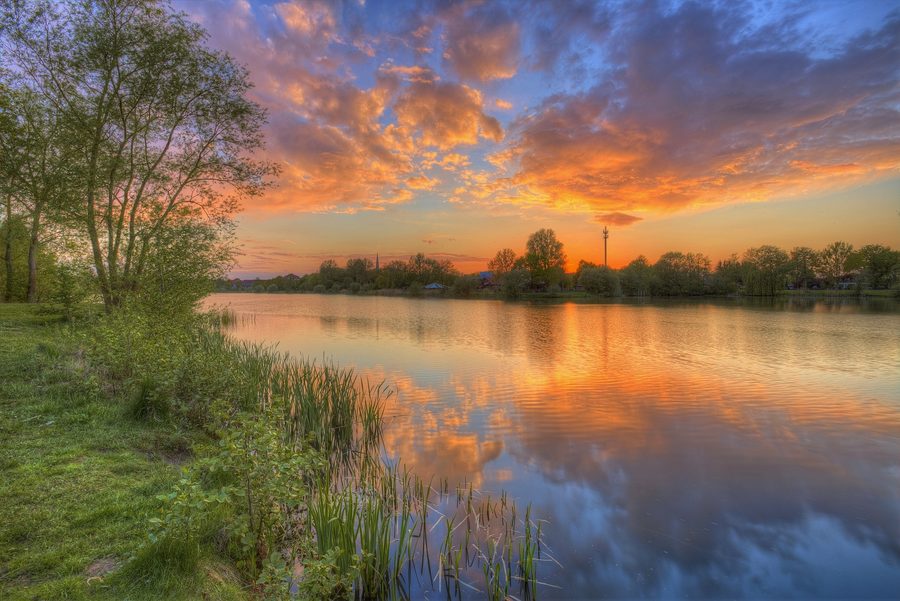 Sonnenuntergang am Thielenburger See in Dannenberg.
Photo: Maik Richter Fotografie via Wikimedia Commons, CC BY-SA 3.0
Thielenburger See and the Dannenberger Marsch
The artificially created Thielenburger See lies close to the town centre, covers more than eleven hectares and was created in the 1980s. You can enjoy long walks here at any time of year. There is an adventure playground on the east shore where children can play, so you can combine a walk by the lake with a play break.
Most of the town borders the edge of the Dannenberger Marsch. This floodplain along the Elbe, which is partly protected by dykes and used for agriculture, is criss-crossed by numerous oxbow lakes and nature reserves; many rare animal and plant species live there. A visit to the town and an experience of the countryside offer different focal points: historic buildings and shops shape a stay in the centre, while the Marsch is characterised by its floodplain landscape.
Cycling
Dannenberg lies on 75-kilometre Section F of the Elbe Cycle Route between Hitzacker (Elbe) and Wittenberge. If you are planning your trip around the cycle route, you can include Dannenberg as a stop along this section. Check the route information before setting out, as the route network may change.
The Waldemarturm and Dannenberg’s history
The museum in the Waldemarturm presents Dannenberg’s history across six floors, with informative exhibitions. The tower is part of a medieval castle complex and served as a defensive tower. The exhibits range from finds from the town’s early history and temporary art exhibitions to the history of flooding. The exhibition “100 Days in Wellies” illustrates the recurring floods that threatened Dannenberg; the museum also documents the major floods of 2002 and 2006.
Visiting the museum involves climbing stairs; it is not wheelchair accessible. Climb the 133 steps to just below the dome for a view over Dannenberg and the surrounding countryside. Guided tours of the museum and educational activities can be booked on request and individually tailored by arrangement.
The town centre also offers its own cultural and historical walk, with well-preserved and carefully restored historic buildings. The cobbled shopping street is home to numerous small shops, many of them independently owned. Another discovery is the interactive permanent exhibition “Don’t Be a Frog.” Nearby, in Neu Tramm, the Historical Fire Brigade Museum displays numerous exhibits on firefighting from the past 100 years.
Getting here and finding your way
Dannenberg can be reached by both car and train. Dannenberg bus station (ZOB) is very close to the Waldemarturm. Dannenberg Ost railway station is two kilometres from the museum in the Waldemarturm. The tourist information office is in the entrance area of the information centre in the Old Town Hall, Am Markt 5, 29451 Dannenberg.
More topics in the wider Lüchow-Dannenberg destination
Other places in the wider Lüchow-Dannenberg destination add to its cultural and natural attractions. The Wendland Round Barn Museum in the round-village of Lübeln features a farmstead as an open-air museum. Traditional crafts are brought to life there in the pottery, blacksmith’s shop, bakehouse and wheelwright’s workshop. The Hitzacker Archaeological Centre is an open-air museum on a site that people were already using around 4,000 years ago. Three reconstructed longhouses and interactive stations give visitors a glimpse into the everyday lives of early people.
For nature, the wider Lüchow-Dannenberg destination offers the Göhrde and Göhrde Forest: the Göhrde is the largest contiguous mixed forest in northern Germany. With its many protected areas, Göhrde Forest provides a habitat for numerous rare and endangered species. The Göhrde Nature Centre offers forest activities and guided forest walks on a range of topics upon request.
The Cultural Country Tour (Kulturelle Landpartie) offers another distinctive seasonal highlight in the wider Lüchow-Dannenberg destination. Since 1989, artists and craftspeople have opened the doors to their farmyards and studios every year between Ascension Day and Pentecost, presenting their work for twelve days. The exact dates vary from year to year. You can consider these cultural and nature-related attractions as additions to Dannenberg’s town history, lake and cycle route when planning your trip.
Discover more destinations
Discover more destinations: Luckau, Woltersdorf, Gorleben, Kassau, Gusborn, Waddeweitz, Lüchow, Clenze
Return to the wider travel overview: Lüchow-Dannenberg.

