
Eußenheim: Fortified Church and Panoramic Views on the Frühmesserweg
Accommodation in Eußenheim
Eußenheim offers two distinct experiences: the historic fortified church in the district of Aschfeld and the panoramic views along the Frühmesserweg. One takes you to a 15th-century fortified refuge, while the other leads through vineyards, woodland and calcareous grassland. You can shape your stay around culture, landscape or a mix of both.
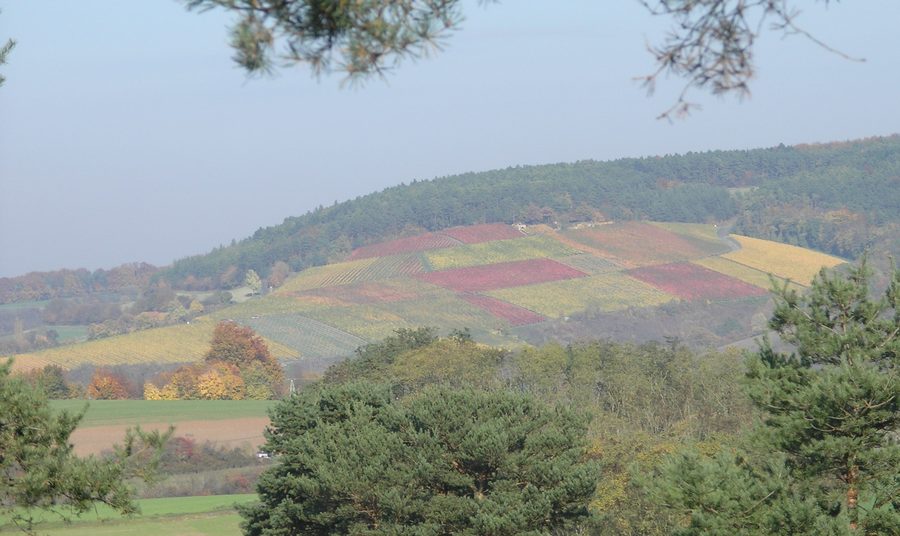 Weinberg am Eußenheimer First im Oktober.
Photo: Christian Lösch, Karlstadt via Wikimedia Commons, CC BY-SA 3.0
Weinberg am Eußenheimer First im Oktober.
Photo: Christian Lösch, Karlstadt via Wikimedia Commons, CC BY-SA 3.0
Aschfeld Fortified Church: history and rural life
The Historic Aschfeld Fortified Church is a fortified refuge dating from the 15th century. Some of the defensive complex is now used as museum space. Visits are possible by appointment or on Open Monument Day—a contrast with the Frühmesserweg, which is accessible year-round and can be planned without arranging a visit in advance.
Twenty fortified storage buildings and cellars display historic defensive weapons, as well as the collection “The Good Old Days You Can Touch.” It focuses on rural life and work. This means the fortified church brings two subjects together: the defence of the complex and the everyday life explored by the collection. Those interested in history will find more than a view of a historic building: rural life and work are also part of the story.
When planning, bear the visiting arrangements in mind: schedule your museum visit by appointment or for Open Monument Day. The fortified church makes a good cultural highlight to plan into your stay; the Frühmesserweg offers a different way to spend time outdoors.
Frühmesserweg: a circular route through changing landscapes
The Frühmesserweg in Eußenheim is accessible year-round and forms a circular route back to the starting point. Along the way, the vineyard area “Eußenheimer First,” the woodland section “Frühmesserstuhl” and calcareous grassland alternate. The route also offers panoramic views.
If you are looking for a complete circuit rather than a single cultural destination, returning to the starting point is a practical advantage. The route also has a clearly defined character: the Frühmesserweg passes through named landscape sections and offers scenic views, while the fortified church focuses on historic defensive architecture and its museum spaces. You can therefore easily decide which experience should shape your stay based on your interests.
Main-Spessart in a wider context
In the wider destination of Main-Spessart, vineyards, water and woodland come together to shape the regional landscape. Hiking routes also vary in scale: the Frühmesserweg is a circular route in Eußenheim, while the Main Hiking Trail is around 500 kilometres long. Just under 100 kilometres of it run through the district of Main-Spessart, connecting Karlstadt, Gemünden a.Main, Lohr a.Main, Rothenfels and Marktheidenfeld. The Spessart Trails carry the “Wanderbares Deutschland” quality seal; in the Spessart Nature Park, possible routes range from short walks to hikes lasting several days.
Main-Spessart also offers a range of cultural themes. The old town of Karlstadt, surrounded by walls, towers and gates, was founded around 1200; its buildings and structures have been preserved for more than seven centuries. The Paper Mill Museum in Homburg offers another way to explore history: production facilities from the 19th and 20th centuries, the paper-making family’s living quarters and a demonstration workshop have all been preserved in their entirety and authenticity. A hand papermaking workshop, now in its fifth generation, still produces fine handmade paper there. You can compare the fortified church in Eußenheim with Karlstadt’s old town and the Paper Mill Museum in Homburg.
These different highlights can help guide your choice of holiday apartment: are you mainly interested in visiting the fortified church and walking the circular route in Eußenheim, or would you also like to explore Main-Spessart’s broader range of hiking and cultural attractions? Local highlights combine a museum visit that can be planned in advance with a year-round accessible trail; the regional examples reveal further landscapes and cultural perspectives.
Discover more destinations
Discover more destinations: Neustadt Am Main, Stockstadt Am Main, Wildensee, Hafenlohr, Retzstadt, Obernburg Am Main, Arnstein, Urspringen.
Back to the main travel overview: Main-Spessart.

