
Discover Markgröningen’s Half-Timbered Houses and Old Town
Accommodation in Markgröningen
Markgröningen brings its history to life in the old town: half-timbered houses, St Bartholomew’s Church, and remnants of the town fortifications tell the story of different building and urban development periods. There is also a signposted tour with 30 stops and various routes along the stream, through meadows and forests, along the wine trail, or around the town. When choosing a holiday apartment for your stay, you can balance your plans between culture and outdoor walks.
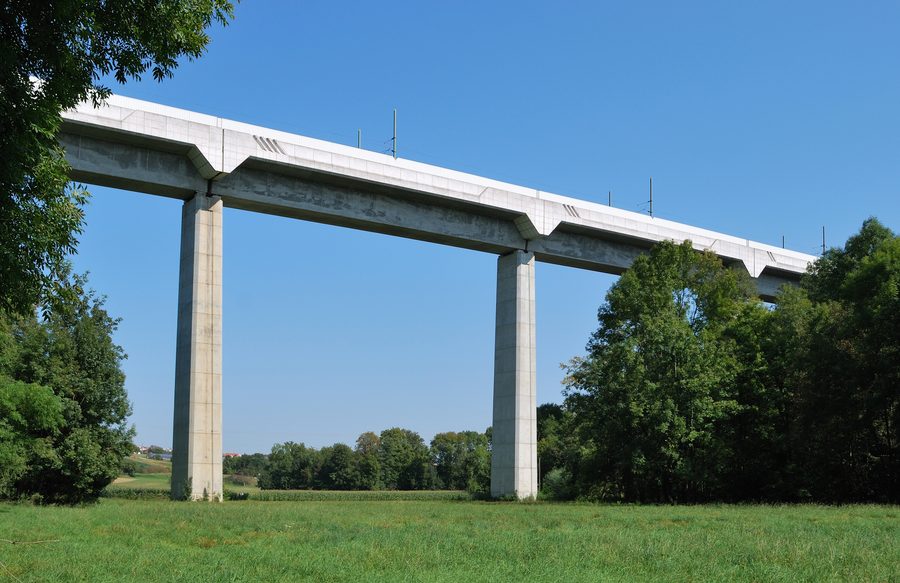 Die Glemstalbrücke überspannt das Tal der Glems nahe Markgröningen.
Photo: Harke via Wikimedia Commons, CC BY-SA 3.0
Half-Timbered Houses and Architectural History
Markgröningen’s oldest half-timbered house stands on Schlossgasse: building no. 8. The part aligned parallel to the street was built in 1347, and the gable-end extension on the east side around 1670. One house thus reveals two construction periods separated by several centuries. As a town with medieval half-timbered houses, Markgröningen is part of the German Timber-Frame Road.
Today’s St Bartholomew’s Church also has a long history. It was built between 1255 and 1280 on the site of a Romanesque basilica dating from the 9th century. The patron was Count Hartmann II of (Württemberg-)Grüningen. The water supply tells another part of the town’s history: in 1499, Peter von Koblenz built the water pipeline to the market fountain. It brought fresh water from a spring in the Oberer Leudelsbach district into the town.
Remnants of the town fortifications survive in old houses and barns along Helenenstraße, Schillerstraße, and Grabenstraße. Exploring the historic old town, visitors encounter not only individual landmark buildings but also traces of the former fortifications in the streetscape. The Wimpelinhof Museum is accessible. If you have specific accessibility requirements, check access details directly with the museum before your visit.
Walking Tours and Routes to Suit Your Interests
The signposted tour starts at the market square and passes through the historic old town, with 30 stops along the way. It offers a set route for getting to know the town on foot. For further exploration, “Markgröningen bewegt” offers four selected routes: along the stream, through meadows and forests, along the wine trail, or around the town. This lets you choose a focus based on your interests.
Around Markgröningen, the Markgröningen local group of the Swabian Alb Association has signposted seven circular hiking trails covering a total of 82 kilometres. Information boards show seven loop routes, each between 8 and 16 kilometres long. These details offer different options for planning a hike; before setting out, it is advisable to check local information on trail markings and current route conditions.
When choosing a holiday apartment, you can start with your interests: are you most interested in the historic old town’s stops, or would you also like to plan nature- and wine-themed routes? The different options provide concrete ideas for planning your stay.
A Festival with Many Groups
The Schäferlauf includes a festival procession with more than 50 groups. This gives the festival a different character from the old town’s architectural heritage, which can be quietly admired: here, the experience includes many groups appearing together. Those interested in traditions will find another cultural highlight in Markgröningen.
Ludwigsburg in a Broader Landscape
Across the wider Ludwigsburg destination, terraced, steep vineyards along the Neckar and Enz rivers shape the district’s landscape. The WeinErlebnisWeg Wunnenstein offers another perspective on winegrowing and winemaking: this approximately four-kilometre walking trail has 60 illustrated information boards and passes viewpoints, restaurants, seating areas, barbecue spots, and vineyard huts. Winegrowing and vineyard landscapes add a distinct regional focus to the history of the old town.
Discover more destinations: Freudental, Kornwestheim, Bietigheim-Bissingen, Oberstenfeld, Möglingen, Gerlingen, Gemmrigheim, Ludwigsburg.
Back to the main travel guide: Ludwigsburg.

