
Großbottwar: Historic Townscape and Lebensweg
Accommodation in Großbottwar
Großbottwar combines a historic townscape with two trails covering different themes: wine at Wunnstein and reflection in the Köchersbergtal. The buildings, alleyways and trails offer specific points of reference as you plan your stay and decide what you would like to focus on.
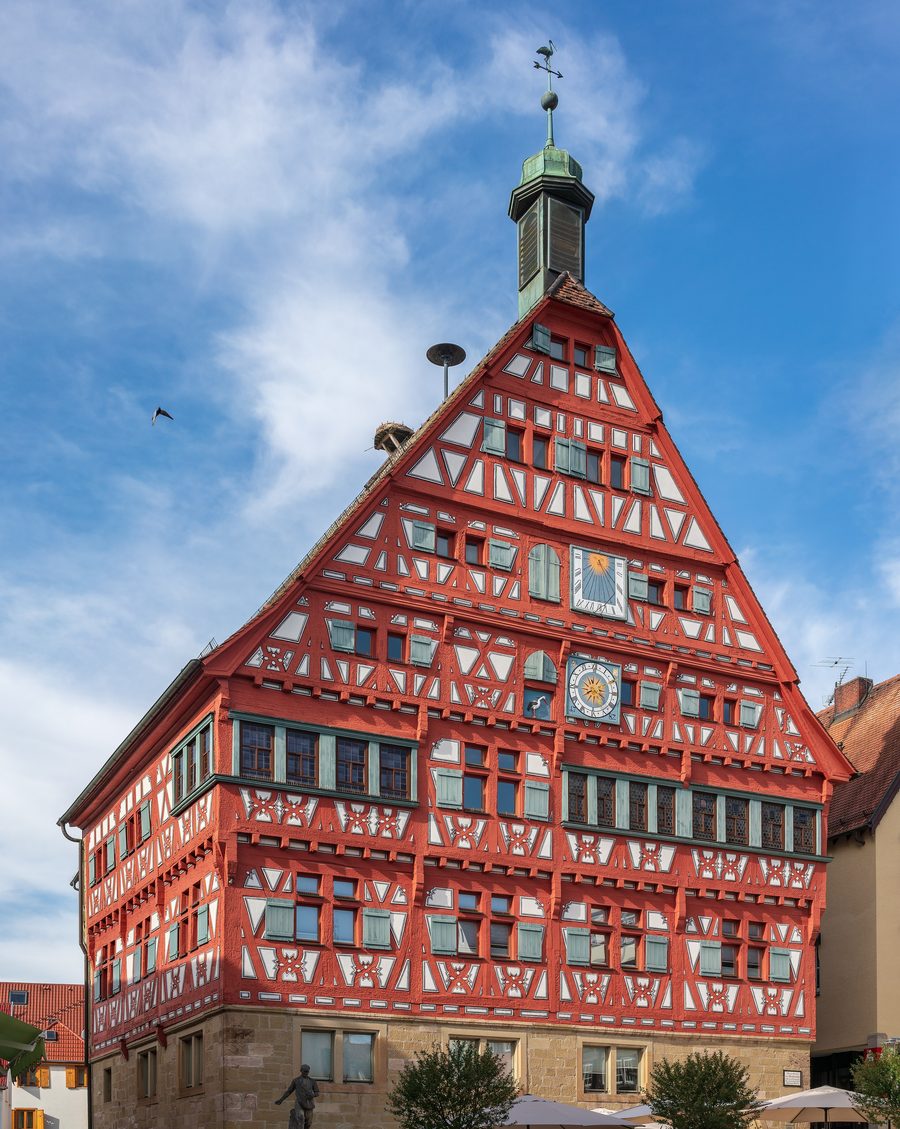 Das historische Rathaus von Großbottwar, 1556/57 errichtet, über dem Marktplatz gesehen.
Photo: Roman Eisele via Wikimedia Commons, CC BY-SA 4.0
Das historische Rathaus von Großbottwar, 1556/57 errichtet, über dem Marktplatz gesehen.
Photo: Roman Eisele via Wikimedia Commons, CC BY-SA 4.0
Half-timbered houses and a largely preserved townscape
The historic townscape, with its alleyways and corners, old buildings and architectural monuments, has largely retained its original character. Notable examples include the historic town hall, the Crooked House, the Old School and the Burgermühle mill. Together, they offer more than just a single point of interest in the town’s history: the old town hall stands alongside other named buildings, while the alleyways and corners also help shape the character of the townscape.
Großbottwar’s Renaissance half-timbered town hall was built in 1556 to replace the dilapidated town hall. The new building thus also marks a specific chapter in the town’s history: the present-day historic building took the place of an older, dilapidated town hall. Those interested in architecture will find a clearly identifiable landmark here, as well as a link to the town’s development.
Wine trail and Lebensweg: two different themes
The wine trail is located on Wunnstein, the local mountain of Winzerhausen. Winzerhausen is a district of Großbottwar. The trail’s name alone sets it apart from the historic buildings: here, the focus is on wine.
The Lebensweg is located in the Großbottwarer Köchersbergtal, above Winzerhausen. It combines a reflection trail with a panoramic trail and has ten stations that encourage visitors to think about fundamental questions of everyday life. This makes it easy to choose according to your preferred focus: the wine trail turns your attention to wine, while the Lebensweg invites reflection on everyday questions.
When looking for a holiday apartment, this distinction can be a useful starting point. First consider whether you are most interested in the historic townscape, the wine trail or the Lebensweg. This way, you can choose where to stay based on the topics you actually want to explore, rather than an arbitrary collection of day-trip destinations.
Ludwigsburg as a broader travel destination
The Ludwigsburg district offers a wider landscape setting. The district is nestled in the Neckar Valley between Stromberg, Strohgäu and the Löwensteiner Berge. Terraced, steep vineyards along the Neckar and Enz rivers are a defining feature of the landscape.
The broader Ludwigsburg travel destination also offers a variety of cultural attractions. Ludwigsburg Residential Palace is one of Europe’s largest Baroque buildings preserved in its original form. The Blühendes Barock in Ludwigsburg is a horticultural show with a fairytale garden. To explore Celtic history, the Celtic Trail links nine significant finds along a route of around 35 kilometres through the district. The Keltenweg AR app brings the nine archaeological sites to life with interactive VR and AR features. The Hochdorf/Enz Celtic Museum includes a richly furnished burial chamber of a Celtic prince, faithfully reconstructed from the original, and offers insights into the everyday life and crafts of early Celtic people.
Other themed trails offer different experiences: the Wine and Literature Trail through the Schiller town of Marbach and the Bottwartal is 35 kilometres long and has 15 literary stations. The wine trail on Geigersberg in Sachsenheim is a 1.9-kilometre circular route with information boards about nature and wine culture, as well as rest areas. Both examples showcase their own trail themes at district level and are distinct from the trails associated with Großbottwar.
The Ludwigsburg district also offers other cycling opportunities. Cycle paths pass Celtic landmarks, historic mills and steep vineyards, as well as running through river valleys; suitable options are also available for e-bike riders. The approximately 350-kilometre Neckar Valley Cycle Route is almost entirely flat and runs steadily downhill. It is considered suitable for beginner cyclists and families with children, and in the Ludwigsburg district it passes wine viewpoints along the steep vineyards. Alongside Großbottwar’s local attractions, regional trails and cultural destinations are therefore also available as distinct travel interests.
Discover more destinations
Discover more destinations: Pleidelsheim, Sachsenheim, Löchgau, Erligheim, Möglingen, Marbach am Neckar, Schwieberdingen, Oberstenfeld.
Back to the main travel overview: Ludwigsburg.

