
Municipality of Čaglin: Churches and Archaeological Traces
Accommodation in Municipality of Čaglin
Church history and archaeological traces
In the Municipality of Čaglin, you will encounter various chapters of history: from the remains of prehistoric settlements to churches and a medieval fortified site. The Church of St Aloysius Gonzaga (Crkva sv. Alojzija Gonzage) is particularly prominent in Čaglin. It stands on a hill, dominating the surrounding landscape, and is one of the municipality’s most important cultural-historical and urban landmarks. Anyone interested in architectural history will find a concrete starting point here for learning more about the historical themes of the Municipality of Čaglin.
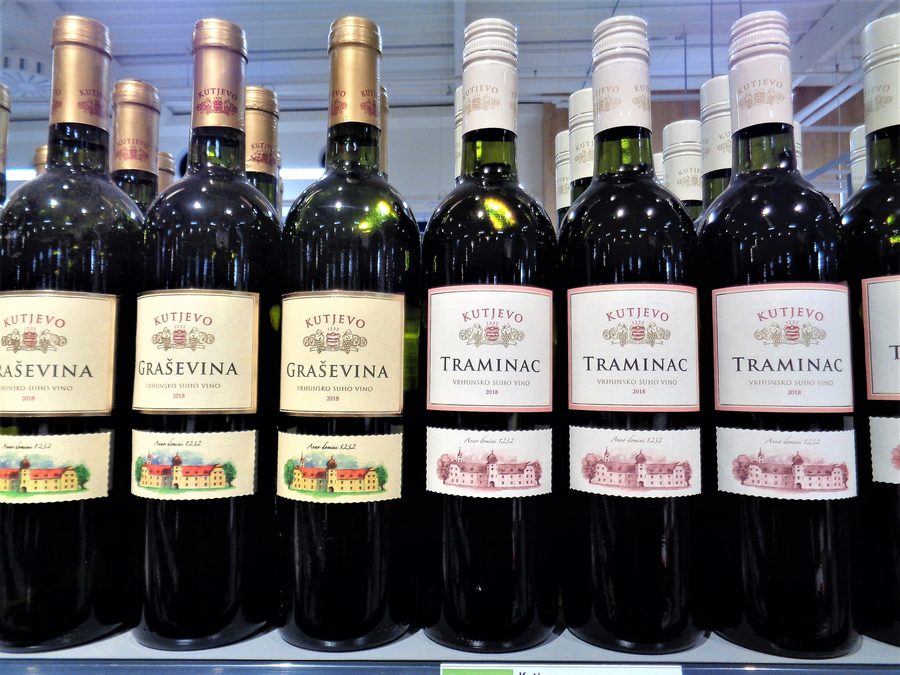 Graševina und Traminac als Beispiele regionaler Weinkultur
Photo: Silverije via Wikimedia Commons, CC BY-SA 4.0
Graševina und Traminac als Beispiele regionaler Weinkultur
Photo: Silverije via Wikimedia Commons, CC BY-SA 4.0
The church’s history can be traced through several dates: it was built as a chapel in 1765, extended in 1943, and has been a parish church since 1945. It was fully restored in 2000, giving it its present appearance. Thus, different stages come together in one building—from the original chapel through the extension to the restoration. For travel planning, this offers a different way to explore history from the archaeological sites, where settlement remains and burial grounds are the main focus.
Among the protected archaeological sites is Krčevina-Staro Selo in Čaglin. Remains of a settlement belonging to the Starčevo culture from the Early Neolithic have been preserved there. Krčevine-Brdo, also in Čaglin, represents other periods: the site preserves remains of settlements belonging to the Lasinja culture of the Middle Eneolithic, as well as the Licenska culture and Pannonian incrusted pottery from the Early Bronze Age. The two sites thus represent different cultures and periods; their names and historical associations can be distinguished when exploring the municipality’s early settlement history.
Further traces can be found in other places in the municipality. In Migalovci, the protected archaeological site of Vojvodine preserves the remains of a Late Bronze Age urnfield. At Velike livade in Ruševo, the remains of a Jewish cemetery are protected as cultural heritage. Ruševo is also home to Zalazine, listed in the municipality’s archaeological inventory as the remains of a medieval fortified town. These sites represent different historical themes: Bronze Age burial practices, Jewish cultural heritage, and a fortified medieval town.
Sacred buildings outside Čaglin also add to this picture. The Orthodox Church of the Great Martyr George in Latinovac is classified as immovable sacred cultural heritage. The Church of the Ascension of Jesus (Crkva Uzašašća Isusovog) in Ruševo and the Chapel of St Matthew (Kapela sv. Mateja) in Sovski Dol have the same classification. Together with the church in Čaglin, these examples showcase different church buildings and locations within the municipality. They offer ideas for travellers who would like to explore not only archaeological remains but also sacred cultural heritage.
For families and other culturally minded travellers, this offers a choice of themes and historical periods rather than a single attraction: you can focus on church history, explore traces of prehistoric settlements, or discover evidence from the Bronze Age and the Middle Ages. If you are looking for a holiday apartment in the Municipality of Čaglin, these interests can help you decide what to focus on during your trip. Places in the municipality to consider as you plan your visit also include Duboka and Čaglin.
For the broader travel overview: Požega-Slavonia County.
More destinations
More places in the same destination:

