
Hutki: Fortification Line and Local History
Accommodation in Hutki
Hutki brings together a history that spans several places and historic memorials in the village itself. A German fortification line from the Second World War began here; there are also historic roadside chapels and a commemorative plaque for Leon Kołodziejczyk. This offers two different perspectives: the military history of a line and the school and local history of Hutki. If you would like to understand how local history fits into a wider context, this contrast offers a concrete starting point.
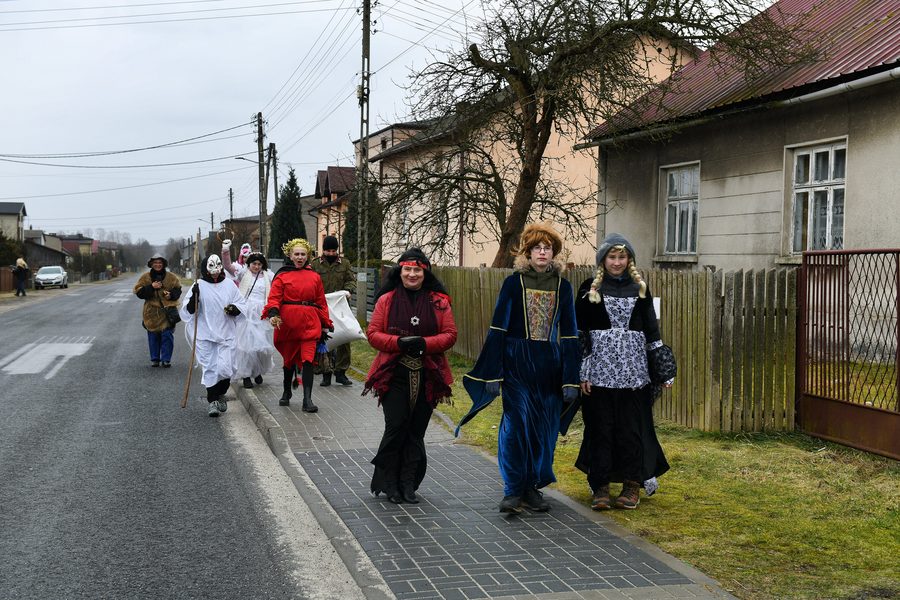 Pochód przebierańców w ostatki w Hutkach, zwyczaj ludowy kultywowany na ziemi częstochowskiej.
Photo: Robert Garstka / Regionalny Instytut Kultury w Katowicach via Source, CC BY 4.0
Hutki at the Start of a Fortification Line
The German fortification line ran from Hutki via Rększowice, Jamki and Aleksandria towards the village of Trzepizury. Hutki is therefore the starting point of the route described, which can be traced through the names of other places. This scale is important for orientation: the history of the line extends beyond Hutki, while the roadside chapels and commemorative plaque are local topics. The sequence of places gives the military-historical account a geographical framework without equating Hutki with the entire course of the line.
What the Line’s Plans Envisaged
The fortification line beginning at Hutki was intended to consist of trenches, communication trenches, barbed-wire entanglements and small concrete bunkers with firing positions. The terms describe different elements: trenches were intended for defence, while communication trenches were to connect individual sections. Barbed-wire entanglements supplemented the design as obstacles; the small concrete bunkers were planned with firing positions. The proposed concept can thus be understood as a combination of trenches, connections, obstacles and fixed positions—not simply as a list of similar structures. Anyone interested in military history can see from this how a fortification line was conceived as a coordinated plan. The elements listed describe what the line was intended to include.
School History and Roadside Chapels
Another way to explore Hutki’s past is through its primary school. Leon Kołodziejczyk was the first head of Hutki’s primary school from 1926 to 1939. A commemorative plaque to him as a lieutenant was unveiled at the Zespół Szkolno-Przedszkolny im. M. Kopernika. His former role in the local school system and his recognition as a lieutenant are thus presented side by side; the dates clearly establish his time as headteacher. Historic roadside chapels add religious architecture to these points of interest. These topics differ markedly from the fortification line spanning several places: here, the focus is on a figure from the history of education and on religiously influenced architecture in the village. If you are interested in different aspects of local history, this juxtaposition offers more than one historical perspective.
Getting There and Focusing Your Accommodation Search
A municipal notice dated 17 December 2025 lists bus route 169 for the 2026 timetable year. It connects Częstochowa Bus Station via Hutki and Starcza with Częstochowa Bus Station. Check the current timetable before travelling so you can take the information for your travel date into account.
When looking for a holiday apartment in Hutki, you can first consider which historical topic you would like to shape your stay. The roadside chapels and the school commemorative plaque relate to Hutki itself; the fortification line covers a route through several named places. This difference can help you identify your preferred focus: local history or a topic with a wider geographical scope. If you are travelling together, you can also discuss which of these perspectives would be of particular interest to your group.
Discover more destinations: Chorzenice, Łysiny, Skrajnica, Koniecpol, Nieznanice, Łabędź, Wyrazów, Rudniki
For the overview of the wider area: Częstochowa.

