
Czernichów: Vistula Route, Cycling Trails and Historic Buildings
Accommodation in Czernichów
Czernichów can be explored through two distinct features: the Vistula and a rich architectural and educational history. This creates a useful contrast when planning your holiday: on one side are the river route and cycling trails; on the other, the manor house complex, agricultural school and sacred buildings. If you are travelling as a family with different interests, you can first decide whether riverside activities or cultural history should be the main focus. This also helps you choose a holiday apartment to suit the kind of trip you want, without committing to a fixed itinerary.
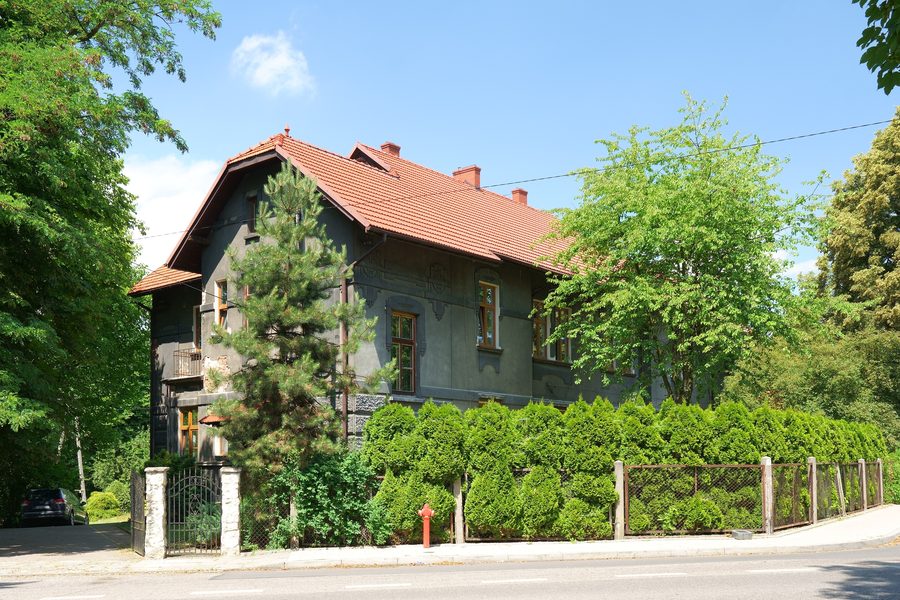 Der dokumentierte Gutshofkomplex in Czernichów bietet einen lokalen Bezug zur Ortsgeschichte.
Photo: Janusz Krzyżek via Wikimedia Commons, CC BY-SA 4.0
The Vistula and kayaking
The municipality of Czernichów organises an annual nationwide kayak trip along the Vistula from Czernichów to Kraków. For your travel plans, it is worth checking the dates of the kayak trip. The Upper Vistula Water Route also runs from the ferry on the Vistula in Czernichów to the landing stage of the Kolejowy Klub Wodny in Kraków.
Cycling and trails in the municipality
Experienced cyclists can complete the Blue Vistula Route in one hour without stopping. Most of it follows the top of the Vistula embankment, as well as asphalt and gravel paths. Touring or mountain bikes are recommended. The time estimate applies to experienced cyclists riding without a break; speed and trail conditions may affect it. For a family, therefore, one hour is not a general travel-time estimate for every group. Check trail conditions before setting out on a specific ride.
Beyond this individual route, around 120 kilometres of cycling, horse-riding and walking trails run through the municipality of Czernichów. In the Kajasówka nature reserve within the municipality, there is a 5.1-kilometre red circular trail around the reserve and its northern edge, as well as a 100-metre access path to Przegińska Cave. These details offer another perspective on trails in the municipality, separate from the Vistula Route.
Architectural and educational history
On the second stage of the Vistula Route, from Czernichów to Łączany, the agricultural school complex, the parish church and an octagonal chapel are listed as places of interest. The heritage-listed manor house complex by the agricultural school includes a manor house and a lamus (historic granary) from the 19th century, a teachers’ house, a power station, farm buildings, a perimeter fence with a gate, and a landscape park designed by Alojzy Różeczka.
The institution Zespół Szkół Rolnicze Centrum Kształcenia Ustawicznego is named after Franciszek Stefczyk and is Poland’s oldest continuously operating agricultural school. At the end of the 19th century, Galicia’s first savings and loan cooperative began operating in Czernichów at the initiative of schoolteacher Dr Franciszek Stefczyk.
The stone Chapel of the Holy Rosary of Saint Lawrence was built in the second half of the 17th century, funded by parish priest Wawrzyniec Kamerer, as a burial chapel for the Rosary Confraternity. The manor house, school, cooperative history and chapel each reveal a different aspect of Czernichów’s cultural history, from 19th-century architecture to the beginnings of the cooperative movement in Galicia.
Discover more destinations
Discover more destinations: Ojców, Krzeszowice, Trojanowice, Wlosan, Bolechowice, Kochanów, Chrosna, Niedźwiedź.
Return to the main travel overview: Kraków.

