
Kąkolewo: Architecture, Memorial Sites and History
Accommodation in Kąkolewo
Kąkolewo brings together church architecture, memorial sites and a palace dating from the late 19th century. At the church, Baroque-Classical design and late Gothic walls meet; plaques and monuments commemorate different groups and events. If you would like to discover culture and local history on your trip, the town offers several clearly distinct points of interest.
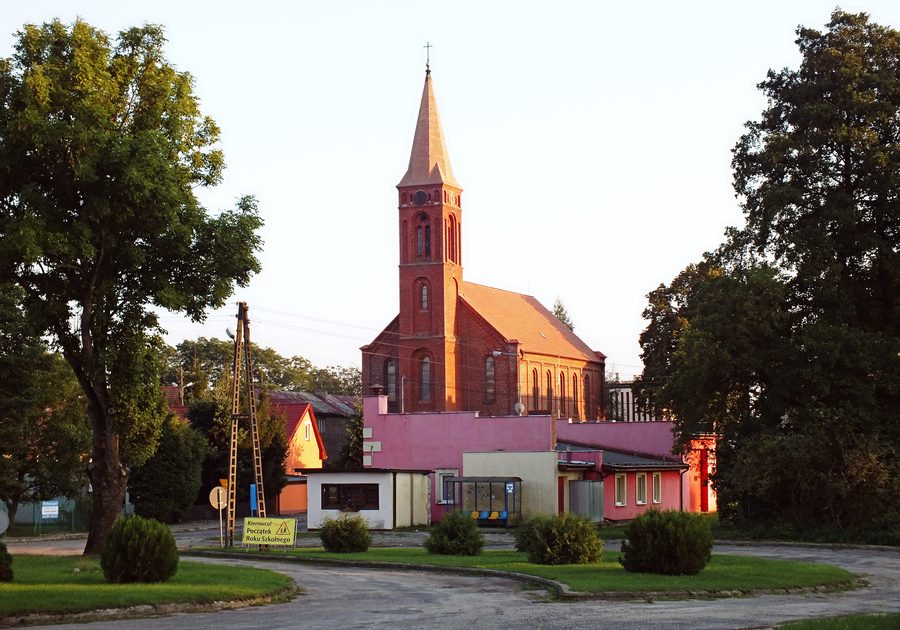
The Church and Palace as Historic Landmarks
The church in Kąkolewo is a Baroque-Classical building that incorporates late Gothic walls. This very juxtaposition makes its architecture interesting: sections of late Gothic wall have been preserved in a building shaped by Baroque-Classical design. The main altar also features a large painting of “Świętych Obcowania” from the 18th century. Alongside the architecture, attention is drawn to a large-scale work of art and its own historical period.
The palace in Kąkolewo was built by the Mielżyński family in the late 19th century. The church and palace offer different historical points of interest: one is a sacred building with late Gothic walls and Baroque-Classical design, the other a palace from the late 19th century. Those interested in architectural history can therefore explore Kąkolewo through more than a single building.
Memorial Sites with Different Points of Reference
Three plaques on the south wall of the parish church tower commemorate different groups. Two side plaques honor 53 fallen soldiers from the years 1914 to 1926. The central plaque above the entrance commemorates 13 parishioners who died in the 1919 and 1920 battles for Poland’s independence. There is also a monument beside the church honoring the Greater Poland insurgents from Kąkolewo.
Another memorial site is at the southern edge of the town on ul. Rydzyńska: a stone with a black plaque commemorates three residents who fell in 1919 in the fight for Poland’s independence. Unlike the plaques at the church, this memorial stone focuses on three residents and a specific year; the church commemorations name several groups and periods. The different memorials thus provide distinct, clearly identifiable points of reference in local history.
Cycle Route Planning and Choosing Where to Stay
An announcement from 2019 proposed two cycle route sections: Osieczna–Świerczyna–Ziemnice and Kąkolewo–Grodzisko–Świerczyna. A total of 10.7 kilometers was planned. This figure refers to the combined length of both sections, not the length of each one. If cycling affects your choice of where to stay, check the current status of this plan before including the sections in your daily itinerary.
For those looking for a holiday apartment, Kąkolewo offers a distinctly history-focused profile: church architecture, memorial culture and the palace built by the Mielżyński family. If you would like to make these themes the focus of your stay, you can consider the town as a base. If cycling is a decisive factor in your choice, take the planning status of the announced sections into account.
Discover More Destinations
Discover more destinations: Lipno, Wijewo, Charbielin, Osieczna, Rydzyna, Leszno, Lubonia, Junoszyno.
Return to the main travel overview: Lissa.

