
Römhild: Castle History, Museum and Ceramics Market
Accommodation in Römhild
Römhild brings together local history, collections and a ceramics tradition in specific places. Exhibitions at Glücksburg Castle tell the story of the castle and town; the cemetery church adds its own historical note with its late Renaissance furnishings. When looking for a holiday apartment, consider whether cultural attractions in town or trips to nearby destinations will shape your stay.
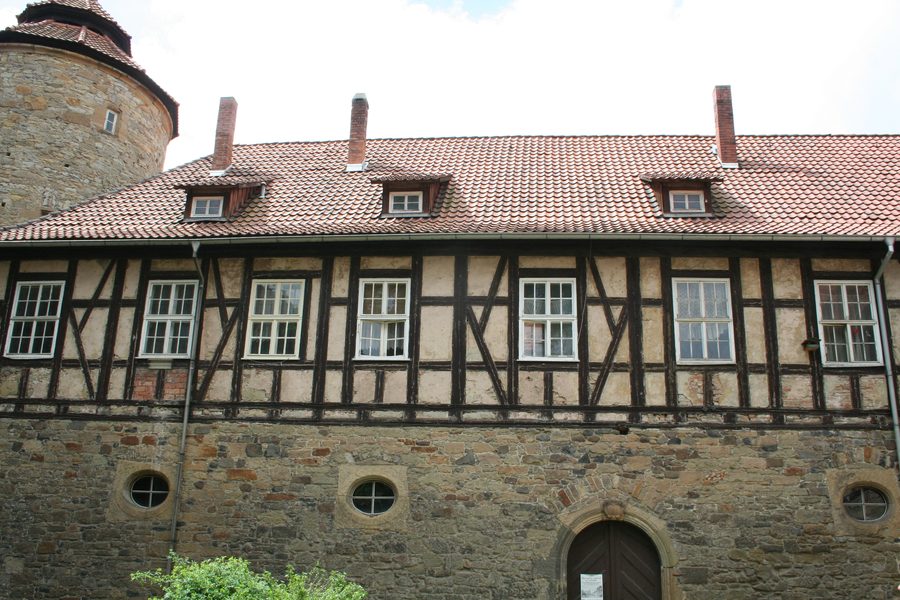
Glücksburg Castle: Local History and Collections
In the centre of Römhild, the permanent exhibition at Glücksburg Castle Museum presents the history of the castle and town, as well as notable local figures. A toy exhibition includes dollhouses, prams, toy shops and wooden toys from great-grandmother’s time. Alongside the history of the town and castle, visitors can also explore objects from everyday life in the past.
Among the notable collections is the special collection of the Greek Mavrogordato family. It includes artefacts from Roman and Greek antiquity, as well as artist and character dolls from the first half of the 20th century. The Hönn Collection explores the region’s crafts and agriculture: its tools illustrate the history of pottery in Römhild in particular. The themes thus range from ancient objects and dolls to the region’s history of work and craftsmanship.
Cemetery Church: Late Renaissance and Remembrance
Römhild’s cemetery church was built from 1708 to 1712 on the orders of Duke Heinrich. The master builder Christian Richter used mainly materials from the demolished pleasure palace “Merzelbach”. The church’s exterior is simple, while its interior is decorated in a restrained late Renaissance style.
Inside is an altarpiece painted by court painter Dupree, showing Duke Heinrich and his wife kneeling before the Crucified Christ. There are also wooden memorial plaques and inscribed grave slabs made of sandstone and cast material. The contrast between the understated exterior and the decorated interior gives a visit to the church its own architectural and historical focus.
Forest Lido and Routes in the Surrounding Area
Römhild Forest Lido is about 2 km from Römhild and opened in 1936. It can be reached on foot or by bicycle via numerous cycling and hiking trails. A visit can be combined with hikes to the Großer and Kleiner Gleichberg, Dingsleben or Gleichamberg. Cycling tours through the Grabfeld, the Gleichberge and the Heldburger Unterland are also among the options mentioned. Check the routes and connections locally before planning your tour.
Planning a Ceramics Market and Museum Visit
The annual programme at Glücksburg Castle Museum includes concerts, readings, talks, film screenings, special exhibitions and museum education activities; individual events vary. The Thuringian Ceramics Market in Römhild takes place every year on the third weekend in August in the courtyards of Glücksburg Castle. If you want to plan your stay around the market, check the event date in advance.
From 1 April to 31 October, the museum is open Tuesday to Thursday from 10 am to 12 noon and from 1 pm to 4 pm; last admission is at 3.30 pm. On Sundays, it is open from 1 pm to 5 pm, with last admission at 4.30 pm. During this season, the museum is closed on Mondays, Fridays and Saturdays. From 1 November to 31 March, visits are possible by appointment only. Check opening times before your visit.
More to Discover in the District of Hildburghausen
The district of Hildburghausen also offers a variety of nature and cultural attractions. The district includes an extensive, contiguous forest area in the Thuringian Forest Nature Park; it is also shaped, among other things, by the Vessertal Biosphere Reserve. In the Rodachaue pasture landscape, the roof of the observation platform offers panoramic views across the meadows. Konik horses and Heck cattle contribute to the development of a natural landscape there.
The Mill Hiking Trail in the municipality of Straufhain is about 7 km long. It passes through an area where nine grain and sawmills once operated; information boards at the former mill sites provide details about them. The German Castle Museum at Veste Heldburg offers a different perspective on cultural history: it presents the history and culture of castles in Europe from the Middle Ages to the present day. Its permanent exhibition is designed as a tour through the entire fortress and shows how castle construction changed from one era to the next.
Discover more destinations: Gießübel, Masserberg, Eisfeld, Erlau, Straufhain, Hildburghausen, Sankt Kilian, Fehrenbach.
For the higher-level travel overview: Hildburghausen-Suhl.

