
Discover Neudietendorf
Accommodation in Neudietendorf
Neudietendorf lies in the Apfelstädt Valley on the southern edge of the Thuringian Basin. In the village, the Weidbach, which comes from Sülzenbrücken, flows into the Apfelstädt; the Weidbach rises in Mühlberg. Neudietendorf is also the cultural and geographical center of the municipality of Nesse-Apfelstädt. To the southwest, you can see the Drei Gleichen, a group of castles that gives the area its name. The river courses, edge of the basin, and this view provide a clear geographical setting for the village.
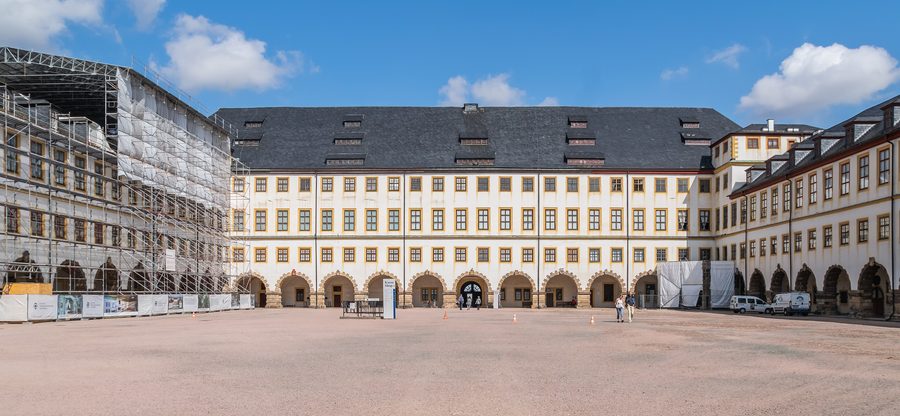 Friedenstein Castle in Gotha, a nearby destination accessible from Neudietendorf by direct train.
Photo: Krzysztof Golik via Wikimedia Commons, CC BY-SA 4.0
Friedenstein Castle in Gotha, a nearby destination accessible from Neudietendorf by direct train.
Photo: Krzysztof Golik via Wikimedia Commons, CC BY-SA 4.0
Orchard Meadow and Nature Experience
The “Kirchberg” orchard meadow is a distinctive natural area in Neudietendorf. It was established in 1724 and has been managed ever since. Numerous animal and plant species find a habitat there, including some that are highly endangered. For example, the local nature conservation group offers guided tours of the meadow for families and children. If you would like to plan a guided tour, arrange a date with the organizer. This place thus combines long-standing management with the diversity of species that find a habitat here.
An Event in October 2026
The 5th Neudietendorf Orchard Meadow Day is scheduled for Saturday, October 10, 2026, from 12 noon to 5 p.m. at Krügerpark, Bergstraße 9, in Neudietendorf. Before your visit, check whether the Orchard Meadow Day is taking place as scheduled.
History of the Bohemian Brethren
An important part of the village’s history begins in 1742: members of the “Bohemian Brethren” purchased an old manor with an adjoining settlement on the banks of the Apfelstädt from Count Gotter. Ten families settled there and wanted to live according to the Moravian model. The early community was disbanded several times because of disagreements with the Lutheran rulers. In Neudietendorf, choir houses were initially built for the unmarried brothers and sisters; the church hall and other buildings followed later. This sequence tells the story of a community, its daily life, and the buildings added at different times.
The dates associated with the church hall also give the village’s history a concrete timeline: its foundation stone was laid on April 6, 1779, and it was consecrated on December 2, 1780. This makes it possible to place the development of the buildings in context, from the first choir houses to this hall, which was consecrated later.
Churchyard and Living Tradition
The cemetery, also called the Gottesacker, has a simple design. The uniform horizontal gravestones bear only the deceased person’s name, their dates of birth and death, and a verse. The oldest grave in the Gottesacker dates from 1743. On Easter Sunday, the Easter liturgy is celebrated there at sunrise. The grave designs, inscriptions, and traditional Easter service show different aspects of local tradition, without telling the same kind of story: the stones record individual life dates and verses, while the service is linked to a recurring religious occasion.
When looking for a holiday apartment in Neudietendorf, you can start by considering what you would like to focus on during your stay: the orchard meadow, with its variety of species and guided tours, or the history of the Bohemian Brethren, their settlement, and the later buildings. This lets you choose where to stay based on the topics that interest you most.
Discover More Destinations
Discover more destinations: Seebergen, Emsetal, Hohenkirchen, Gierstädt, Apfelstädt, Laucha, Ohrdruf, Leinatal
Back to the main travel overview: Gotha.

