
Discover Bollendorf
Accommodation in Bollendorf
Bollendorf combines narrow paths through a distinctive rocky forest with buildings from different periods. The Grüne-Hölle-Tour leads through the Bollendorf rocky forest and past bizarre sandstone formations. There is also a Baroque-style castle, a Neoclassical parish church and the history of a Roman villa. You can plan your stay around whether you would most like to discover landscapes, architecture or traces of the past.
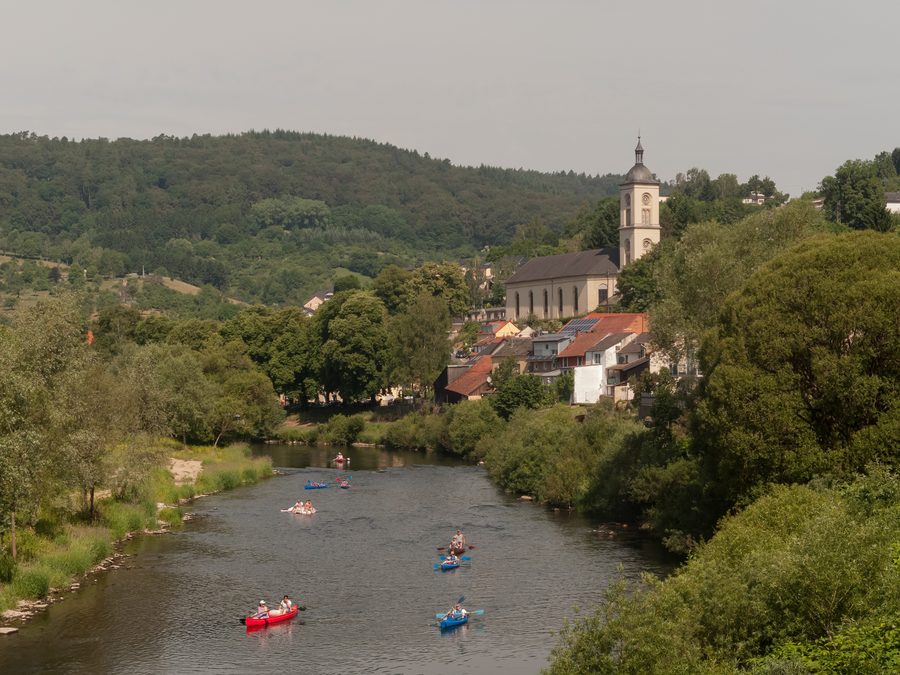 Bollendorf on the Sauer, with St. Michael parish church in the background.
Photo: Michielverbeek via Source, CC BY-SA 3.0 de
Bollendorf on the Sauer, with St. Michael parish church in the background.
Photo: Michielverbeek via Source, CC BY-SA 3.0 de
Rocky Forest and Hiking Experiences
Narrow paths are part of the experience on the Grüne-Hölle-Tour. The bizarre sandstone formations give the route through the forest its distinctive landscape. If you are considering Bollendorf for a hiking trip, you will find a specific nature-focused attraction here that differs from the town’s historic buildings. No information is provided here about the tour’s duration or difficulty, so plan these aspects according to your own requirements.
The Bollendorf Fairy-Tale Trail is described as a fairy-tale walk through the rocky forest. Alongside the Grüne-Hölle-Tour, it offers another nature-focused option to consider when planning your trip. The Bollendorf Audio Tour app offers the audio tours “Grüne Hölle” and “Manfreds Felsentour.” When choosing a tour, you can also consider whether you would prefer a fairy-tale walk or one of the available audio tours.
Castle, Church and Roman History
Bollendorf Castle acquired its present appearance in the Baroque period. In the 18th century, Abbot Gregorius Schouppe had the castle extensively remodeled. The enceinte wall and remains of the tower survive from the medieval predecessor. This complex is said to have been built on Roman remains. The reported reference to this earlier history remains a supposition; by contrast, the enceinte wall and tower remains are surviving parts of the medieval complex.
St. Michael’s Parish Church was built in 1838/39 to plans by Johann Georg Wolff, who was Trier’s municipal architect at the time. The Neoclassical hall church has an altar with columns and an attached tower. The church offers specific features of a Neoclassical building to discover, while Bollendorf Castle tells a different architectural story through its present Baroque appearance and the surviving parts of its predecessor.
The Roman Villa Bollendorf, also known as the “villa rustica,” offers another glimpse into the town’s past: it was inhabited from the 2nd century until the end of the 4th century. Remains of a floor-heating system, the hypocaust, are still visible at the villa. On the entrance side facing the valley, the building had a colonnaded hall between two corner towers. A bathing area was later added to the west. It included a hot room, the caldarium; a warm bath, the tepidarium; and a cold bath, the frigidarium. In 1997, a modern protective structure was built over the villa through the initiative of the Bollendorf branch of the Eifel Association.
Which Focus Suits Your Trip?
To decide whether Bollendorf is right for your holiday, you can weigh up the different experiences: forest paths and sandstone formations on the one hand, and architectural and Roman-history attractions on the other. If you are looking for a holiday apartment, choosing between these interests is a useful starting point for deciding whether the town matches your travel plans. You can also discover Holsthum and Ernzen for more places to visit.
For the broader travel overview: Irrel.

