
Rees: History, the Rhine and planetary trails
Accommodation in Rees
Rees lies right on the Rhine and combines a long history with ideas for spending time outdoors: you can explore the historic town fortifications and the museum, walk through the Lower Rhine landscape along a planetary trail, or experience the town from the water. When choosing your holiday apartment, it can also help to consider which aspects of Rees you want to shape your stay—history, activity or the Rhine.
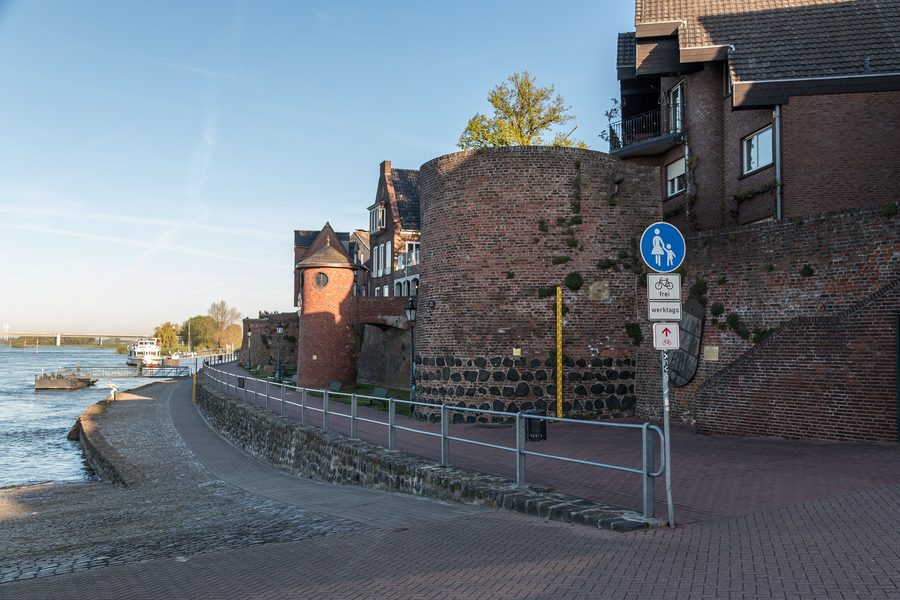 Rheinpromenade mit Pegelturm und altem Zollturm in Rees
Photo: Dietmar Rabich via Wikimedia Commons, CC BY-SA 4.0
Rheinpromenade mit Pegelturm und altem Zollturm in Rees
Photo: Dietmar Rabich via Wikimedia Commons, CC BY-SA 4.0
Town history between fortifications and the Hanseatic League
The historic town fortifications comprise six successive defensive systems, built by four European nations between the 12th and 18th centuries. Rather than a single phase of construction, they reflect a development spanning several centuries. If you are interested in the town’s history, you can combine this with a visit to the Städtisches Koenraad Bosman Museum, whose two main focuses are art and town history.
Beneath the museum building is also a casemate built around 1500 for lighter guns. It offers a concrete historic structure that adds to the picture of the town’s history. Rees was granted town status by the Archbishop of Cologne on 14 July 1228. In the 15th century, Hanseatic trade is documented, as is the designation of Rees as a Hanseatic town in an alliance with towns in the eastern Netherlands. The guided tour “In the Footsteps of the Oldest Town on the Lower Rhine” takes you through the historic town centre and provides a general introduction to Rees’s history, as well as information about its sights and monuments.
The Rees Sculpture Park offers another perspective: entry is free for visitors. Art, town history and historic buildings thus provide different starting points for a stay, without requiring you to focus your trip on just one theme.
The Planet Trail and cycling tours at your own pace
The planetary hiking trail in Rees depicts the solar system at a scale of 1:1 billion. The Planet Trail on the Lower Rhine combines a walk through the Lower Rhine landscape with information about the sun and planets. Alongside getting outdoors, the route offers an engaging way to learn about the solar system.
For a longer outing, there is the approximately 22 km Planet Route. It starts at the Sculpture Park in Rees and follows the first Planet Trail on the Lower Rhine to the dyke, then along the cycle path to Rees-Mehr. The approximate route length is a useful guide for planning your day; it does not indicate how long the tour will take. If you prefer a shorter or longer cycling tour, you can also choose from 19 signposted cycling routes in and around Rees. They range from 17 to 140 km and lead through the Rees municipal area, into the surrounding region and to neighbouring towns. The range of route lengths gives you a concrete comparison if distance is a key consideration in your planning.
Experience the Rhine from the riverbank and the water
From the Rees Rhine promenade, you can take the passenger ferry across to the other side of the Rhine. Alternatively, boat trips on the Rhine aboard the passenger vessels “Stadt Rees” and “Germania” depart from there. These offer different options: a crossing to the opposite bank or a trip along the river. If experiencing the Rhine is a priority for your trip, you can consider including these outings on the water in your plans.
When choosing a holiday apartment in Rees, you can use the focus of your stay as a guide: Would you mainly like to learn about the town’s history, explore its art and historic buildings, cover longer distances by bike, or spend time by the Rhine? Each of these experiences offers a different focus, so you can decide what you want to prioritise on your trip.
Discover more places
You can also discover these places: Kleve, Straelen, Kerken, Issum, Goch, Weeze, Wachtendonk and Uedem.
Back to the main travel overview: Kleve.

