
Rossin: Manor House and Village Church with a History
Accommodation in Rossin
Rossin’s architectural history is told through two distinct examples: the manor house represents clear Neoclassical style, while the village church reflects a history of construction and furnishings that has evolved over centuries. Outbuildings and surviving fragments of the park are also part of the historic manor estate. Those interested in architecture and local history will find a specific focus for planning their trip here.
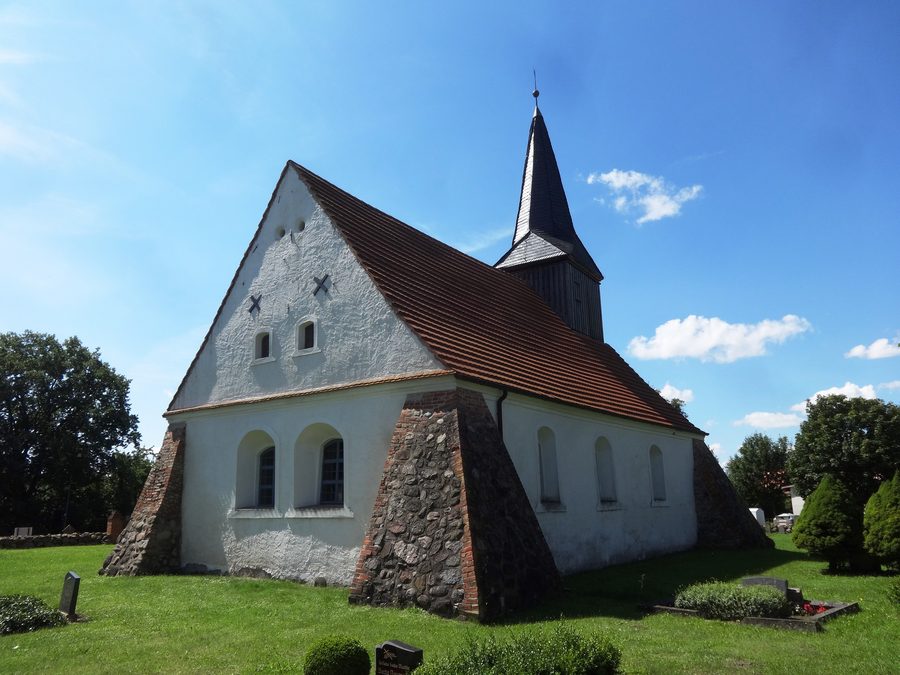 Die Kirche in Rossin im Landkreis Vorpommern-Greifswald.
Photo: Assenmacher via Wikimedia Commons, CC BY-SA 4.0
The Manor House: Neoclassical Clarity
Rossin Manor House was built in 1837 on behalf of the estate owner August Friedrich Theodor Kolbe. It is one of the few outstanding surviving buildings in the Anklam region in a purely Neoclassical style and clearly reflects the Berlin School of Schinkelian Neoclassicism. Its connection to architectural history can be seen in its design: the building is a well-proportioned, strictly symmetrical cube. Strong cornices, a regular rhythm and the consistent repetition of the windows define its appearance.
The symmetry and recurring forms give the building a clear structure. Cornices are projecting horizontal features; together with the rhythm of the windows, they make the austere design easy to understand, even without specialist knowledge. The manor house thus offers a distinct way into Rossin’s architectural history, focusing above all on proportion, repetition and the language of Neoclassical forms.
The Village Church and Its Long History
Rossin Village Church is a simple 15th-century fieldstone hall. Its present appearance was shaped by its reconstruction in 1678 after it was destroyed during the Thirty Years’ War. Its furnishings include a painted flat ceiling and a simple pulpit altar dating from 1771. A bronze bell dates from 1504; two ornate wooden epitaphs were restored in 2004 and 2006.
The organ also has its own restoration history: the organ by B. Grüneberg of Stettin was built in 1863 and reconstructed between 2006 and 2008. The church’s roof and masonry were also fully renovated between 1991 and 2004. The dates mark out different chapters, from the bell and the church building to later furnishings and the documented work on the building. Taken together, the historical span stretches from the medieval church to traces from the 19th century.
The Manor Estate, Park and Former Use
Rossin comprises a manor estate with the manor house, several outbuildings and a park. A 2018 landscape assessment highlights the estate’s very good state of historic preservation. Three massive stable granaries and a barn survive from the former manor complex. Fragments of the park belonging to the manor house remain; the family tombs of the von Köppern and Kolbe families are also located there.
Until it was sold again in 2010, the manor house was used for exhibitions and concerts. This former use adds another chapter to the house’s architectural history. Exploring Rossin is therefore about more than a single building: it also involves traces of a manor estate and its various historic features.
Rossin and the Wider Vorpommern-Greifswald Region
At the level of Vorpommern-Greifswald district, there are also other nature and cycling options. The three nature parks cover almost 40 percent of the district. Hiking, cycling and horse riding are among the activities available in the Ueckermünde Heath. These regional suggestions have a different focus from Rossin’s architectural and church history, and may be relevant when planning a broader holiday.
Several cycle routes also provide ways to explore the district: the Baltic Sea Cycle Route, part of the EuroVelo Route EV10, passes through Vorpommern-Greifswald. The Szczecin Lagoon Circular Route and the Route of North German Romanticism are regional cycling routes for exploring the district. When choosing a holiday apartment, it may therefore help to consider whether Rossin’s local history should be the main focus or whether you would rather plan around the wider regional range of nature and cycling options.
Discover more destinations: Stolpe an der Peene, Ducherow, Krusenfelde, Bugewitz, Neu Kosenow, Iven, Spantekow, Medow.
For the main travel overview: Amt Anklam-Land.

