
Northwest Mecklenburg: Hill Country, Radegast Valley and Brick Renaissance
Accommodation in Northwest Mecklenburg
Northwest Mecklenburg features varied landscapes and a distinctive architectural history. In the north, the district includes the “Northwest Mecklenburg Hill Country with Wismar Bay” landscape area; in the south, it encompasses the “West Mecklenburg Lake District with Lake Schwerin.” This provides a useful starting point: first consider the kind of landscape you would like to experience, then choose specific nature or cultural themes for your trip.
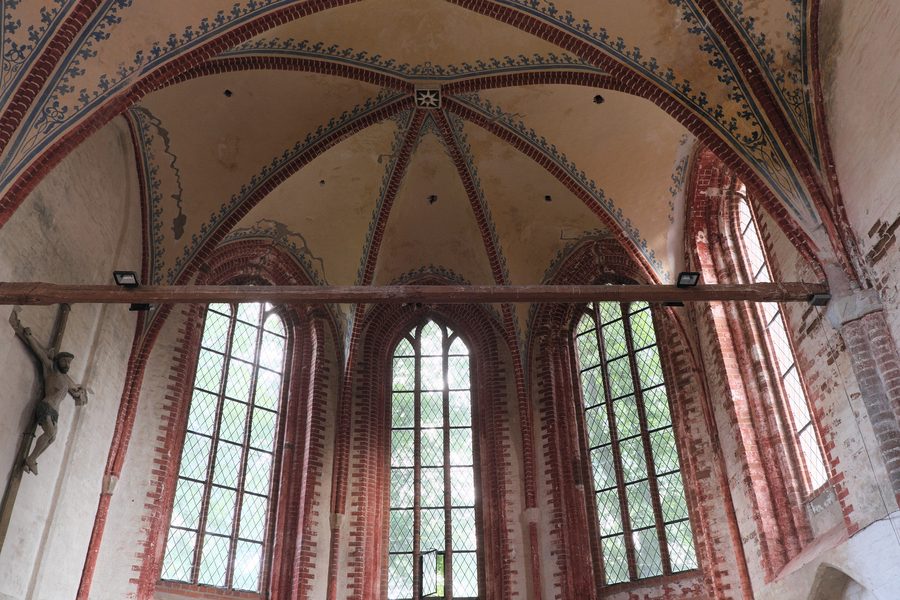 Die Dorfkirche in Kirchdorf auf der Insel Poel.
Photo: GFreihalter via Wikimedia Commons, CC BY-SA 4.0
Hill Country, Coastal Landforms and Lake District
Northwest Mecklenburg’s landscape is shaped by terminal moraine ridges, gently undulating ground moraine plateaus, steep and gently sloping coastal sections, meltwater and drainage channels, and outwash plains. These terms describe different landforms: ridges and gently rolling plateaus alternate with various stretches of coast and channels. Together, they describe a varied landscape rather than uniform terrain. If you are looking for a holiday apartment, you can start by considering whether the hill country and Wismar Bay or the lake district with Lake Schwerin better suit your travel interests. The northern and southern areas provide an initial guide, while the individual landforms make it more specific.
The Radegast Valley as a Distinct Landscape
The “Radegast Valley” conservation area covers approximately 600 hectares between the southern edge of Rehna and Neddersee near Gadebusch. It encompasses the Radegast’s strongly meandering, near-natural course and adjoining grassland, reed beds, wooded areas and wet woodlands. Alongside the broader landscape designations, this is a clearly defined valley featuring a river and a range of habitats. If you are especially interested in river landscapes and wetlands, the Radegast Valley offers a specific focus for planning your trip. Its extent between Rehna and Neddersee near Gadebusch also provides a concrete geographical reference to consider when choosing your destination area.
Renaissance and Reliefs in Gadebusch
Gadebusch Castle is a Renaissance castle dating from 1573, located in Gadebusch in the district of Northwest Mecklenburg. It is considered a rare example of Mecklenburg or North German Brick Renaissance; its features include reliefs in the regional Johann Albrecht style. This makes the castle a specific point of interest for anyone interested in architectural history. Alongside the district’s landscape profile, the focus here is on a named building from a particular period with a distinctive style.
How It Fits into the Wider Destination of Mecklenburg-Western Pomerania
Across the wider destination of Mecklenburg-Western Pomerania, the historic centres of Wismar and Stralsund represent the Hanseatic trading history and the development of Brick Gothic architecture in the Baltic region. Wismar has also preserved its medieval harbour basin. These themes add a broader regional cultural context to a visit to Northwest Mecklenburg. By contrast, Gadebusch Castle offers a Renaissance focus, with reliefs in the Johann Albrecht style. This makes it easy to distinguish between the different architectural and historical themes: Renaissance in Gadebusch, and Hanseatic history and Brick Gothic architecture in the wider travel region of Mecklenburg-Western Pomerania.
Choosing a Focus: Landscapes or Architectural History
If you are looking for a holiday apartment in Northwest Mecklenburg, first decide which theme you would like to shape your trip most: the landscape areas, the Radegast Valley or Gadebusch Castle. This priority can help narrow down the areas you search, while keeping your nature and cultural interests distinct. If you also consider Wismar or Stralsund, you can explore their regional Hanseatic and Brick Gothic themes separately from Northwest Mecklenburg’s specific landscape and architectural history themes.
Discover More Destinations
Discover more destinations: Hundorf, Klein Labenz, Kirchdorf, Hohen Wieschendorf, Beckerwitz, Hohen Schönberg, Gressow, Wedendorf, Groß Strömkendorf, Groß Schwansee, Demern, Poel Island, Gramkow, Wohlenberg, Barendorf, Dassow-Tankenhagen, Welzin, Robertsdorf, Frauenmark, Teschow, Dorf Mecklenburg-Bad Kleinen Administrative District, Gadebusch Administrative District, Grevesmühlen-Land Administrative District, Klützer Winkel Administrative District, Neuburg Administrative District, Neukloster-Warin Administrative District, Rehna Administrative District, Schönberger Land Administrative District, Lützow-Lübstorf Administrative District.
Return to the wider travel overview: Mecklenburg-Western Pomerania.

