
Zingst: Baltic Sea, Culture and Discovery
Accommodation in Zingst
Zingst combines experiences on the Baltic Sea with culture and discoveries to suit a range of interests. The beach is all about swimming and water sports, while museums, a neo-Gothic church and an experimentarium offer other sides of the town. When looking for a holiday apartment, you can consider which of these experiences you would like to shape your days.
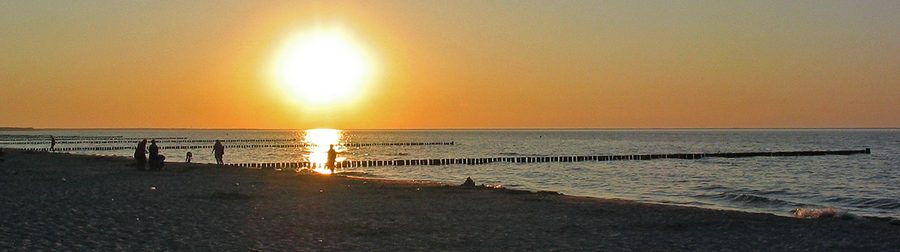 Buhnen am Ostseestrand bei Zingst.
Photo: Darkone ( talk · contribs ) via Wikimedia Commons, CC BY-SA 2.5
Buhnen am Ostseestrand bei Zingst.
Photo: Darkone ( talk · contribs ) via Wikimedia Commons, CC BY-SA 2.5
Beach, Pier and the Baltic Sea
Zingst has a sandy beach without stones, up to 30 metres wide. During the summer months, it is patrolled by lifeguards. Visitors can swim, paddle, kitesurf, surf, sail and kayak in the Baltic Sea. The options range from relaxing by the water to active pursuits on the Baltic Sea.
The present-day Zingst Pier was inaugurated in May 1993. It is 270 metres long and 2.50 metres wide, and invites visitors to take a stroll in every season. A diving gondola has been located at the end of the pier since 2013. It can accommodate up to 30 people, who can use it to explore the underwater world of the Baltic Sea. A walk along the pier and a view beneath the surface are two different ways to experience the sea.
Water Sports and Outdoor Activities
At the sports beach by beach access 14, visitors can windsurf and kitesurf, or watch the sunset from a stand-up paddleboard. The Zingst Water Sports Centre offers courses in a wide range of water sports and also rents out the necessary equipment. Those wishing to include these activities in their holiday will find both beach activities and opportunities to try out different water sports in Zingst.
Another outing leads to the Sundische Wiese National Park Exhibition. From Zingst, it can be reached by bicycle or on foot via the sea dike and Osterwald; the road heading east also leads there. There are several ways to make the journey.
History to Explore and Experience
The Zingst Local History Museum is housed in a former captain’s house dating from the 19th century and presents the history of the Zingst peninsula. The museum includes a historic farmstead with several restored buildings. Period-accurate furniture and objects offer insights into rural life in past centuries. Those interested in everyday history can explore the captain’s house as well as the furnishings and buildings of the museum farmstead.
At the Zingst Experimentarium, children and adults can explore science and technology at more than 70 interactive stations. The varied workshop programme also offers the chance to create original works of art. The visit combines hands-on experimentation with creative activities, complementing the historical insights with a practical experience.
Church and Cultural Events
The neo-Gothic St Peter and Paul Church was built to designs by Friedrich August Stüler, a student of Karl Friedrich Schinkel, and consecrated in 1862. A series of evening concerts takes place there each summer. Architectural history and musical events add distinct cultural touches to Zingst.
The Max Hünten House regularly hosts exhibition openings and multimedia shows. Readings and other cultural events are held there throughout the year. The history of Zingsthof is also part of the town’s story: built in 1929, it became an important centre for the activities and gatherings of members of the Confessing Church during the Nazi era. The Seamen’s Grave in the cemetery commemorates Zingst’s maritime tradition and honours the sailors who lost their lives in the Baltic Sea.
More Destinations
Discover: Amt Barth, Amt West-Rügen, Amt Miltzow, Süderholz, Binz, Amt Recknitz-Trebeltal, Marlow, Amt Ribnitz-Damgarten.
Return to the main travel overview: Vorpommern-Rügen.

