
Briggow: Green Village, Church and Manor House
Accommodation in Briggow
Briggow is a green village with a neo-Gothic brick church and a Neoclassical manor house. The village green, distinctive buildings and Huzzlepurzle-Berg motte provide several starting points for a glimpse into the village’s history. The motte lies on the western edge of the former manor estate; a footbridge leads across the moat to it. As access conditions may change, check accessibility before visiting.
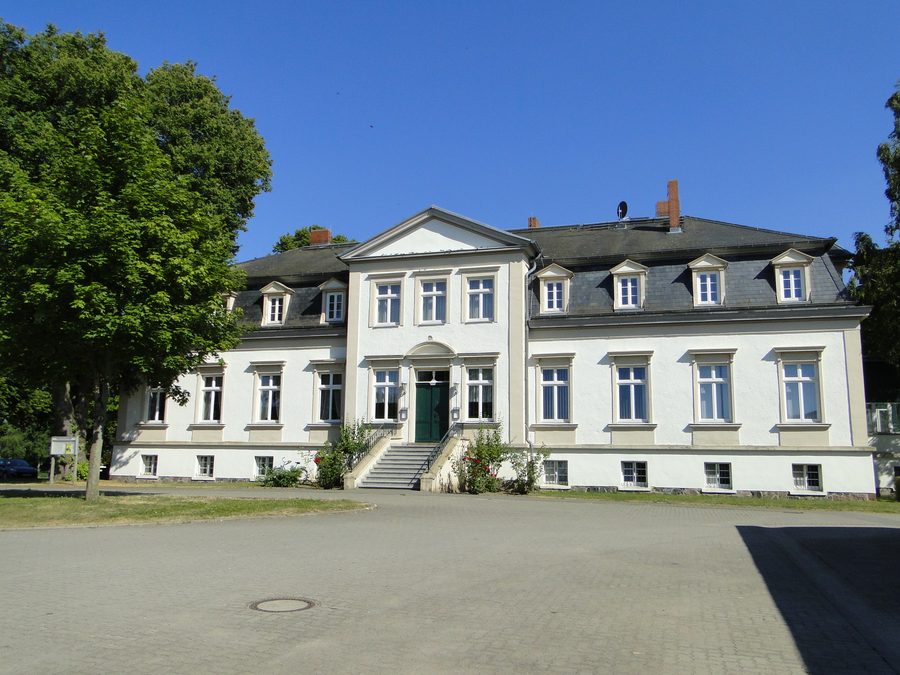 Das Gutshaus gehört zu den markanten lokalen Bezugspunkten Briggows.
Photo: Niteshift ( talk ) via Wikimedia Commons, CC BY-SA 3.0
Church, Manor House and Earlier History
The brick church was built in 1866 on the foundations of an older church. Karl Alexander von Oertzen had it constructed to plans by government building officer Friedrich Wilhelm Buttel. Its neo-Gothic design provides a contrast to the Neoclassical manor house and makes the village’s architectural history tangible through two distinctive buildings.
The manor house acquired its present form around 1880. The listed manor estate includes the manor house at numbers 44/46, remnants of the park and a stable at number 52. A few old trees stand beside the manor house and may have belonged to the former park. A small castle was probably destroyed by the Thirty Years’ War at the latest and replaced by a manor house; this sequence remains a historical interpretation.
Public and private events are held in the former Briggow manor house. If you would like to include an event in your travel plans, check the event dates in advance.
Village layouts in the associated municipality
Sülten is one of the three districts of the associated municipality. The village is described as a typical street-green village with three-sided farmsteads and has a neo-Gothic village church. Sülten-Hof, the former manor village, is characterised by new settlers’ farmsteads and a nine-bay rendered building with a half-hipped roof. Comparing it with Briggow reveals different village layouts and architectural forms: here, a green village with a Neoclassical manor house; there, a street-green village with three-sided farmsteads and the buildings of the former manor village. This offers a chance to discover several facets of rural architecture within the associated municipality.
Nature experiences in the Mecklenburg Lake District
For a wider-ranging trip, the Mecklenburg Lake District offers its own natural attractions. Müritz National Park is characterised by forests, moors, lakes and vast meadows. Its hiking trail explores the landscape in nine stages: it runs along lakes, through ancient forests, past inland dunes and to the source of the Havel. Certified nature and landscape guides offer informative tours there, including guided visits to the UNESCO World Heritage beech forest in Serrahn and tours from the water.
The Damerower Werder bison reserve offers a different nature experience. It lies on a peninsula in Lake Kölpin, in the Mecklenburg Lake District and the Nossentiner/Schwinzer Heath Nature Park; visitors can observe bison there. The reserve also has a forest discovery trail with climbing opportunities, an ant house, an exhibition with tactile and visual panels, and a dendrophone. In the Mecklenburg Lake District, therefore, hiking in stages and guided tours in Müritz National Park sit alongside wildlife watching and nature exploration at the bison reserve as different travel interests.
Discover more destinations
Discover more destinations: Stavenhagen, Kittendorf, Zettemin, Knorrendorf, Mölln, Rosenow, Gülzow and Bredenfelde.
Go to the main travel overview: Amt Stavenhagen.

