
Faulenrost: Castle History and the Ostpeene
Accommodation in Faulenrost
Faulenrost combines a Baroque estate history with a special connection to the Ostpeene: the grounds of the “Zum Fischer Fritz” restaurant are divided by the gently flowing river and connected by a wooden bridge. Rittermannshagen, with its Early Gothic village church, is also part of the municipality of Faulenrost. For orientation: the municipality lies about 10 km south of Malchin and is easy to reach via the country road between Malchin and Waren.
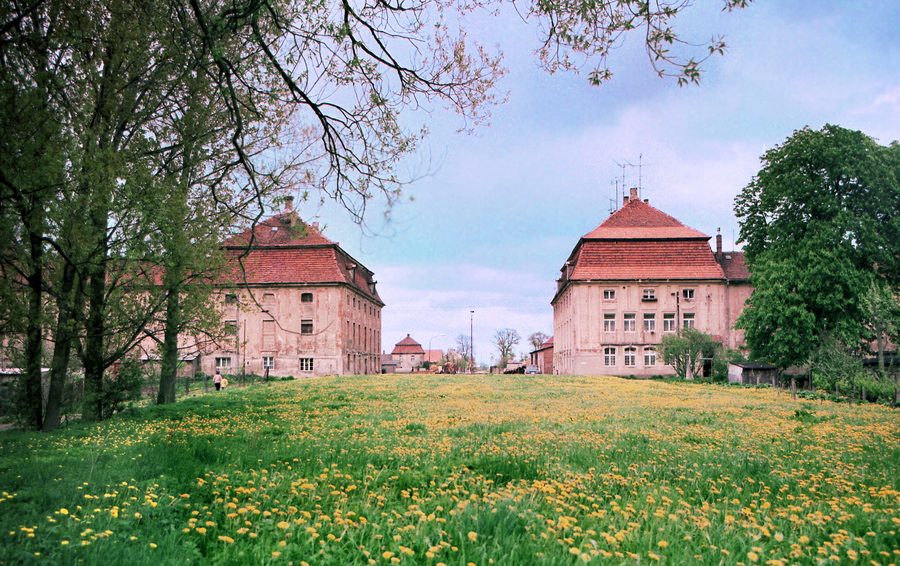 Reste der einstigen Schlossanlage von Faulenrost
Photo: Jörg Blobelt via Wikimedia Commons, CC BY-SA 4.0
Castle Complex and Estate
The Baroque castle complex in Faulenrost was built in the mid-18th century. The manor house, also known as Faulenrost Castle, was constructed as a summer residence around 1760–1764; the main building was flanked by cavalier houses. The estate complex includes two surviving cavalier houses, two gatehouses, a stable and a barn. The historic buildings give the place a clearly recognisable architectural theme without limiting everything to the manor house.
The history of the landscape is also part of the story: the former English landscape park of the manor house contains remains of a fortification built by the lower nobility in the 13th or 14th century. Different periods thus meet here—the Baroque summer residence and older fortification remains. Those interested in architectural history will find further points of interest beyond the castle that shape the way they see the estate grounds.
Rittermannshagen Village Church
In Rittermannshagen, a village within the municipality of Faulenrost, an Early Gothic brick village church stands on a dressed granite plinth. The choir’s roof structure is dated to 1299. The church’s history also includes the Börger organ: it dates from 1902 and was restored in 2004. The date of the roof structure and the more recent history of the organ offer different starting points for exploring the church and its architectural and furnishing history.
The church key is available from the rectory in Rittermannshagen, at Dorfstraße 27. The phone number 0399512268 is listed; check before visiting whether it is currently possible to collect the key there.
The Ostpeene and the History of Fishing
The “Zum Fischer Fritz” restaurant was founded in 1935 by master fisherman Fritz Schliemann and his wife Henny. Fishing equipment shapes the ambience, including two brick smokehouses and a 100-year-old coal stove. The restaurant’s history is rooted in the village, and its visible features reflect its connection to fishing. On special occasions, smoked fish is brought straight from the oven to the table. If you would like to plan for this, check with the restaurant in advance to confirm availability.
The Ostpeene divides the restaurant grounds, and a wooden bridge connects the two sides. This sets it apart from the history of the castle and church: here, the riverside setting is connected to the restaurant’s fishing heritage.
Traditions and Events
Faulenrost has an open-air stage as a cultural venue. Events that have become traditions include the Fischerfest (Fishermen’s Festival), the May Festival and the Harvest Festival. If you would like to plan your stay around one of these festivals, check the dates in advance. Event dates require separate planning alongside enduring features such as the castle complex, village church and Ostpeene.
The Mecklenburg Lake District as a Wider Travel Destination
The Mecklenburg Lake District also offers its own natural and scenic highlights. Müritz National Park is part of the Mecklenburg Lake District and is characterised by forests, bogs, lakes and wide meadows. The Müritz National Park hiking trail explores this landscape in nine stages: it runs along lakes, through ancient forests, past inland dunes and to the source of the Havel. This offers another perspective on the Mecklenburg Lake District; these landscape features describe the national park, not Faulenrost.
If you are looking for a holiday apartment in Faulenrost, you can base your choice of location on the themes you would like to focus on: estate history and architecture, the village church in Rittermannshagen, or the riverside setting and fishing heritage. A planned festival visit may also influence your travel dates.
Discover more destinations
Discover more destinations: Neukalen, Malchin, Kummerow, Gielow, Basedow, Duckow, Gorschendorf.
Return to the main travel guide: Amt Malchin am Kummerower See.

