
Ahnsen between Harrl and Bückeberge
Accommodation in Ahnsen
Ahnsen is in the Schaumburg region, between the Harrl and Bückeberge ranges. Its layered local history adds to the landscape: the mill, forge, timber-framed farmstead and archaeological finds represent different periods and ways of working. When choosing a holiday apartment, you can therefore decide whether to focus your stay primarily on the setting or on the town’s historical themes.
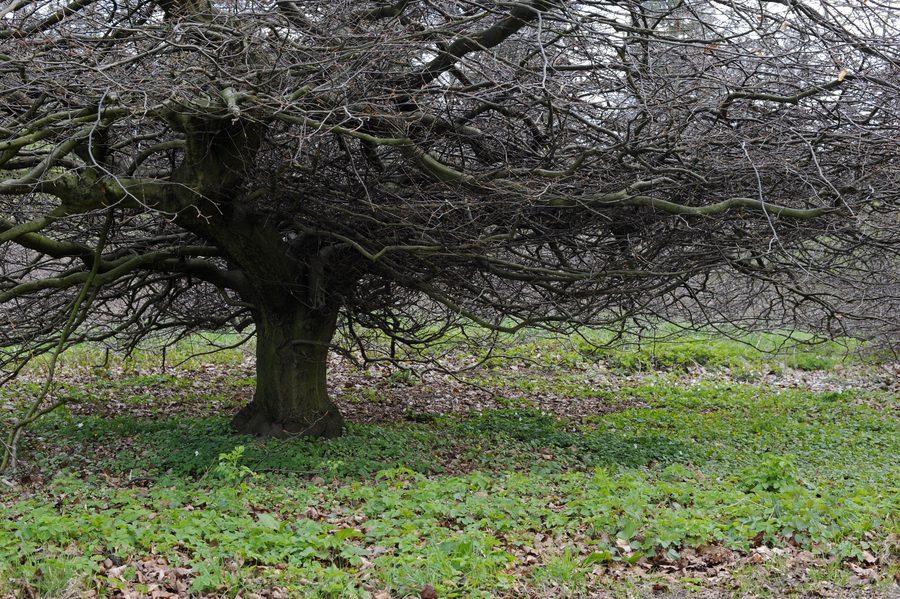 Süntelbuche im Dachtelfeld im Naturpark Weserbergland Schaumburg-Hameln.
Photo: Sünte-Loh via Source, CC BY-SA 4.0
Getting here and finding your way
Federal highways 83 and 65 run north and south of the municipality, connecting Ahnsen to the road network. The nearest access point to the A2 motorway is at Bad Eilsen, about 6 km from Ahnsen. The motorway runs in the direction of Hanover–Dortmund. The approximate distance provides a first indication for travel by car, but does not indicate how long the journey will take.
Distinguishing between local and regional orientation can also help when choosing a holiday destination: the federal highways and motorway access mentioned above relate to Ahnsen. Train and boat connections are part of the regional overview of Schaumburg district.
Landscape and local history
The location between Harrl and Bückeberge gives Ahnsen a distinct landscape setting. At the same time, its historic buildings and archaeological finds are worth exploring if you are interested in how crafts, farming and life in the area have changed over time. The examples differ considerably: a mill complex, a former forge and a listed farmstead each tell their own story of local history.
Schönbier Watermill is in the southeastern part of the village and forms part of a listed group of buildings. The complex comprises a mill building set with its eaves facing the road, a sawmill with a horizontal frame saw to the east, and a turbine house above the water channel. The turbine house connects the two brick buildings. This description illustrates the different functions of the complex: the mill, sawmill and turbine house belong together but remain clearly distinct parts.
The mill also has a long history. Records of the Hofkammer from 1620 identify it as the New Mill; it may have existed even earlier. Both its recorded name and its long documented history are therefore of interest when considering the complex.
The listed farmstead at Vehler Straße 20 stands on the northern edge of the village. Its main house was built using the four-post construction method, and an inscription dates it to 1851. The farmstead also includes a large timber-framed barn from 1903, with its gable facing Vehler Straße. At the eastern edge of the farmyard is a timber-framed storage building bearing an inscription from 1733. The three dates show that different construction phases are documented within the same farmstead.
The historic Ahnsen forge represents another aspect of local craftsmanship: the workshop was once used to shoe horses and repair wagons and agricultural machinery. Archaeological evidence dates back even further. Tools and stone axes from the early Neolithic period have been found at three different sites in the Neumühlen part of the village. Together, the forge and the finds offer two very different insights into Ahnsen’s history: the work of a workshop and early human use of the area.
Schaumburg in a wider context
For a regional perspective, it is useful to distinguish Ahnsen from the other landscapes in Schaumburg district. In the northeast, the district borders Lake Steinhude near Hagenburg; in the south, the Weser and Weser Uplands shape the landscape. The highest elevation in the district, at 378 m above sea level, is in Goldbeck, a locality within the town of Rinteln.
The region also offers a variety of routes and themes. The Weser Renaissance Route is a guide for those interested in art and history. At the Liekwegen Old Quarry, visitors can learn about the importance of the quarry habitat and its biodiversity at five current information stations along two circular trails, 1.7 km and 2.3 km long. When choosing a holiday destination, you can therefore decide between Ahnsen’s local history and other cultural or natural attractions in the district. For the district as a whole, the regional overview includes travel by car, train and boat via the Mittelland Canal; an important east–west railway line crosses the district, with stations in Stadthagen and Bückeburg and smaller stops in Lindhorst and Kirchhorsten.
Discover more destinations: Luhden.
Go to the overview of destinations: Bad Eilsen.

