
Seevetal Between Nature and History
Accommodation in Seevetal
Seevetal brings together landscapes between the Seeve and the Elbe, historic circular routes and unusual cultural sites. The Lower Seeve Lowlands, the checkered lily and paths through several districts offer a different experience from the windmill in Hittfeld or the mill complex in Karoxbostel. For your stay, you can decide whether to focus on nature, local history or a mix of both.
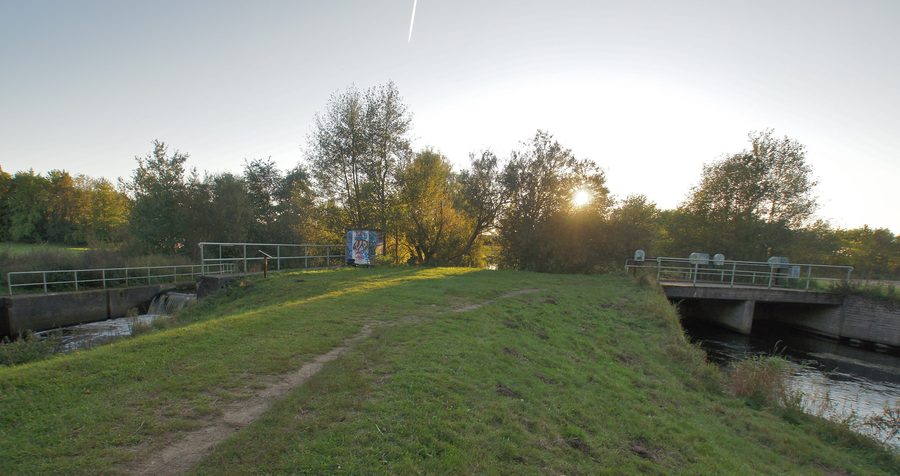 Seeve und Seevekanal bei Maschen in der Gemeinde Seevetal
Photo: flamenc via Wikimedia Commons, CC BY-SA 3.0
Seeve und Seevekanal bei Maschen in der Gemeinde Seevetal
Photo: flamenc via Wikimedia Commons, CC BY-SA 3.0
Landscape and checkered lilies in the Seeve Lowlands
The Lower Seeve Lowlands are a distinctive part of the Elbe marshes. The soil varies across the area: clay soils are found in the north, and closer to the Elbe they are also mixed with sand. In the southern part, farther from the Elbe, extensive areas of lowland peat have formed. These differences give the landscape its own character and make the lowlands a destination for anyone wishing to take a closer look at nature and the landscape during their trip.
One distinctive plant of the lowlands is the checkered lily, also known as the snake’s head fritillary or meadow tulip. During its flowering season, from late April to May, it can be seen in great numbers and over a wide area in Junkernfeld and in the meadows extending from there towards Stelle. If seeing the flowers is important to your trip, this period provides a specific seasonal guide for planning.
The Steller See also offers a special view of nature: an observation shelter stands on the western shore, providing a view over most of the lake without being seen yourself. The Lower Seeve Lowlands are easy to reach by train via Maschen station. This is a practical consideration if you would like to combine your stay with an excursion to the lowlands.
Circular routes with different stories
The Hallonen Circular Route passes through Maschen, Horst and Hörsten and can be explored on foot or by bicycle. Along the way, you’ll find historic sites, old farms and monuments, as well as rare natural features. This combination makes the route appealing if you’d like to include both local history and nature observation on the same outing.
In Hittfeld, the Bahnhof Circular Route focuses on cultural history and is suitable for walking and cycling. The Hittfeld Village Circular Route offers a different historical perspective: 26 information boards explain what Hittfeld used to look like, and the route explores the village’s development. In Ramelsloh, the Ansgar Circular Route passes ten stops and provides examples of how Ramelsloh has changed over time. The routes therefore differ mainly in their approach to local history: one focuses on the area around the railway station, another on the village’s former appearance, and another on Ramelsloh’s transformation.
Mills, art and a landmark structure
The listed Hittfeld windmill dates from 1875 and is a landmark of Hittfeld. In the municipality of Seevetal, the Karoxbostel Watermill Monument Ensemble also tells the story of different building phases: the thatched main house was built in 1817 as a four-post timber-frame building. In 1893, millwright Pätzmann from Winsen added the three-storey mill building; the sawmill was completed in 1900.
Art enthusiasts will find a sculpture park in Seevetal-Ramelsloh, where only kinetic works are exhibited. Maschen offers a different, large-scale impression: south of Hamburg, on the Hanover–Hamburg railway line, lies Europe’s largest marshalling yard. Mills, art and railway infrastructure offer different reasons to explore Seevetal beyond its landscapes.
Choose the right base for your holiday
Other places: Neu Wulmstorf, Sottorf, Winsen An Der Luhe, Rosengarten, Wenzendorf, Garlstorf, Hittfeld, Brackel.
For the broader travel overview: Harburg.

