
Discover Braunschweig: History, culture and the Oker
Accommodation in Braunschweig
Braunschweig brings together important medieval buildings and works of art, museums, a natural pond landscape and experiences on the Oker. You can therefore shape your stay in a variety of ways: around the city’s history, art and exhibitions, life in its neighbourhoods or a trip on the water. When looking for a holiday apartment, it helps to first consider which of these aspects of Braunschweig you would most like to explore.
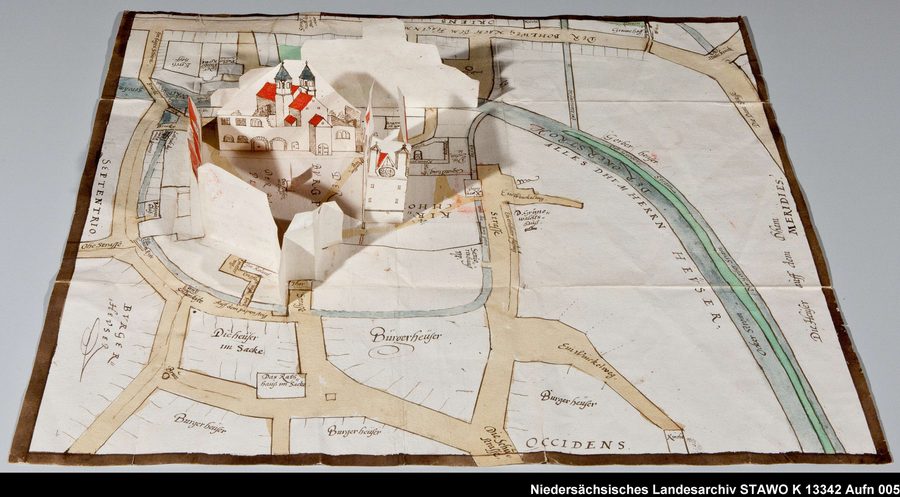 Historische Darstellung des Burgplatzes mit dem Dom in Braunschweig.
Photo: Johannes Krabbe zugeschrieben via Source, CC0
Historische Darstellung des Burgplatzes mit dem Dom in Braunschweig.
Photo: Johannes Krabbe zugeschrieben via Source, CC0
City history around the cathedral and Burgplatz
Henry the Lion had St. Blasius’ Cathedral built between 1173 and 1195 as a three-aisled vaulted basilica. Inside, you will find works and artefacts from different periods of the Middle Ages, including the 1188 Marian altar, a seven-branched candelabrum dating from around 1170/80 and the Imervard Cross from the second half of the 12th century. Wall paintings and the tomb of Henry the Lion and Matilda complete the interior. Anyone interested in medieval art and the history of rulership will find several specific points of interest here to explore at leisure.
Dankwarderode Castle also tells the story of Henry the Lion, though its construction history is later. It was built between around 1160 and 1175 as his palace, replacing a Brunonian complex. From 1885 to 1906, city architect Ludwig Winter had it rebuilt as a Neo-Romanesque structure in the spirit of Historicism. Burgplatz is considered the heart of Braunschweig. The cathedral and castle thus represent different historical layers: the cathedral’s medieval furnishings and the castle’s later form offer distinct ways to explore the city’s history.
Art, collections and stories of Braunschweig
The Herzog Anton Ulrich Museum has a collection history spanning more than 300 years. It displays paintings, applied arts and sculptures; in total, around 4,000 works of art spanning 3,000 years of art history are shown across 4,000 m² of exhibition space. This wide timespan and range of art forms give you several possible focuses for your museum visit. If you would rather connect art with the history of the city and everyday life, the Städtisches Museum Braunschweig is dedicated to the history of the city and its residents. Founded in 1861, it displays more than 270,000 exhibits across two buildings.
The Museum Hinter Aegidien offers another perspective. It houses the permanent exhibition “A Part of Us. German-Jewish Stories from Lower Saxony,” which has been open to visitors since 9 December 2021. This lets you add a cultural focus to your travel plans that includes German-Jewish stories from Lower Saxony alongside architecture and collections.
Neighbourhoods, water and nature
The Magniviertel is one of Braunschweig’s oldest surviving neighbourhoods. Its half-timbered houses are home to small shops and cafés. The neighbourhood offers a different kind of city experience from the major collections or architectural history: as you explore, you can focus on the half-timbered buildings and the small shops and cafés. Burgplatz, meanwhile, is considered the heart of the city. The two places offer different points of interest if you want to get to know Braunschweig beyond its museums.
The Oker offers a perspective from the water. Visitors can explore Braunschweig by raft, canoe or stand-up paddleboard. From May to October, raft trips are available, including barbecue trips and guided city tours on the water. There are several ways to explore: you can go out on your own in a canoe or on a board, or choose a raft trip. The Braunschweig State Theatre’s Burgplatz Open Air offers a different kind of experience: open-air music theatre with an annual programme that alternates between classical opera and modern musicals.
If you would like to explore a natural landscape as well as the city, you can visit the Riddagshausen Nature Reserve. It is the largest nature reserve in the city of Braunschweig. The natural pond landscape lies in the east of the city, between Riddagshausen, Gliesmarode, Schapen and Weddel. This means urban cultural attractions and a landscape of ponds are available as different travel interests, without requiring you to focus on just one.
Market and Mumme
A traditional weekly market takes place at Altstadtmarkt on Wednesdays and Saturdays. If you are interested in local food culture, Mumme is also part of Braunschweig’s history. In Braunschweig, you can try dishes made with Braunschweig Mumme as well as Mumme beer. An annual occasion to do so is the mummegenussmeile: held each year as a weekend event in November, it brings the historical, cultural and culinary significance of Mumme to life. When planning your stay, you can weigh up whether to focus more on cultural interests, experiences on the water, nature or culinary discoveries.
If you would like to discover other places, you can also find Wilhelmshaven, Salzgitter and Wolfsburg here.
For the main travel overview: Lower Saxony.

