
Otzberg: Fortress, Hiking Trails and Historic Sites
Accommodation in Otzberg
Otzberg offers several reasons to plan days outdoors or focused on local history: six hiking trails with different distances and estimated times, the keep of Otzberg Fortress, and historic buildings in Habitzheim. The routes range from about an hour and a half to a full day of hiking. When planning, you can decide whether a shorter time slot or a longer outing fits better into your day.
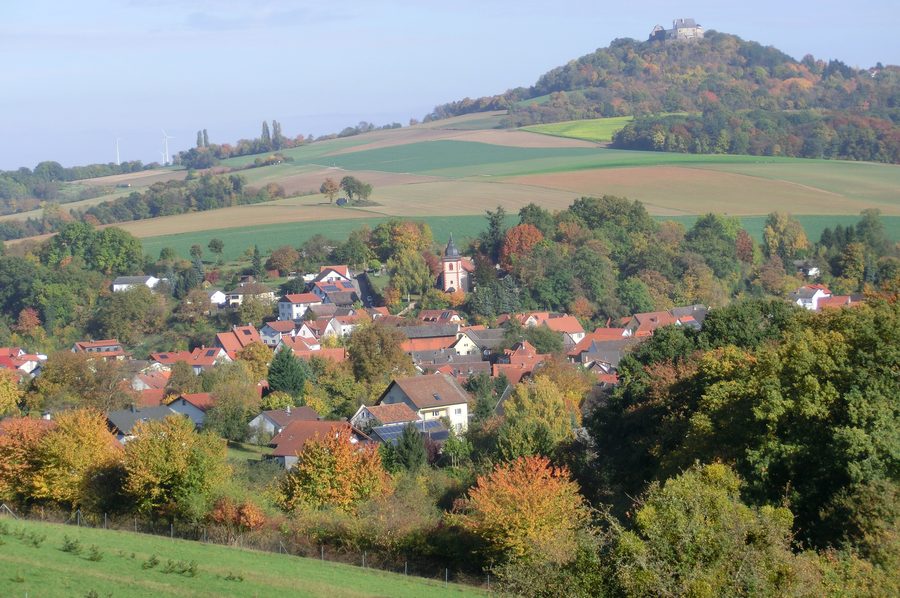 Blick auf Ober-Klingen und die Veste Otzberg auf dem Otzberg.
Photo: Thiotrix via Wikimedia Commons, CC BY-SA 4.0
Compare hiking trails by distance and time
Each trail starts and ends at a named location. This gives you specific starting and finishing points for planning, in addition to approximate walking times and distances:
- The Märkerwald Trail is 4.5 km long, takes about 1.5 hours, and starts and ends at the Schmelzmühle in Ober-Klingen.
- The Otzberg Trail (NK1) covers 6.5 km and takes about 2 hours; its start and finish are at the Hollergraben hiking car park.
- The Ohmbuckel Trail (NK2) is 12.5 km long and takes about 3.5 hours. It starts and ends at the sports hall in Nieder-Klingen.
- The Rondel Trail covers 6.9 km and takes about 2.25 hours, starting and finishing at the Bettelmannsbuche in Ober-Nauses.
- The Schloß-Nauses Trail covers 8.3 km and takes about 2.5 hours; its start and finish are at the nature park car park in Hering.
- At 23.1 km and about 7.5 hours, the Sparkassen Anniversary Trail through the Reinheim Hills is the longest of the listed loops. It starts and ends at the Old Town Hall in Lengfeld.
This puts shorter and longer time commitments side by side, so distance alone does not determine your choice. If you are planning with family, use the approximate duration as an initial way to compare how each route might fit into your day, then consider its starting point. The figures make the differences between the trails clear: the Märkerwald Trail is the shortest loop, and the Sparkassen Anniversary Trail is the longest.
Panoramic Views and Architectural History
From the Weiße Rübe, the keep of Otzberg Fortress, the view extends across the Odenwald, the Bergstraße and the Rhine-Main region. This panorama brings several landscapes into view at once and offers a distinctive experience alongside the hiking trails.
Habitzheim also offers tangible historical points of interest. Its buildings include the castle, built around 1500, the Protestant church dating from 1741, and the Catholic Church of St Cyriacus, built in 1858. Their different dates place the buildings in different centuries. The Habitzheim estate was established on the grounds of the former palace; the zu Löwenstein family still lives and farms there today.
Another local point of interest is the Hollergraben barbecue area in the district of Nieder-Klingen. The Nieder-Klingen-Aktiv e.V. association maintains and looks after the area, and rents it out. If you would like to include it in your plans, contact the association about renting it.
If you are looking for a holiday apartment in Otzberg, these attractions can help you get your bearings: if hiking is your main focus, compare the trails by their approximate duration and starting points. For culture-focused days, the fortress and the buildings in Habitzheim offer different points of interest. This can help you decide what suits your stay before choosing accommodation.
Darmstadt-Dieburg: the wider setting
The wider destination of Darmstadt-Dieburg encompasses the Hessian Rhine Plain, the Lower Main Plain, the Messel Hills, the Reinheim Hills, the Vorderer Odenwald and the Sandstone Odenwald. Within the district, the Bergstraße forms a distinctive transition between the Rhine Plain and the Odenwald. These regional landscapes provide a broader setting for anyone who wants to explore different natural and cultural areas while planning a trip.
One of the distinctive cultural and natural attractions in the wider destination of Darmstadt-Dieburg is the Messel Pit UNESCO World Heritage Site. This fossil site is known for its uniquely well-preserved and diverse fossils, which document the history of the Earth 47 million years ago. The visitor centre explains the history and significance of the Messel Pit.
There are further ways to explore the district: Darmstadt-Dieburg has an extensive network of well-signposted routes for hiking, walking and Nordic walking. Themed cycling routes run along the small rivers Modau and Gersprenz; there is also the Leisure Cyclists’ Route and the Family Cycling Route. The latter runs from Erzhausen to Seeheim-Jugenheim over a distance of about 40 kilometres. These regional offerings complement the local hiking trails as additional options within the wider destination.
Explore more destinations
Explore more destinations: Roßdorf, Alsbach-Hähnlein, Griesheim, Dieburg, Bickenbach, Seeheim-Jugenheim, Groß-Umstadt, Fischbachtal.
Back to the main travel guide: Darmstadt-Dieburg.

