
Pleystein: Rose Quartz Town and Geology on Kreuzberg
Accommodation in Pleystein
Pleystein is known as the Rose Quartz Town. At Kreuzberg, distinctive geological features meet a history of quartz mining; the town museum is dedicated to minerals and everyday life in the past. The Bockl and the PleyStein Trail add a cycling route and an adventure trail. These varied themes offer concrete starting points for planning your trip: Would you like to explore rocks and local history, or focus on trails and outdoor activities?
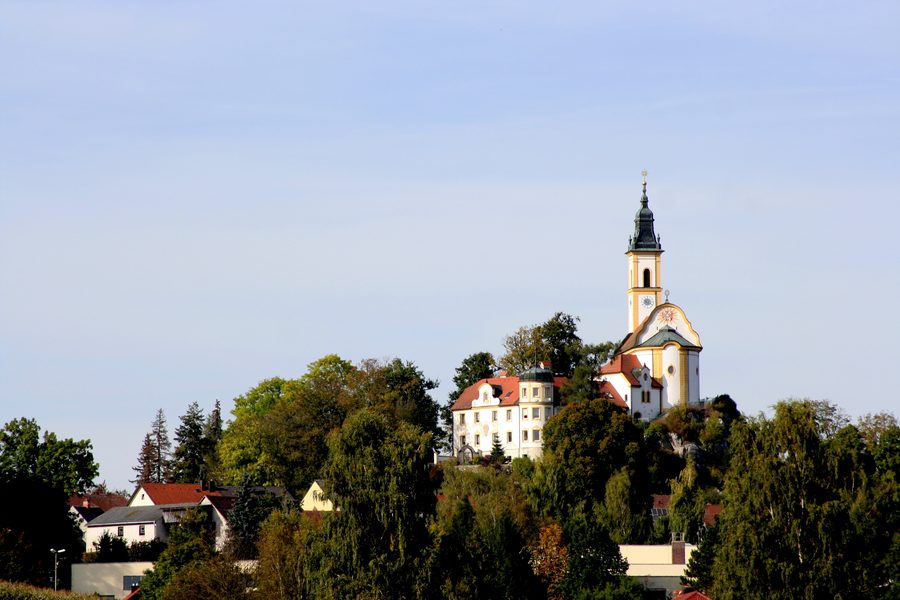 Die Wallfahrtskirche Hl. Kreuz prägt den Kreuzberg und den kulturgeschichtlichen Ortsbezug Pleysteins.
Photo: M.B.Kammerer via Wikimedia Commons, CC BY-SA 3.0 de
Die Wallfahrtskirche Hl. Kreuz prägt den Kreuzberg und den kulturgeschichtlichen Ortsbezug Pleysteins.
Photo: M.B.Kammerer via Wikimedia Commons, CC BY-SA 3.0 de
Rose Quartz and Mining at Kreuzberg
Kreuzberg is one of Bavaria’s most beautiful geotopes. Pink rose quartz is visible in places, and rare phosphate minerals also occur there, including strengite, rockbridgeite and phosphosiderite. So the geology of Kreuzberg is about more than rose quartz. Quartz is also linked to a historic industry: it was mined here from 1851 to 1920 and used as a raw material for making porcelain and glass. Anyone interested in where materials come from can explore both the rocks and the raw material’s former use.
Minerals and Everyday History at the Town Museum
The Pleystein Town Museum focuses on mineralogy. It provides an overview of the region’s pegmatite and mineral deposits and houses an information point for the Bavaria-Bohemia Geopark. The collection includes Stone Age finds, notable objects from the surrounding area and exhibits relating to the local tradition of woodcarving. The museum also shares fascinating information about how rocks form.
The exhibition also includes a glimpse of life in the past: the town museum displays a historically furnished kitchen dating to around 1920; many everyday objects and furnishings from earlier times are exhibited in several rooms. The museum also offers a vivid portrayal of middle-class life from 50 to 100 years ago. Mineralogical topics sit alongside concrete insights into homes, everyday life and crafts. For a trip that combines nature and culture, the museum offers a different perspective from the trails at Kreuzberg.
The Bockl and PleyStein Trail: Cycling Route or Geology Trail
The Bockl is a 52-kilometre railway trail and Bavaria’s longest railway trail. From Pleystein or Lohma, it follows the same route as the Grüner Dach cycling route, also known as the Pfreimdtal cycling route, and continues to the Eslarn–Železná/Eisendorf border crossing on the Czech border. The Bockl is also part of the Paneuropean Cycle Route from Paris to Prague. This makes it possible to include Pleystein on a cycling route whose described course reaches the border.
The PleyStein Trail has a different focus: this adventure trail runs around G´steinach near Pleystein and begins with a geology trail. The Bockl focuses on a cycling connection with a named endpoint at the border, while the PleyStein Trail centres on an adventure trail around G´steinach. This distinction can help you choose the activities you want without expecting the same experience from both trails.
Choose a Holiday Apartment Based on Your Travel Interests
These themes can be a useful starting point when choosing a holiday apartment in Pleystein. If you want to focus on minerals and local history, the town museum and Kreuzberg offer relevant attractions; if you’re interested in cycling and adventure trails, you can include the Bockl and the PleyStein Trail in your plans. Consider what you want your trip to focus on: the link between geology and the former use of local raw materials, the museum’s collections and stories of everyday life, or the different trail experiences.
Discover More Destinations
Discover more destinations: Parkstein, Waldthurn, Weiherhammer, Grafenwöhr, Tännesberg, Schwarzenbach, Neustadt An Der Waldnaab and Georgenberg.
For the main travel overview: Neustadt An Der Waldnaab.

