
Oberschleißheim: Baroque Palaces and Aviation
Accommodation in Oberschleißheim
Oberschleißheim can be explored through a variety of perspectives: Baroque palace rooms, religious festive and everyday culture, porcelain and restoration work. These themes give the town its distinctive character. If you are looking for a holiday apartment in Oberschleißheim, consider whether architecture, cultural history or technology should play the biggest part in your stay.
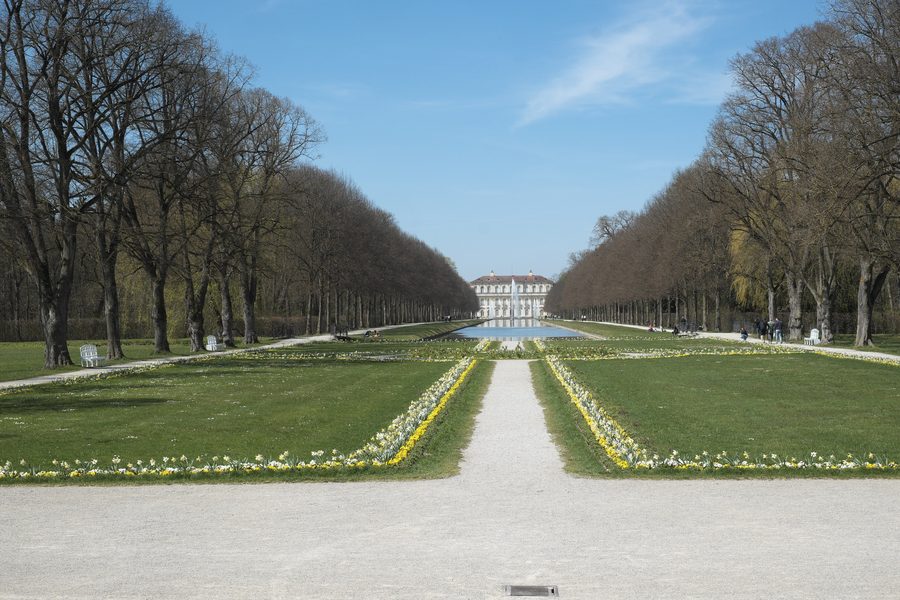 Das Neue Schloss und der Schlosspark sind Teil der Schlossanlage Schleißheim.
Photo: GFreihalter via Wikimedia Commons, CC BY-SA 3.0
Palace Rooms and Collecting Culture
With more than 200 rooms and the Wilhelmskapelle chapel, the Old Palace is considered a major work of the Early Baroque in Bavaria. The number of rooms conveys the scale of the building; the chapel adds its own religious note. The description of the palace thus brings together its size and a specific, named sacred space—two different ways of looking at Baroque architecture.
The permanent exhibition in the Old Palace offers a different perspective. In 250 display cases, it presents more than 6,000 individual objects relating to the religious festive and everyday culture of peoples around the world. The subject connects special occasions with daily life. This gives you a different focus from viewing the palace rooms: here, the collection objects and the cultures they belong to take centre stage.
Baroque Painting, Room Sequence and Porcelain
In the state rooms of the New Palace at Schleißheim, the Bavarian State Painting Collections present masterpieces of European Baroque painting. The impressive ceremonial sequence of rooms includes the grand staircase, the Great Hall, the Victoriensaal and the Great Gallery, as well as the Elector and Electress’s apartments. Their lavish decoration and furnishings rank among the most significant interior schemes in Baroque palace architecture. These rooms and their furnishings give greater weight to the architecture than any single hall or painting.
Lustheim Palace adds a specific historical context to this perspective. It was built in 1685 to mark the marriage of the Bavarian Elector to the Emperor’s daughter, Maria Antonia, and stands on an artificial island in the palace park. Set in the surroundings of the former Electoral hunting lodge, Lustheim Palace displays more than 2,000 fine porcelain pieces as a particularly appealing Baroque ensemble. The collection and its historical setting belong together here: the porcelain is notable not only for its quantity, but also as part of this ensemble.
Insights into Restoration Work
The Schleißheim Aviation Museum is part of the German Museum’s centre for the history of aviation and spaceflight. Visitors can watch ongoing restoration work from a gallery and through a glazed restoration workshop. Here, the work process itself is also on view. This offers a different perspective from the focus on palace rooms and collections, and another way to explore culture and technology.
Tailor Your Stay to Your Interests
When looking for a holiday apartment, your preferred focus can be a helpful guide: are you especially interested in Baroque architecture and furnishings, collections or restoration work? The differences between the sequence of rooms, exhibition objects and visible work processes offer concrete points of reference, rather than grouping every experience under a single theme. If you are planning a family trip, you can decide together which of these perspectives should shape your stay the most.
Discover more destinations: Schäftlarn, Gräfelfing, Ismaning, Haar, Brunnthal, Grasbrunn, Straßlach-Dingharting, Unterföhring.
See the overview of destinations: Munich.

