
Oberkotzau: Peace Project, Churches and History
Accommodation in Oberkotzau
A peace project, two churches with stories of their own, and a path that connects them: Oberkotzau invites you to discover culture from several perspectives. The Fernweh-Park “Signs of Fame” is both a peace project and a tourist attraction. St. Jakobus and St. Antonius are linked by the Oberkotzau Bible Path; the listed castle adds local history to the religious themes. If you choose a destination based on whether it offers different ways to engage with culture, you’ll find specific starting points here. When choosing a holiday apartment, you can first consider which of these stories you want to shape your trip.
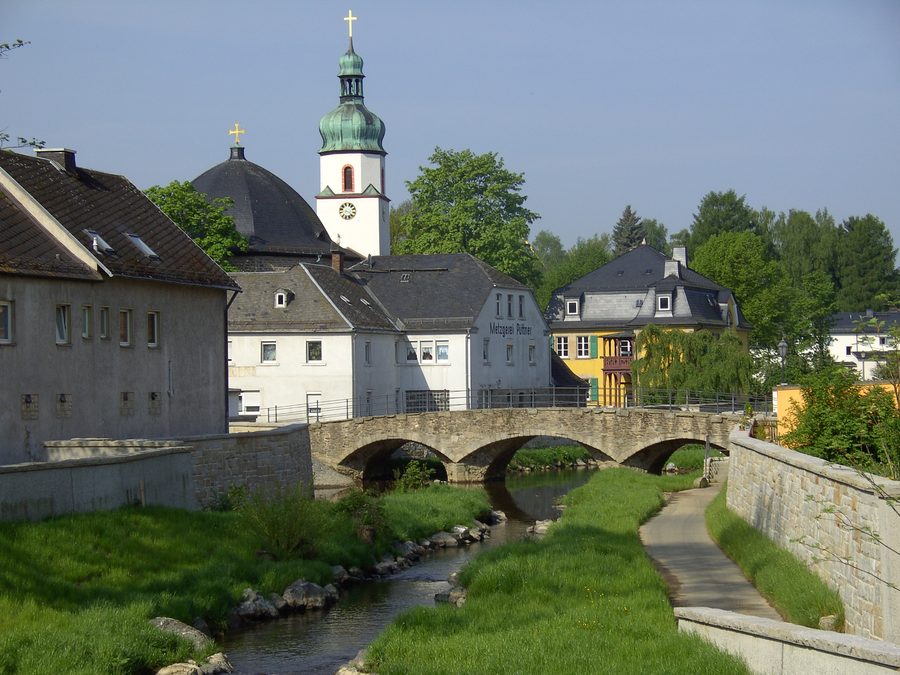 Oberkotzau: Brücke über die Schwesnitz, im Hintergrund die evangelische Kirche St. Jakobus mit Pfarrhaus.
Photo: TPO via Wikimedia Commons, CC BY-SA 3.0
A Peace Project as a Distinctive Feature
The Fernweh-Park “Signs of Fame” is a tourist attraction in Oberkotzau and also a peace project. Its name gives the park a clear cultural focus. Admission is free, a practical benefit when planning a visit. Its theme also differs from the church connection represented by the Bible Path and the history of the castle: here, the peace project is the focus in its own right. If you’re choosing different cultural themes for a trip to Oberkotzau, you can distinguish this special feature from the religious and historical connections.
Two Churches and a Shared Themed Path
The Catholic Church of St. Antonius was consecrated on 15 May 1967 in honour of St. Anthony of Padua. The consecration was performed by the then Archbishop of Bamberg, Dr. Josef Scheider. The date, dedication and consecrating archbishop place the event precisely in its historical context. The possible origins of the Protestant Church of St. Jakobus, by contrast, go much further back: they are thought to date to around the turn of the first millennium. This dating is uncertain and does not specify an exact year of foundation. Thus, a precisely dated consecration sits alongside a cautiously worded account of origins reaching far back in time. The Oberkotzau Bible Path connects the two churches. This means you encounter two denominations not just as individual buildings, but as part of a shared religious context. If you’re interested in church history, you can consider the consecration, the possible early origins and the connection between the churches as distinct topics.
Local History and a Route Connection
The listed castle offers another perspective on Oberkotzau’s past: it was once the seat of the von Kotzau family. Here, family history takes centre stage, while the Bible Path connects two churches. The Jean-Paul-Weg offers another connection. Its second stage runs between Hof and Schwarzenbach through Oberkotzau territory. This stage information may be of interest if you want to include a named route in your travel plans alongside individual cultural and historical themes. It connects Oberkotzau with a section of a route, while the castle and churches each offer their own historical or religious associations.
Cultural Interests and Choosing a Destination
When searching for a holiday apartment, your trip’s cultural focus can be a useful starting point. Consider whether you’re particularly interested in the peace project, church history or the castle’s former role. This lets you connect your choice of destination with specific themes rather than a general idea of a cultural holiday. The Jean-Paul-Weg offers another perspective: here, the focus is on the route of a named stage through Oberkotzau territory. If you want these cultural connections to shape your stay, you can consider Oberkotzau as a destination for your holiday apartment.
Discover More Destinations
Discover more destinations: Münchberg, Sparneck, Zell Im Fichtelgebirge, Bad Steben, Selbitz, Köditz, Berg, Feilitzsch
Back to the main travel overview: Hof.

