
Sommerkahl: Discover Mining History and Nature
Accommodation in Sommerkahl
In Sommerkahl, traces of mining meet a landscape shaped by people over centuries. The Wilhelmine Mine, a nature trail and a designated cycling tour offer different ways to experience the area: explore local history, discover the landscape or include Sommerkahl as a stop on a cycling stage.
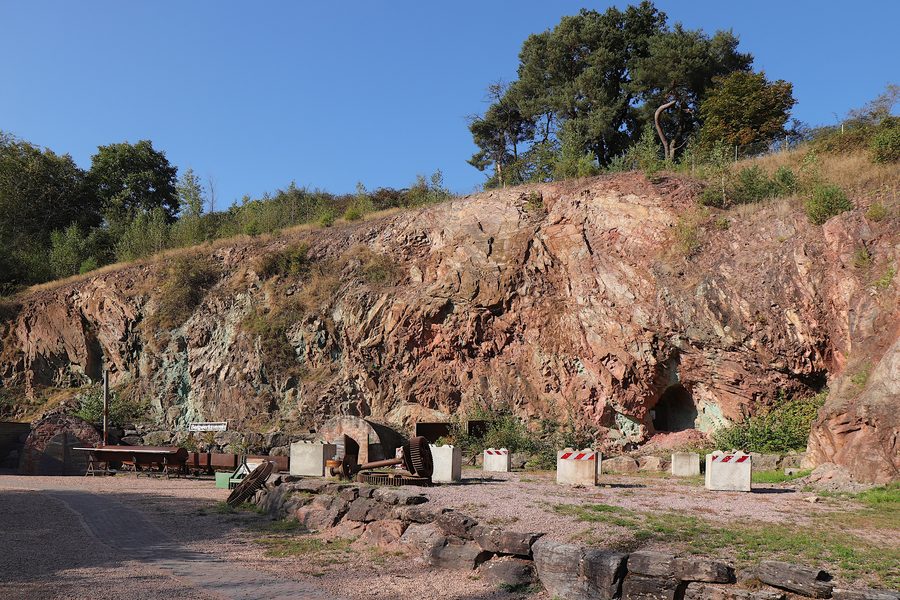 Die Grube Wilhelmine erinnert an die lange Bergbaugeschichte Sommerkahls.
Photo: KaiBorgeest via Wikimedia Commons, CC BY 4.0
Die Grube Wilhelmine erinnert an die lange Bergbaugeschichte Sommerkahls.
Photo: KaiBorgeest via Wikimedia Commons, CC BY 4.0
Wilhelmine Mine: Mining History and Distinctive Minerals
Copper ore mining in the area of the Wilhelmine Mine was first mentioned in official records in 1704. For centuries, the mine yielded copper, iron and manganese. The history of mining can therefore be explored through both this early written record and the raw materials mentioned.
Some of the old tunnels have been exposed and illuminated. The slope above the mine entrance has been reinforced, and an information building with toilets has also been built. Guided visits are possible only by prior arrangement. If you plan such a visit, be sure to arrange it in advance.
One striking geological feature is the 20-metre-high gneiss wall at the Wilhelmine Mine. Large areas of its surface are covered with green malachite and blue azurite. Both are secondary copper ores. If you are travelling with children, the colours and mineral names can be a starting point for exploring together the connection between mining and rock.
Nature Trail and a Landscape Shaped by People
The “Around Wilhelmine” nature trail explores the landscape around Sommerkahl and invites both locals and visitors to enjoy nature. It was established in 2006 in collaboration with the Spessart Nature Park, the municipality of Sommerkahl, the Copper Mine “Grube Wilhelmine” Sommerkahl e.V. association, the Lower Nature Conservation Authority in the district of Aschaffenburg and the Government of Lower Franconia. The trail combines experiencing nature with the mining history that particularly defines Sommerkahl.
The landscape around Sommerkahl has been shaped by agriculture and mining; the area has been inhabited for more than 800 years. The surroundings thus combine a long history of settlement with a landscape shaped by farming and mining. If you enjoy spending time outdoors, the nature trail offers a way to explore this landscape, rather than focusing your stay solely on mining history.
Cycling Route and Further Discoveries
Sommerkahl can also be included in a longer journey by bicycle: the Westerngrund–Heimbuchenthal cycling tour, formerly R6, runs from Huckelheim via Sommerkahl and Bessenbach and the Hohe Warte to Heimbuchenthal. The village is therefore part of the route described. If you plan your trip around this route, check local conditions before setting off.
Another glimpse into the village’s history can be found at the parish church, built from red sandstone in 1961. Together with the mine, which operated for centuries, it offers a contrast between a specific construction date and a much longer mining history. Both subjects offer different ways to shape your stay, without requiring you to choose just one way of exploring the area.
Which Holiday Apartment Is Right for Your Stay in Sommerkahl?
When choosing a holiday apartment in Sommerkahl, it helps to decide first what you want to focus on during your trip. If you are mainly interested in historic mining, the Wilhelmine Mine and its gneiss wall are highlights. If you want to experience the landscape, the nature trail offers a different perspective; for a cycling trip, Sommerkahl’s place on the described Westerngrund–Heimbuchenthal route is what matters.
For families, it can help not to treat the different subjects as a checklist: the minerals, the mine’s history and the landscape shaped by people all offer different opportunities to ask questions together and tailor your stay to your interests. Check whether guided visits require prior registration, and check local conditions before a cycling trip.
Discover More Destinations
Discover more destinations: Rohrbrunner Forst, Krombach, Mespelbrunn, Hösbach, Haibach, Kahl, Großostheim, Laufach.
Back to the main travel guide: Aschaffenburg.

