
Munderkingen: Historic town center in the Danube loop
Accommodation in Munderkingen
The Danube winds around Munderkingen’s well-preserved town center in a loop. The picturesque silhouette of the tall-gabled house fronts is reflected in the water—a striking interplay of river and townscape. Those who choose Munderkingen will find a place whose distinctive appearance is directly connected to the Danube. There are also traces of history and various ways to explore the surrounding area on foot, by bike or on the water.
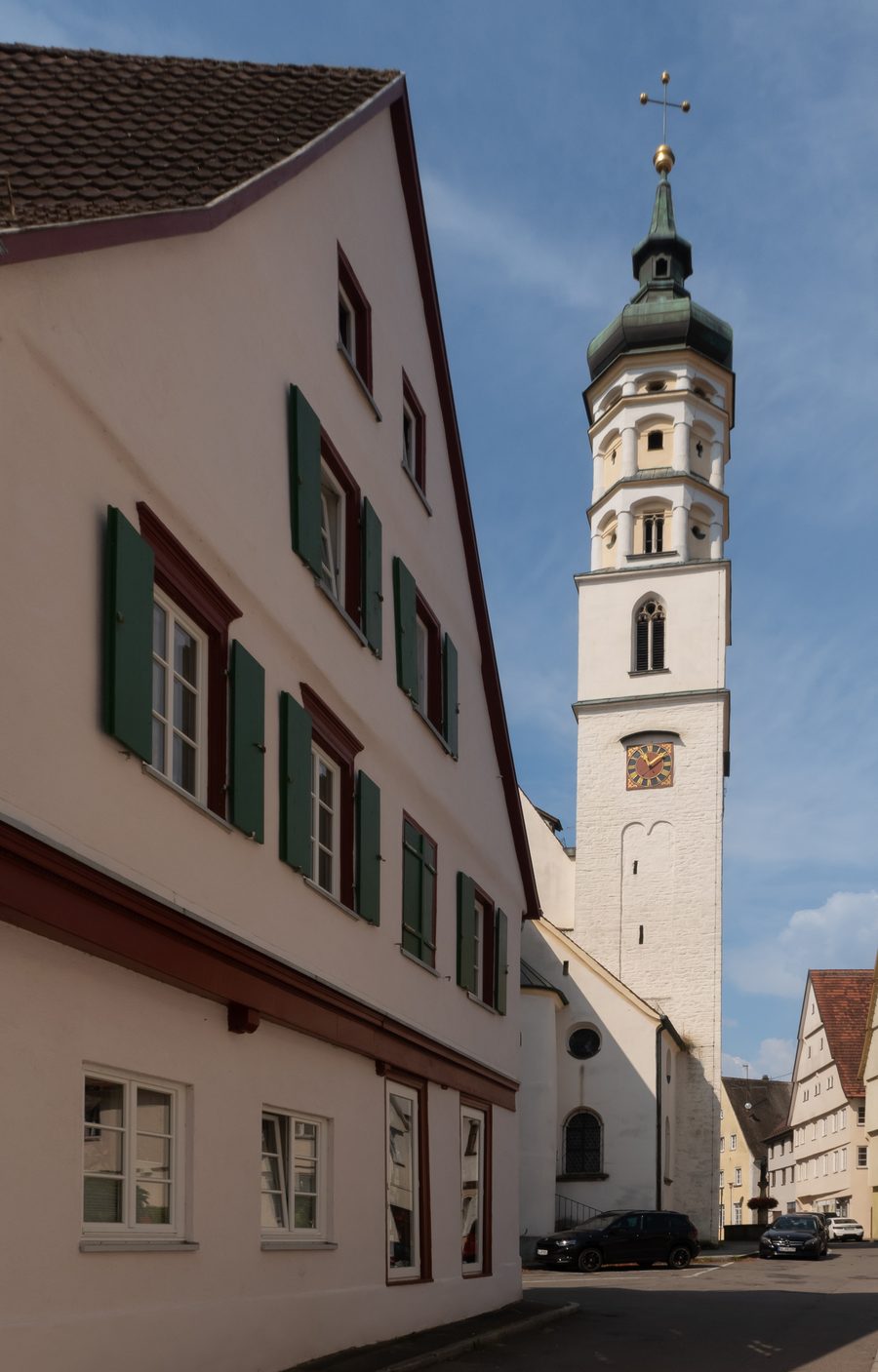 Die Pfarrkirche Sankt Dionysius ist Teil des historischen Ortsbilds von Munderkingen.
Photo: Michielverbeek via Wikimedia Commons, CC BY 4.0
Die Pfarrkirche Sankt Dionysius ist Teil des historischen Ortsbilds von Munderkingen.
Photo: Michielverbeek via Wikimedia Commons, CC BY 4.0
Discover the town’s history through its churches and buildings
St. Dionysius Parish Church was first mentioned in 1275. Its patronage points to Munderkingen’s early Frankish history: Saint Dionysius was the patron saint of the Franks. The church also has a historic connection to Marchtal Abbey, to which it was incorporated. These details offer several historical and cultural points of reference, while the town’s history is not limited to a single era.
Another architectural detail can be found on the west wall of the Marienkapelle (Chapel of St. Mary): the ashlar blocks there date back to the Hohenstaufen era. Munderkingen’s municipal museum is located in the Heiliggeistspital (Hospital of the Holy Spirit), whose building dates from the 16th century. The church, chapel and hospital building thus represent different historical connections. If you are interested in architecture and history, you can take these topics into account when planning your stay, alongside experiences on the Danube.
The Brunnensprung (fountain jump) is also part of Munderkingen’s annual events. It takes place on Shrove Sunday at 4 p.m. and on Shrove Tuesday at 6 p.m., after the parade. If this event is important to your travel plans, check the dates in advance. This allows you to schedule your stay around the specified carnival days.
Cycling, canoeing and trails in the surrounding area
For a cycling tour, a route runs from its starting point in Munderkingen along the Danube all the way to Ehingen-Berg. The river is the route’s consistent point of reference. Munderkingen also has canoe launch and landing points, as well as secure storage for boats. Cycling and canoeing offer different focuses: by bike, you follow the river towards Ehingen-Berg; for canoeing, the launch and landing points and boat storage are the specific facilities mentioned.
The exercise trail runs along the Danube and through the Munderkinger Ried. If you prefer to explore on foot, you can plan a hike from Munderkingen into the Große Lautertal. These activities differ in the areas and destinations described: the trail runs alongside the Danube and through the Ried, while the hike leads from the town into the Große Lautertal.
More to discover in the Alb-Donau district
The wider travel destination of the Alb-Donau district offers additional cultural and landscape highlights that broaden the picture of the region. The Hohle Fels cave near Schelklingen is a UNESCO World Heritage cave and the site where the “Venus of Hohle Fels” and the “Geierknochenflöte” (“vulture-bone flute”) were found; both finds are around 42,500 years old. Obermarchtal Abbey stands directly above the Danube and acquired its present form between 1686 and 1795. These destinations are independent examples from the Alb-Donau district, not features of Munderkingen’s town center.
Discover more destinations: Rottenacker, Emerkingen, Schelklingen, Ulm, Dietenheim, Langenau, Öllingen, Bernstadt.
View the wider travel overview: Alb-Donau district.

