
Holzkirch: Architectural History and Traces of Prehistory
Accommodation in Holzkirch
Holzkirch combines a local history dating back to the 14th century with distinctive features at St. Barbara’s Church and traces of a prehistoric rampart. At the church, various architectural styles and dates can be observed; in the Kletthalde area, the view extends further into the surrounding landscape. The town thus offers different points of interest for anyone interested in history, architecture and landscape.
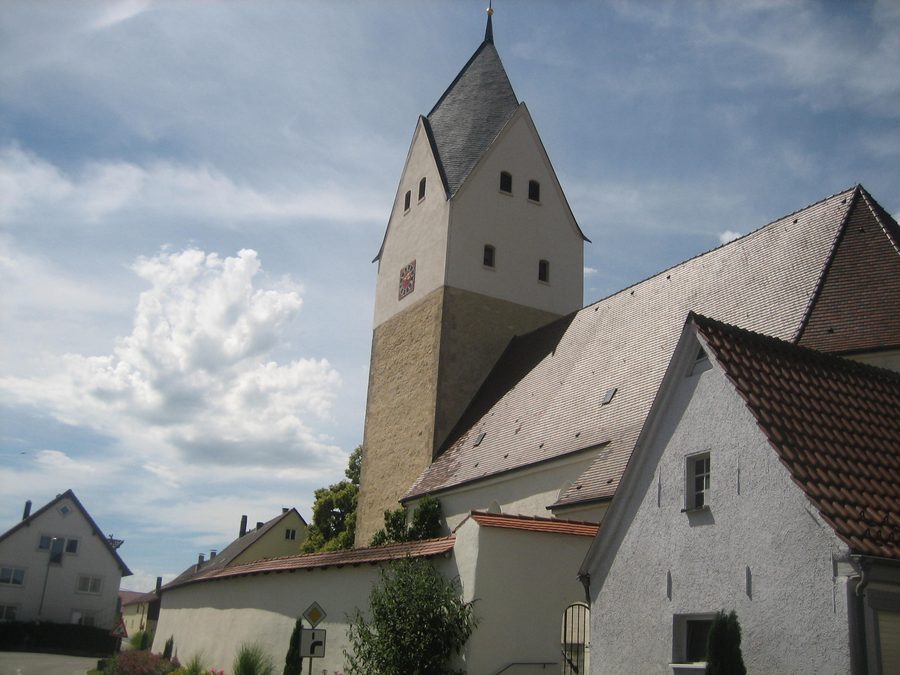
St. Barbara’s Church: Building phases in a compact space
The substantial west tower of St. Barbara’s Church has loopholes. Its lower four storeys are Romanesque, while the upper storey dates from 1783. The division into storeys, the loopholes and the upper storey dated 1783 characterize the west tower. Romanesque and 1783 refer to different historical classifications of the same tower.
The nave and the two-bay, polygonal choir are also Late Gothic. A wooden ceiling in the nave dates from around 1486. Two-bay describes the division of the choir into two bays, while polygonal refers to its many-sided shape. St. Barbara’s Church thus combines Late Gothic building elements, a wooden ceiling from the late 15th century and a tower with Romanesque lower storeys and an upper storey dating from 1783. Considering the building elements separately makes it possible to appreciate their different features rather than reducing the church to a single construction period.
Holzkirch was first mentioned in a document in 1362. In 1385, the town came into the possession of the Free Imperial City of Ulm. The first documentary mention and the later change of ownership are two distinct milestones in the town’s history. Together with the building phases of St. Barbara’s Church, they provide several points in time from which to view Holzkirch’s history.
Traces in the landscape
The municipality of Holzkirch borders the Lone Valley to the south. Remains of a prehistoric rampart can be seen in the Kletthalde in the northwest of the municipal area. There, a semicircular stone wall runs along the slope edge of the Trutteltal, which leads into the Lone Valley.
For travellers interested in historical traces, Holzkirch brings together two distinct topics: the architectural history of a named church building and the remains of a prehistoric structure in the Kletthalde.
Culture and nature in the Alb-Donau district
The wider destination of the Alb-Donau district offers further cultural and historical points of interest. Near Schelklingen is Hohle Fels, a UNESCO World Heritage cave and the findspot of the “Venus of Hohle Fels” and the “Geierknochen Flute”. Both finds are around 42,500 years old. In Blaustein, the Stone Age village of Ehrenstein is a Neolithic settlement in the Blau Valley and part of the transnational serial UNESCO World Heritage property “Prehistoric Pile Dwellings around the Alps”.
The monasteries of the Alb-Donau district also represent different historical periods. Blaubeuren Monastery was founded as a Benedictine monastery in 1085; today, it consists mainly of Gothic-style buildings dating from 1466 to 1510. The former Premonstratensian abbey of Obermarchtal is also in the Alb-Donau district. Its monastic complex rises directly above the Danube and took on its present form between 1686 and 1795. The different foundation and construction dates make these destinations distinct stops for travellers interested in monastic and architectural history.
The Alb-Donau district is part of the Swabian Alb Biosphere Reserve. Several types of routes are available for active days: the 20 “Ice Age Trails” circular routes are six to 14 kilometres long and are suitable for day hikes. They are complemented by family-friendly “Ice Age Tracks”, ranging from one to six kilometres, as well as the Contemplative Path for multi-day tours. The distances of the themed cycling routes vary considerably: the “Ice Age Valleys” tour is 75 kilometres long, the “Berg Bier Tour” 115 kilometres and the “Albtäler” cycle route 186 kilometres; the latter has a four-star award. This makes it easy to distinguish hiking and cycling routes by length and format.
Tailor your stay to suit you
When looking for a holiday apartment in Holzkirch, you can first consider what you would like to focus on during your stay: local history, including St. Barbara’s Church and traces of the rampart, or a broader programme featuring distinct destinations and routes in the Alb-Donau district. The regional offerings differ not only by theme but also by scale: from the shorter “Ice Age Tracks” to day hikes on the “Ice Age Trails” and multi-day tours on the Contemplative Path. The cycling routes mentioned also range from 75 to 186 kilometres. When choosing the right holiday apartment, the mix you want of local history, regional culture and activities can help guide you.
Discover more destinations
Discover more destinations: Schelklingen, Neenstetten, Berghülen, Bernstadt, Obermarchtal, Griesingen, Lonsee, Westerheim.
To the main travel overview: Alb-Donau district.

.jpg)