
Accommodation in Monaco
Accommodation in Monaco
Monaco is a destination where the Mediterranean, a city-state, and culture come together in a very small area. Between the coast, the historic Monaco-Ville, and the urban character of Monte-Carlo, an varied setting emerges for days of shared discovery: sometimes with views of the marine world, sometimes among bright facades and small squares, and sometimes with architecture and urban culture.
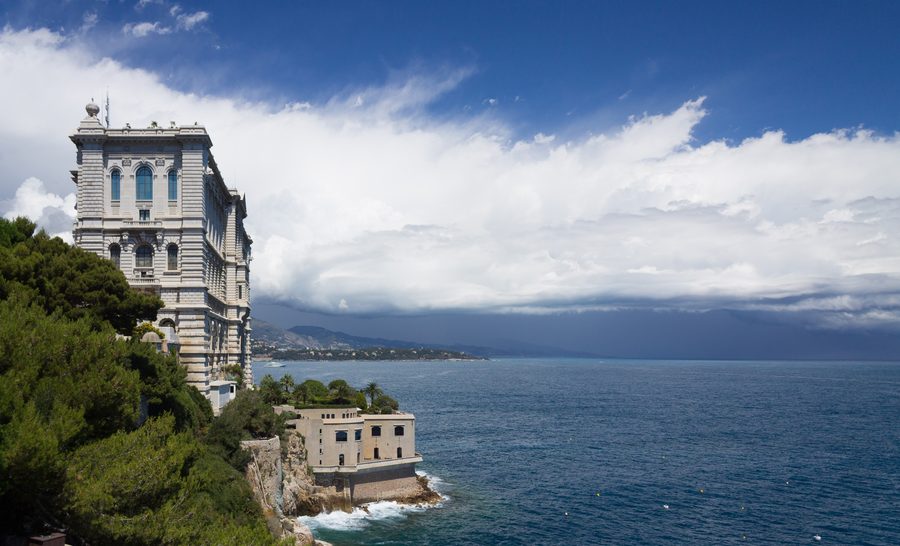 Das Ozeanographische Museum prägt den Rand von Monaco-Ville über dem Mittelmeer.
Photo: Stanimir Stoyanov via Wikimedia Commons, CC BY-SA 4.0
Das Ozeanographische Museum prägt den Rand von Monaco-Ville über dem Mittelmeer.
Photo: Stanimir Stoyanov via Wikimedia Commons, CC BY-SA 4.0
Briefly & clearly
- Monaco is a city-state located directly on the Mediterranean.
- The principality belongs to the Côte d’Azur and lies in the Maritime Alps.
- Monaco-Ville is the oldest part of the principality.
- Narrow streets, bright facades, and small squares shape the historic appearance of Monaco-Ville.
- At the edge of Monaco-Ville, the Oceanographic Museum is dedicated to the marine world.
- Monte-Carlo adds striking architecture and cultural venues to historic Monaco.
Where the Mediterranean and the city-state belong together
Monaco’s special quality lies in the combination, not in a single motif. The coast is not merely a scenic backdrop, but part of a city-state that can be experienced in close detail. This means that on a single day you can combine maritime impressions, historical atmosphere, and urban culture. For families with different interests, this contrast is helpful: while some prefer to explore the cityscape and coastline outdoors, a cultural venue offers a quieter and weather-flexible option.
Monaco-Ville and the marine world
Monaco-Ville forms the historic heart of the principality. The narrow streets, bright facades, and small squares give Monaco’s oldest district its own atmosphere and create a clear contrast to the more modern cityscape. At the edge of the old town lies the Oceanographic Museum. There, historical and scientific exhibits about the marine world are combined with live sea animals.
This combination makes Monaco-Ville an obvious focal point for a stay that aims to combine history and marine culture. It also allows you to structure the day in a varied yet manageable way, without reducing Monaco to the familiar images of Monte-Carlo.
Monte-Carlo: architecture and urban culture
Monte-Carlo is a district of Monaco and sets a different tone. The Casino de Monte-Carlo is among the principality’s best-known buildings; the Opéra de Monte-Carlo, also called Salle Garnier, represents historic architecture and culture. Those who want to deepen the urban focus can use the page for Monte Carlo and view the vacation home in Monte Carlo as a subordinate local detail.
In content terms, this creates a clear contrast: Monaco-Ville stands for historic lanes and the marine museum, while Monte-Carlo stands for grand buildings and urban culture. This distinction helps when choosing the type of trip, especially if you want to decide in advance whether cultural history, maritime themes, or urban impressions should take priority.
Experience Monaco compactly or place it within the Côte d’Azur?
For a concentrated stay in the principality, the appeal lies in combining Monaco’s different sides: Monaco-Ville, the Oceanographic Museum, and Monte-Carlo together create a distinctive program of history, marine culture, and architecture. This suits travelers looking for a compact city-and-coast experience and wanting to bring different interests together in just a few days.
Another travel idea places Monaco in a broader Côte d’Azur context. The principality lies on the Côte d’Azur; Èze is located between Nice and Monaco, showing that the trip can also be oriented toward other coastal places. In this case, you choose your accommodation base not only according to the Monaco program, but also according to whether Monaco is intended as an independent focal point or as part of a wider coastal trip. You should check specific routes and travel times separately for your travel period.
Which base suits the itinerary?
A central base in the principality fits conceptually with a stay in which Monaco itself is the main focus and Monaco-Ville, the Oceanographic Museum, and Monte-Carlo belong to a shared program. If, however, you want to include several coastal towns on the Côte d’Azur, a location with a stronger Riviera connection may be the more suitable conceptual foundation. The main question at first is the experience framework you want; afterwards, you can check the facilities, exact location, and current conditions at the chosen accommodation.
Frequently asked questions about Monaco
What makes Monaco different from an ordinary stay on the Côte d’Azur?
Monaco combines the character of an independent Mediterranean city-state with coastline, historic Monaco-Ville, and maritime culture. As a result, urban history and marine experiences are concentrated in an unusually compact area.
Which different experiences can be combined in Monaco?
Historic lanes and small squares in Monaco-Ville can be combined with the Oceanographic Museum. Monte-Carlo adds striking architecture and cultural venues such as the casino and opera to this focus.
When does Monte Carlo work as a deeper look at a Monaco stay?
Monte Carlo is especially suitable when you want to get to know not only Monaco’s historic side, but also its architecture and urban culture. As a district, Monte Carlo is a separate focus within the principality, not a synonym for it.

