
Nyúl: Loess Ravines, Stations of the Cross and Winemaking
Accommodation in Nyúl
Nyúl combines rolling hills and long loess ravines with sacred architecture and a winemaking tradition. The routes offer different highlights: one passes a wide range of local attractions, while another is laid out as a religious Stations of the Cross route. There is also a cycling tour through the hills and a location in the Pannonhalma wine region.
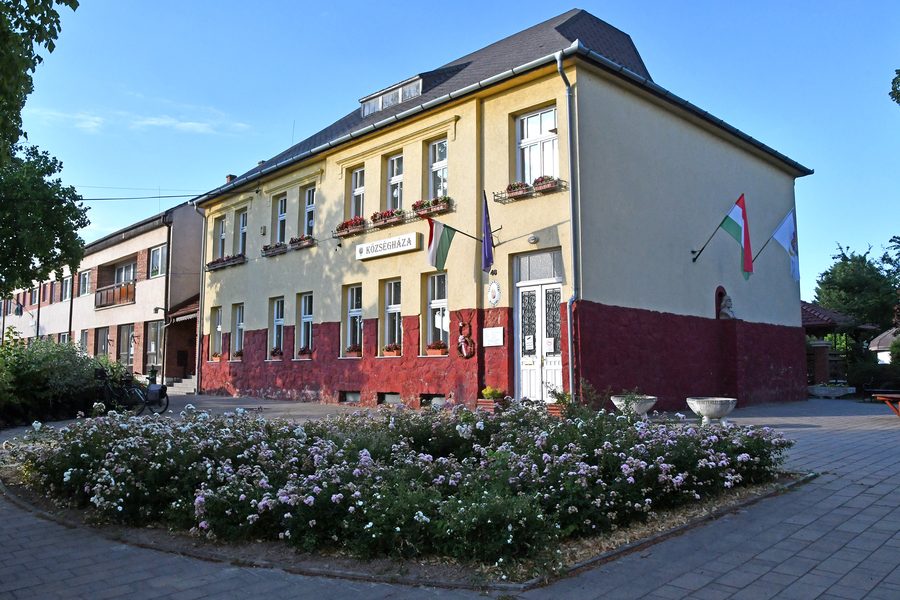 Village hall in Nyúl, Győr-Moson-Sopron, Hungary.
Photo: Pasztilla aka Attila Terbócs via Wikimedia Commons, CC BY-SA 4.0
Paths Through Hills and Loess
The 12-kilometre Kökörcsin-körút runs mostly through the hilly part of Nyúl. It passes local geological, biological, architectural, ethnographic, historical and literary attractions, as well as viewpoints and rows of wine cellars. Its many themes give the circular route a different character from a trail focused on a single place or attraction.
A distinctive landform is the Szurdik, a gently sloping, long loess ravine in Nyúl. It is more than two kilometres long and 20 to 30 metres deep. Vaskapu is a typical cellar lane in Nyúl; the 450-metre-long loess ravine is particularly striking at its lower entrance and is a popular photo spot. The two ravines differ in scale: the Szurdik stands out for its length and depth, while Vaskapu is notable for its distinctive length and lower entrance.
Stations of the Cross or a Cycling Tour?
The 13-kilometre Nyúli Keresztút is a varied walking route laid out as a religious Stations of the Cross trail, with 14 stations where the Passion of Christ is recounted. In a set order, the route passes 14 of the 15 roadside crosses in Nyúl. Compared with the 12-kilometre Kökörcsin-körút, the routes are similar in length, but their thematic focus differs considerably.
If you prefer to get around on two wheels, a cycling tour through the hills of Nyúl is listed as 12 kilometres and about two hours long. Its short description mentions viewpoints, wineries and a restaurant. Nyúl lies in the heart of the Pannonhalma wine region, where wine has been made for millennia. This long regional tradition gives the landscape a distinct cultural connection alongside its trails and buildings.
Sacred Architecture in Nyúl
The Roman Catholic Mindenszentek Church in Nyúl is a late Baroque building. It was built between 1774 and 1778 to designs by Fellner Jakab. It offers a concrete insight into the history of architecture in the village; the Stations of the Cross take a different approach, exploring religious history through stations and roadside crosses.
Nearby, the Szent-Donát Chapel was built in 1710 during a plague epidemic in the area. Together with the history of Mindenszentek Church, it offers a glimpse into the history of sacred buildings in Nyúl and its immediate surroundings.
The Wider Region: Győr-Moson-Sopron
The wider destination of Győr-Moson-Sopron provides a broader regional context. The Benedictine Monastery in Pannonhalma was founded in 996. The World Heritage property of the Archabbey of Pannonhalma and its Natural Environment includes the monastic complex, basilica, educational buildings, the Chapel of Our Lady, the Millennium Chapel, and botanical and herb gardens.
The Fertő/Neusiedler See Cultural Landscape is also part of the wider destination of Győr-Moson-Sopron. It includes Eurasia’s westernmost steppe lake and a diverse landscape of wetlands, saline soils, reed beds and shores. This regional context offers a different focus from Nyúl’s local loess landforms, trails and architectural history.
When choosing a holiday apartment in Nyúl, you can weigh up your preferred focus: an interest in nature and geology, religious routes, sacred architecture or winemaking tradition. This makes it easier to choose the village according to the themes you want to shape your trip.
Discover More Destinations
Győrzámoly, Dunaszeg, Töltéstava, Nagybajcs, Győr, Abda, Pér, Vének
Back to the wider travel overview: Győr.

