
Bükkösd: Castle History, Church and Eco Park
Accommodation in Bükkösd
In Bükkösd, castle history, the Roman Catholic church and nature watching in the eco park cater to different travel interests. If you are looking for a holiday apartment, you can consider whether historic buildings or the eco park’s offerings should shape your stay more.
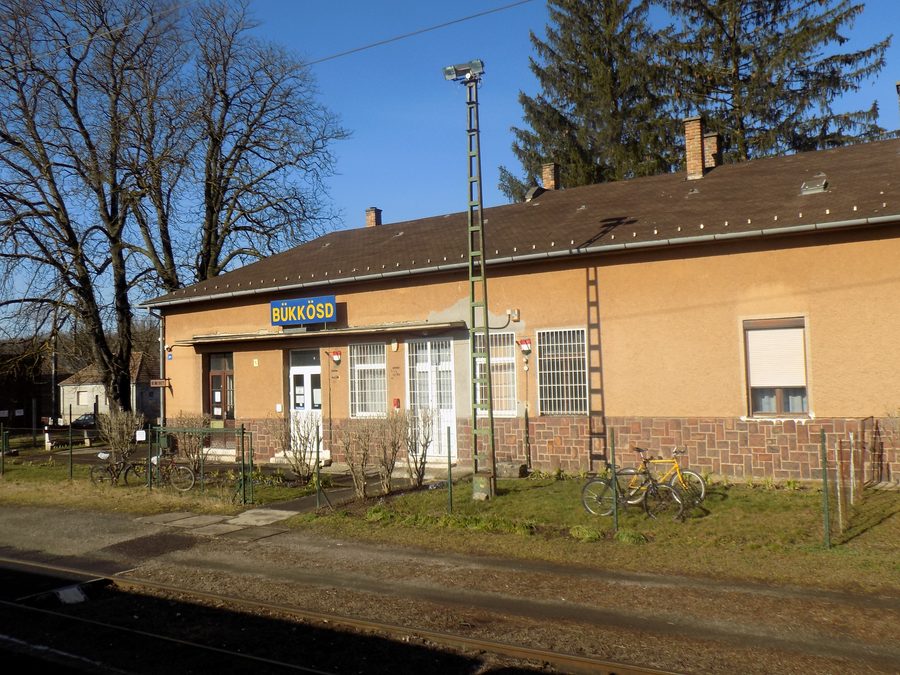 Der Bahnhof Bükkösd liegt im Ortszentrum an der Bahnstrecke Budapest–Pécs.
Photo: Kemenymate via Wikimedia Commons, CC BY-SA 4.0
Castle history with two attributions of its patronage
The Petrovszky Castle, later known as Jeszenszky Castle, in Bükkösd was designed by Fischer von Erlach. It is disputed who commissioned its construction. According to one account, Zsigmond Petrovszky had the castle built in 1786. Other researchers attribute the construction to Horváth Dániel: he is said to have had the castle built for his son-in-law, Petrovszky József, and his daughter, Horváth Krisztina.
Church: design, façade statues and tradition
The Roman Catholic church in Bükkösd was built in 1791 by Petrovszky Zsigmond and one of his siblings. The church was designed by Buch József, the first drawing teacher in Pécs. Niches in the façade hold statues of Saint John of Nepomuk and Saint Sigismund. The church can thus be explored through several specific details: its construction date, the attribution of its design, and the figures on its exterior façade.
The altar base also has a story of its own. According to oral tradition, it comes from the Pauline monastery on Jakabhegy near Pécs and is made of Goric marble. While the patronage of the castle’s construction is disputed, tradition links the altar base to a named monastery and material.
Routes and wildlife watching in the eco park
Visitors to the Bükkösd Eco Park can choose between the Völgy séta and Erdőjárók útja routes. Visitors can also observe waterfowl and landfowl, as well as large game species found in Hungary, in their natural surroundings. The routes and wildlife watching offer two different ways to experience the park: following a path through the grounds and observing the animals that live there.
Thematic programs for preschool and school groups include feeding and interacting with animals, horse riding and a playground. Bookings must be made by prior arrangement.
Baranya as the wider setting
The wider destination of Baranya offers further cultural and nature-related experiences. In Pécs, the Early Christian Necropolis of Sopianae includes decorated tombs from the 4th century. The tombs were built as underground burial chambers with above-ground memorial chapels and adorned with richly detailed Christian wall paintings. The Zsolnay Cultural Quarter in Pécs offers a different focus, with the “Golden Age of Zsolnay” and “Pink Exhibition” displays, as well as an exhibition on the family and factory history.
For children, the Zsolnay Cultural Quarter offers outdoor playgrounds, an interactive lab, a planetarium, the Bóbita Puppet Theatre, a ceramics painting workshop and classes at the Hercules Workshop. The Ős-Dráva Visitor Centre near Szaporca explores nature and agriculture. It has an interactive exhibition, a working demonstration farm and three themed educational trails. They cover traditional farming, the Ős-Dráva Programme and the wildlife along the Drava. The farm area features native Hungarian domestic animals, including Hungarian Grey cattle, Mangalica pigs, Hucul horses, and old breeds of sheep and poultry.
More destinations
Discover more destinations: Hetvehely, Szentlőrinc, Dinnyeberki, Helesfa.
Back to the wider travel guide: Szentlőrinc.

