
Municipality of Tinjan: Kažuni, Heritage and Cycling
Accommodation in Municipality of Tinjan
The defining themes of the Municipality of Tinjan include medieval traces, unusual Kažuni, the Jure Grando cycling route and the tradition of smoked prosciutto. Here, local history and craftsmanship meet a practical way to experience the area actively. When planning your trip, consider whether architecture, cycling or local traditions should be your main focus.
Architectural history from the Middle Ages to the Baroque period
The Depiera House in Tinjan is a Baroque architectural monument. Its distinctive details include a projecting chimney dated 1670, a Neoclassical arcaded porch and a cistern dating from 1820. The individual building elements provide concrete markers in the area’s history: in a single building, you can encounter different architectural features and two explicitly dated elements.
The religious buildings also reflect different periods. The parish church of Saint Simon and Jude Thaddeus dates from the 18th century and is considered an example of late Baroque architecture in Istria. By contrast, the old cemetery church of the Holy Cross was built in the 13th century in the Romanesque style. If you are interested in architecture, you can compare these two churches by their construction dates and distinct styles.
Visible remains of Tinjan’s older defensive wall have survived; you can make out bricked-up battlements dating from the 14th century. The former town gate was protected by a drawbridge. The former town loggia, meanwhile, was a covered public space, open on three sides, where representatives of the people, community leaders and judges gathered. At the Županski stol, locals once made decisions about important matters affecting their community. These places point to different aspects of historic community life: defence, assembly and collective decision-making.
Kažuni, dry-stone construction and local tradition
The Kažuni are worth a closer look: they are not always round, but often square, and some are even underground. This broadens the familiar image of a field hut with some surprising variations. Istrian dry-stone construction uses natural stone without mortar. In Tinjan, Kažuni are recorded as field huts.
Another regional tradition shapes the Tinjan area: the production of high-quality smoked prosciutto. Numerous registered prosciutto producers preserve this tradition. Alongside the area’s craftsmanship, it shows that local identity here is expressed through more than just buildings.
Cycling route, views and blacksmithing
The Jure Grando cycling route is a 27.7-kilometre, moderately difficult circular route. It starts in Kringa and has a total elevation gain of 378 metres. The route connects the cycling networks of the municipalities of Kanfanar, Sveti Lovreč and Tinjan, linking the Istrian interior with the coast. Its length, difficulty rating and elevation gain provide concrete points of comparison when choosing a cycling route for your trip. As route conditions can change, check the latest information before setting out.
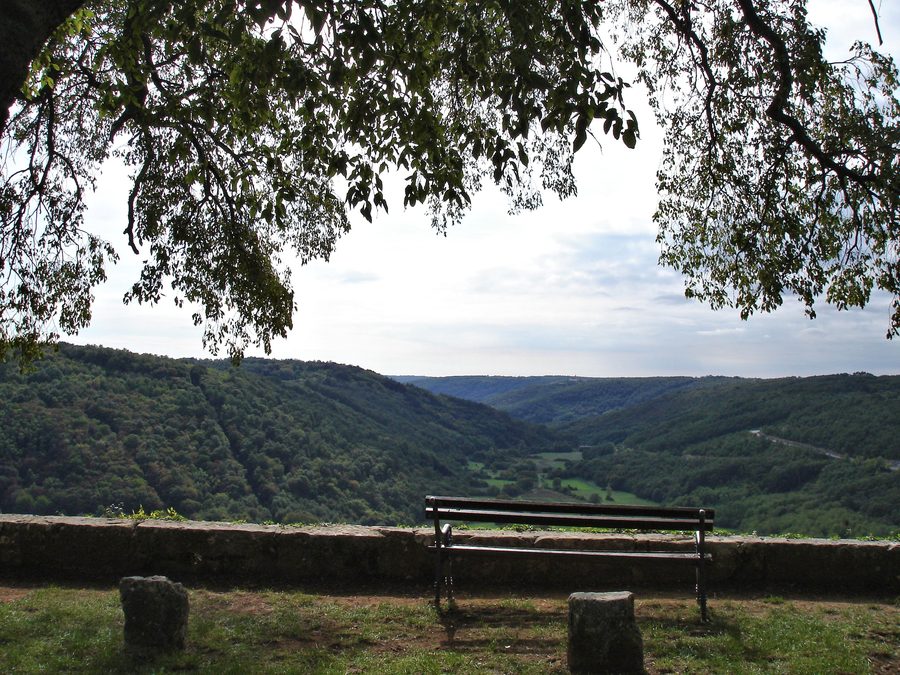
The viewpoint in Tinjan offers a different perspective on the landscape: from there, you can watch the Lim Valley wind through the scenery. This gives you different themes to consider when planning your trip—the figures and difficulty rating of a cycling route on the one hand, and a viewpoint overlooking the valley on the other.
Blacksmithing also has a firm place in local tradition. A festival of Kosir knives and other blacksmithing crafts is traditionally held in Tinjan on Saint Simon’s Day, bringing blacksmiths together from across Istria. Exact dates and the programme may vary. If you would like to plan your trip around the festival, check the latest information.
Which trip idea suits what you’re looking for?
When searching for a holiday apartment in the Municipality of Tinjan, it helps to decide on your main focus first: are you particularly interested in architectural history, the cycling route, views of the Lim Valley, or local craftsmanship and prosciutto traditions? This lets you compare trip ideas based on specific themes, rather than choosing accommodation based on unverified features. If you are planning a trip with children, you could use the different building styles and the history of former meeting places as conversation starters; suitable activities will depend on your family’s interests.
Discover more places
Discover more places: Kringa, Žužići, Muntrilj, Tinjan, Jakovici, Brečevići, Radetići, Brčići.
For the broader travel overview: Istria County.

